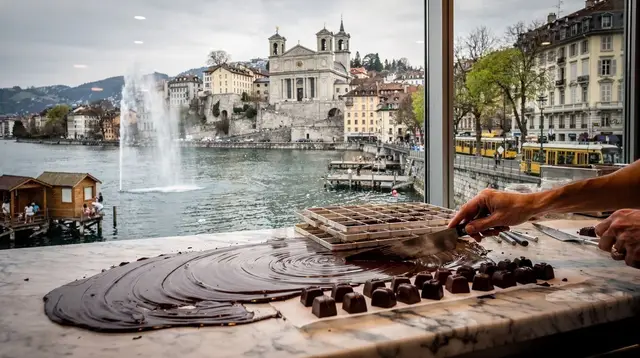
Ask most visitors what they picture when they think of Geneva, and it’s this: a column of water shooting improbably high above a blue lake, framed by mountains. That image belongs to the waterfront — not the perched lanes of the Old Town above it, and not “Geneva” as a whole, but the specific stretch of quays, piers, and bathing platforms that runs along Lake Geneva (Lac Léman) through the heart of the city. This is Geneva’s outdoor living room: where residents swim before work, tourists take the obligatory fountain photo, and everyone, eventually, ends up sitting on a bench doing nothing in particular.
What’s actually along the waterfront
The waterfront isn’t a single site but a connected stretch you can walk in one go. On the Right Bank, the Bains des Pâquis juts out into the lake on a small breakwater, a public bathing and relaxation spot that’s been a Geneva institution since the 1930s. On the Left Bank, the Jetée des Eaux-Vives carries the base of the Jet d’Eau itself, visible from almost anywhere on the lake or the surrounding hills. Between and around them run the paved quays — Quai du Mont-Blanc, Quai Gustave-Ador, Quai des Bergues — lined with benches, plane trees, small beaches, and the English Garden with its famous flower clock, a nod to Geneva’s watchmaking heritage. Ferry stops (the little yellow “Mouettes” shuttle boats) dot the shoreline, making it easy to cross the lake instead of walking around it.
None of this requires advance planning. There’s no single entrance, no opening hours for the promenade itself, and no admission fee to walk along the water. That’s part of the appeal — and also why it pairs so easily with a morning in the Old Town or an afternoon at International Geneva.
The Jet d’Eau: what it is, and when it actually runs
The Jet d’Eau is Geneva’s single most photographed landmark: a jet of water rising about 140 metres above the lake, propelled by two pumps that shoot roughly 500 litres of water per second into the air at around 200 km/h. Originally built in 1886 as a safety valve for a hydraulic power network, it was repositioned to its current, more visible location in 1891 and has been a deliberate civic symbol — not just plumbing — ever since.
Here’s the fact most guides gloss over: the fountain is not running continuously. It operates on a schedule that shifts with the seasons — roughly 10am to 4pm in winter, and from about 9am until after sunset (when it’s illuminated) in summer — and it is switched off outright in strong wind, near-freezing temperatures, and during scheduled maintenance. A gusty bise day, the cold wind that funnels down the lake in winter, is a common reason it stays off. If seeing the Jet d’Eau in full flow is important to your visit, build in flexibility rather than planning a single tight window around it — and don’t be surprised if it’s dormant when you arrive.
When it is running, the best views are from the Jetée des Eaux-Vives itself (you can walk most of the way out along the breakwater), from the Pont du Mont-Blanc looking east, or from a lake cruise passing nearby — a detail worth knowing before booking a lake excursion from Nyon or an evening sail. On a clear day, the fountain, the lake, and the Mont Blanc massif line up in a single frame, which is why this stretch of quay draws photographers at both sunrise and sunset — see our notes on photo sessions around the Jet d’Eau for timing.
Bains des Pâquis: swimming, sauna, and doing nothing well
If the Jet d’Eau is Geneva’s postcard, Bains des Pâquis is where the city actually lives its lake life. It’s a public bathing site built on a breakwater on the Right Bank, combining a small beach, sunbathing decks, diving platforms, changing rooms, a restaurant, and — since the 1990s — a wood-fired sauna overlooking the water. Entry is free or nominal, with small separate charges for extras like the sauna, a locker, or a sun lounger.
The site is open year-round, but it is genuinely two different places depending on the season, and it’s worth being honest about that rather than promising a single, consistent experience:
- Summer (roughly June-September): this is peak swimming season. Expect a lively, crowded scene — locals on lunch break, sunbathers, children jumping off the platforms, and long queues for the restaurant terrace at peak hours. Water temperatures are comfortable for swimming, typically in the low-to-mid 20s°C by midsummer.
- Winter (roughly November-March): swimming shifts to a different crowd altogether. Lake temperatures drop into single digits, and casual summer-style swimming isn’t realistic. What draws people instead is the sauna, paired with short, bracing dips for those who want them — a much quieter, more ritual experience with far fewer visitors than summer.
- Shoulder seasons (spring and autumn): somewhere between the two, with mild days drawing sunbathers and cooler ones thinning the crowds considerably.
Whatever the season, one thing holds true across all of them: both the lake water and Geneva’s tap water are safe to drink. The city draws and treats its drinking water from the lake, and public fountains along the promenade are commonly used by locals to refill bottles — no need to buy bottled water just to stay hydrated on a waterfront walk.
Walking the promenade: a realistic timeline
It’s tempting to think of the waterfront as a five-minute photo stop, but treated properly it’s a proper stretch of city to walk. A relaxed, uninterrupted walk covering the main quays — from around the English Garden and flower clock, past the Jetée des Eaux-Vives, and along to Bains des Pâquis on the opposite shore — takes roughly one to two hours at an unhurried pace, without factoring in stops.
| Plan | Approximate time | What it covers |
|---|---|---|
| Quick look | 20-30 min | Flower clock, a view of the Jet d’Eau from the quay |
| Full promenade | 1-2 hours | Both banks, English Garden to Bains des Pâquis |
| Promenade + swim/sauna | Half a day | Full walk plus time in the water or at the sauna |
| Promenade + lake cruise | Half a day to a full day | Walk plus a boat crossing or longer cruise |
Add benches, ice cream kiosks, and the pull of just sitting by the water, and a “quick stop” easily becomes a half-day outing — especially if it includes Bains des Pâquis. This is worth factoring into a first day in Geneva: the waterfront rewards unhurried time far more than a rushed checklist visit.
Seeing the lake from the water
Walking the shore is only half the picture — Lake Geneva itself is worth getting out onto. The little yellow shuttle boats (the “Mouettes”) make short hops across the lake and are covered by standard city transport fares, useful for crossing rather than lingering. For a longer experience, scheduled cruises run from the city center, including evening options that put the Jet d’Eau, the illuminated quays, and the mountains behind you as the sun goes down.
an evening sailing tour under the stars departing from nearby Nyon is a good fit if you want the lake experience without the daytime crowds, sailing rather than a motorised cruise. For something further afield on the water, a boat excursion to a secluded lake beach from Nyon pairs well with a day that starts on Geneva’s waterfront and continues along the shore toward Nyon.
The lake also opens onto excursions further afield. Several travellers use a morning on the Geneva waterfront as the calm start to a day that ends across the border — a half-day trip from Geneva to Annecy, the “Venice of the Alps”, trades Geneva’s lake for Lake Annecy and its own canals, a genuinely different lakeside town just over the French border.
Seeing it with a guide instead of alone
Not every visitor wants to piece the waterfront together solo, and there’s no penalty for taking a guided route through it — several walking tours use the Jet d’Eau and the quays as their spine precisely because the landmarks sit so close together. a walking tour combining the Old Town, the lake, and the fountain is built for exactly this pairing, covering the cobbled streets above and the waterfront below in one outing rather than two separate trips. For a shorter, broader introduction to the city that still ends at the water, a guided city tour that finishes with a scenic lake cruise folds the fountain view into a wider first look at Geneva, useful on a first afternoon before deciding what to return to on foot.
Those who’d rather cover ground on two wheels than on foot have an option too: an e-bike tour of the Old Town that includes free museum entry extends easily along the flat lakefront paths once the historic center is done, since the quays are some of the most bike-friendly stretches in the city. And for an evening that turns the walk into something more social, a guided city tour paired with a lake cruise and dinner lets the fountain do its evening lighting act while you’re already out on the water rather than watching from the quay.
None of these guided options are necessary — the waterfront works perfectly well as a self-guided wander, and much of this page is written on that assumption. But on a first visit, when Geneva’s landmarks are still unfamiliar and time is short, letting someone else handle the route between the Jet d’Eau, the Old Town, and the lake can free up mental space to actually look at the view instead of navigating toward it.
Getting out onto the water yourself
Beyond scheduled cruises, the waterfront is also a launch point for visitors who want to be active on the lake rather than just beside it. paddleboarding on Lake Geneva with equipment included puts you at water level for a very different perspective on the Jet d’Eau — looking up at the spray rather than across at it — and is a straightforward add-on to a morning that starts with a walk along the quays. It’s a good match for the “half a day with Bains des Pâquis” plan noted in the quick facts above, since both activities draw on the same stretch of shoreline and swimming gear.
For a lower-key way to see the fountain and the city center together without committing to a full walking tour, a 50-minute Lake Geneva cruise passes close to the Jetée des Eaux-Vives and gives a compact, fixed-length alternative to an open-ended afternoon on foot — useful when you’re short on time but still want the classic view of the fountain against the mountains from the water.
A short history worth knowing
The Jet d’Eau’s origin as an industrial safety valve rather than a designed monument is part of what makes it distinctive among European city landmarks — most fountains built for spectacle were conceived that way from the start. Geneva’s was not: 19th-century engineers needed a way to release excess pressure from a hydraulic network that powered workshops around the city, and the plume of escaping water at the original site on the Rhône quickly became a local curiosity in its own right.
Moving it to the lake in 1891 turned an engineering byproduct into a deliberate civic symbol, decades before it reached anything like its current height. That layered history — utility first, spectacle second — is worth keeping in mind if the fountain happens to be switched off on the day you visit: it was never promised to run non-stop, and its off days are closer to the norm the city originally built around than a modern inconvenience.
What the waterfront isn’t
It’s worth being clear about what this stretch of Geneva is not, so expectations line up with reality. It is not the historic core — for cobbled streets, St-Pierre Cathedral, and museums, that’s the Old Town on the hill above. It is not International Geneva’s diplomatic quarter, home to the Palais des Nations and the Red Cross Museum, though it’s an easy onward walk from the quays. And it is not a guaranteed fountain show: the single biggest misconception visitors carry in is that the Jet d’Eau runs constantly, like a landmark switched permanently “on.” It doesn’t, and no honest guide should promise otherwise.
What it is: a genuinely free, genuinely local stretch of city where a fountain, a public bath, and a lake come together — best enjoyed with an hour or two of unstructured time rather than a rigid itinerary. After the water, Carouge, Geneva’s artisan quarter, is a short tram ride away for a change of pace, or head up to Mont Salève for a view back down over the whole waterfront from above.
For a change of scene without leaving the water theme entirely, an outdoor escape game paired with wine tastings in Carouge makes a good rainy-day fallback if lake weather doesn’t cooperate — a real possibility given how weather-dependent the Jet d’Eau itself is. Check our notes on what’s open in Geneva in winter and on how the Jet d’Eau schedule actually works before building a tight itinerary around either.
Practical notes
- Getting there: the waterfront is a 10-15 minute walk from Gare Cornavin (the main train station) or a short ride on the free Unireso transport network covered by the Geneva Transport Card given to overnight visitors.
- Cost: walking the quays and viewing the Jet d’Eau is free; Bains des Pâquis charges only for extras like the sauna or a locker.
- Timing the fountain: check conditions before making a special trip — wind, cold, and maintenance all take it offline, and there’s no live public schedule guaranteeing it will be running at a specific hour.
- Families: the flat, paved promenade and shallow swimming areas at Bains des Pâquis make this one of the easier stretches of Geneva for visiting with kids, see also our free things to do in Geneva roundup for a low-cost day.
- Best light: early morning or the hour before sunset, when the crowds thin and the light across the lake toward Mont Blanc is at its best — see best time to visit Geneva for a season-by-season breakdown.