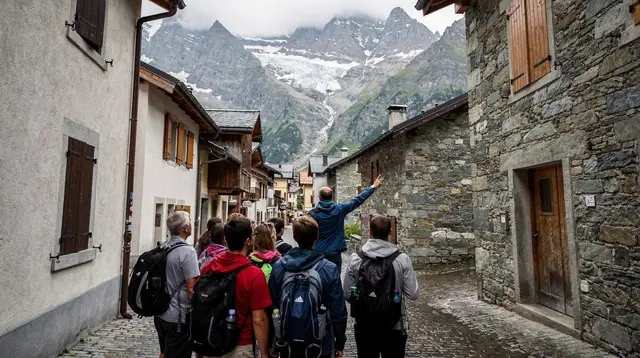
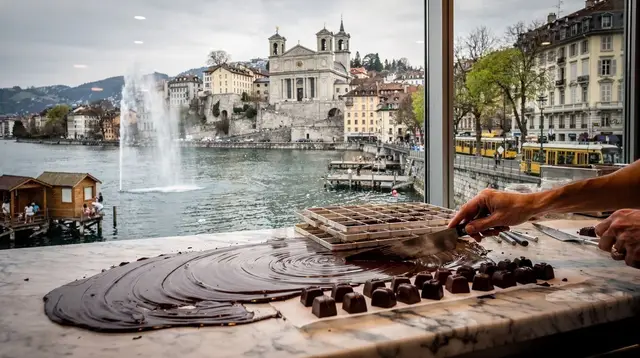
The Lavaux vineyard terraces climb the slope above Lake Geneva in tight, sun-facing rows, stacked one above the next between Lausanne and Montreux. UNESCO listed them as a World Heritage cultural landscape in 2007, recognizing nearly a thousand years of continuous winegrowing on land that would otherwise be too steep to farm. The appeal here is specific and different from the two cities that bookend it: not museums or an Old Town, but a walk through vines with the lake spread out below and the French Alps rising on the far shore.
That distinction matters when planning. Lausanne has its own dense city center, cathedral and Olympic Museum, and Montreux has its lakefront promenade and Château de Chillon just along the water. Lavaux sits between them, physically and thematically: a landscape excursion of vineyard paths, small wine villages and lake panoramas, best treated as its own outing rather than a stop squeezed into a Lausanne city walk or a Chillon visit.
Why the Lavaux terraces are worth a dedicated trip
The terraces run roughly 30 kilometers along the lakeshore, from the edge of Lausanne past Cully, Epesses, Rivaz, St-Saphorin and Chexbres toward Vevey. Walking even a short stretch puts you inside a working landscape: low stone retaining walls, narrow paths threading between rows of Chasselas vines, and the lake filling most of the view below. The terraces face south and southeast, catching sun reflected off the water as well as direct light — a combination locals credit for the character of the wine and one reason the region has stayed in production for so long.
Villages along the way are small and largely residential, with a handful of tasting cellars, a village church, and a train or bus stop rather than a tourist center built for crowds. That is part of the draw for some visitors and a limitation for others: don’t expect the restaurant density or souvenir shops of Montreux, but do expect quieter paths and a landscape that looks the way it has for centuries.
Getting there from Geneva
The practical route from Geneva is by train, and it is not a single seamless ride in most cases. Direct and connecting trains run from Geneva toward Lausanne (roughly 35-45 minutes), where most journeys continue on a second, shorter regional train toward Vevey or Montreux, stopping at Lavaux village stations including Cully, Rivaz, Grandvaux and Chexbres. Total travel time from central Geneva to a Lavaux station is typically 45 to 70 minutes each way, depending on connections — plan for the change at Lausanne rather than assuming a through train.
CGN lake boats also call at some Lavaux villages, including Cully and Rivaz, and a lake approach is a scenic way to arrive. However, boat service along this stretch runs mainly on seasonal, spring-to-autumn schedules, and a same-day loop combining boat and train needs checking against the current timetable — do not assume a year-round or hourly boat connection from Geneva itself, since most sailings that reach Lavaux start from Lausanne or Vevey rather than directly from Geneva.
Driving is possible, with small parking areas near several villages, though spaces fill quickly on weekends in September and October. Given the narrow lanes through the villages, the train remains the least stressful option for most visitors.
| From Geneva to | Typical time | Typical route |
|---|---|---|
| Cully | ~55-65 min | Train to Lausanne, change to regional toward Vevey |
| Rivaz | ~60-70 min | Train to Lausanne, change to regional toward Vevey |
| Grandvaux | ~50-60 min | Train to Lausanne, change to regional toward Vevey |
| Chexbres | ~65-75 min | Train to Lausanne, change toward Vevey/Fribourg line |
Walking the terraces
The signed regional trail through Lavaux, sometimes called the Lavaux vineyard path, links the villages along the slope and can be walked in shorter sections or as a longer traverse. A single village loop — around Rivaz or Epesses, for instance — takes under an hour on mostly level ground close to the station. Linking several villages, such as from Cully through Epesses and Rivaz to St-Saphorin, involves a full afternoon and includes real elevation change: the terraces step upward from the lakeshore, and paths climb and descend between levels rather than running flat throughout.
For a lighter option, the small Lavaux Express tourist train departs from Cully and Lutry in season, covering a loop through the vines with commentary and no walking required — useful for visitors with limited mobility or simply less time, though it runs on a seasonal schedule with reduced or no service outside the main season.
Cyclists and e-bike riders also use quieter lanes through the lower terraces near the lake, an alternative for those who want to cover more ground with less effort than walking the steeper upper paths.
Tasting and where the wine comes from
Chasselas is the grape most associated with Lavaux, producing a light, mineral white wine that pairs closely with the region’s fondue and lake fish. Small, often family-run cellars in villages like Rivaz, Epesses and St-Saphorin open their doors for tastings during set hours, and a walk through Lavaux naturally passes several of them. Larger tasting centers near Rivaz and Cully offer more structured introductions to the appellation for visitors who want context along with a glass.
Walk-ins work at many smaller cellars outside peak weekends, but during September and October — harvest season, and the busiest stretch for visitors — booking ahead for a guided tasting or cellar visit is the safer approach, since some producers limit hours or require appointments as harvest work takes priority.
Combining Lavaux with a guided visit
For visitors who would rather not manage train connections and tasting-room hours themselves, a guided option covers the logistics. An UNESCO Lavaux vineyards food and tasting tour by private van departs from Montreux and handles transport between terraces and tasting stops directly, useful for a focused half-day or full-day visit without working out the rail changes.
Seeing the terraces from the water is another way to take in the scale of the landscape: a two-hour Riviera cruise from Vevey passes below the Lavaux slopes along the lakefront, giving a different angle on the terraces than the walking paths above.
Travelers based in Geneva who want Lavaux folded into a broader Riviera day, alongside Lausanne or Montreux, can also consider a private Swiss Riviera tour from Geneva, which typically includes a stop in the vineyard region as part of a longer route.
When to go
Late April through October is the realistic visiting window for the terraces at their best. Vines leaf out in spring, flowering in late May and June adds a burst of green growth across the slopes, and by September the rows fill with grapes ahead of a harvest that usually runs into October. This period also brings the fullest range of open tasting rooms, the Lavaux Express running its regular schedule, and boat connections along the lake.
Outside this window, particularly from November through March, the vines are bare, several tasting cellars reduce their hours or close for the season, the tourist train typically does not run, and boat schedules thin out considerably. Lavaux in winter is quieter and the panorama over the lake still holds, but visitors should not expect the same density of open cellars or seasonal transport options that make a spring or autumn visit easier to plan.
Combining Lavaux with nearby stops
Because Lavaux sits between Lausanne and Montreux, it fits naturally into a longer Swiss Riviera day rather than standing entirely alone. A common pattern is a morning in Lausanne, a midday stop and walk through Vevey or one of the Lavaux villages, and an afternoon continuing to Montreux and the Château de Chillon — all connected by the same regional rail line, without needing to backtrack to Geneva between stops. Aigle, a little further along the line and known for its own vineyards and castle, extends the day further for travelers with more time.
For structured planning, our Swiss Riviera three-day itinerary sequences Lausanne, Lavaux and Montreux across a longer stay, while the one-day Lausanne and Lavaux itinerary is built for a single, focused day out of Geneva. Those weighing Lavaux against Switzerland’s other well-known wine region can also read our comparison of Lavaux versus Valais wine country.
Practical tips
Wear real walking shoes if you plan to cover more than one village — the terrace paths are uneven stone and packed earth, with real elevation change between levels, not a flat lakefront promenade. Bring water and sun protection in summer, since much of the upper trail has little shade on the open, south-facing slopes.
Public toilets and food options are limited to the villages themselves, spaced several kilometers apart along the trail, so plan stops rather than assuming amenities along the open terrace sections. If traveling by train, check the connection at Lausanne before departing Geneva, since not every Geneva-Lausanne train lines up conveniently with the next departure toward the Lavaux stations.
For a broader look at how to move around this stretch of lake, our guides to Lavaux wine-region activities, Lavaux lake cruises and Lausanne day trips cover the surrounding options in more detail, and the seasonal notes in our Lavaux seasonal guide go deeper on what changes month to month.
Frequently asked questions about visiting the Lavaux vineyards
How do you get to the Lavaux vineyards from Geneva?
Take a regional or InterCity train from Geneva toward Lausanne, then a second short train toward Vevey/Montreux and get off at Cully, Rivaz or Grandvaux. The whole trip is typically 45-70 minutes each way, and there is no direct train that skips the change at Lausanne on most departures.
Is Lavaux the same as visiting Lausanne?
No. Lausanne is a city with its own Old Town, museums and Olympic Museum, sitting at the western edge of the Lavaux region. The vineyard terraces themselves stretch mainly between Lausanne and Montreux, centered on villages like Cully, Epesses and Rivaz, and require their own dedicated trip out of the city center rather than a quick stop.
Can you visit Lavaux by boat from Geneva?
CGN lake boats do call at Lavaux villages such as Cully and Rivaz, but mainly on seasonal spring-to-autumn schedules and usually with a change of boat or a rail leg from Geneva rather than a single direct year-round sailing. Confirm the current timetable before planning a boat-only day, especially outside summer.
How long does it take to walk through the Lavaux terraces?
A short loop around one village, such as Rivaz or Epesses, can be done in under an hour. The classic signed trail linking several villages along the terraces, roughly from Lutry to Chexbres, takes most walkers a full afternoon to a full day, depending on stops for photos and tasting.
When is the best time to see the Lavaux vineyards?
Late April through October offers green, planted terraces, with flowering vines in late spring and harvest activity in September and October adding extra color and atmosphere. Winter terraces are bare and many tasting rooms and the tourist train reduce hours or close.
Do you need to book a tasting in advance?
Small, family-run cellars in villages like Rivaz and Epesses often welcome walk-ins during open hours, especially outside peak weekends, but larger tasting centers and guided cellar visits are safer to book ahead, particularly in September and October when harvest activity draws more visitors.
Is Lavaux suitable for a day trip with limited walking?
Yes, with realistic planning: the train stations at Cully, Rivaz and Grandvaux sit close to short, flat or gently sloped village sections of the terraces, and the little Lavaux Express tourist train covers some ground without hiking. A full end-to-end terrace walk, though, does involve sustained uphill and downhill sections.