Lavaux Vineyard Terraces: A Guide to Switzerland's UNESCO Wine Country
What is the best way to visit the Lavaux vineyards?
Take a regional train from Geneva (around an hour) to Vevey or Cully, then walk the signed vineyard paths between villages like Rivaz, Épesses and Saint-Saphorin, or ride the Lavaux Express tourist train through the terraces. Tasting rooms cluster in the lakeside villages, though not all are open without notice.
Terraces built by hand, one stone at a time
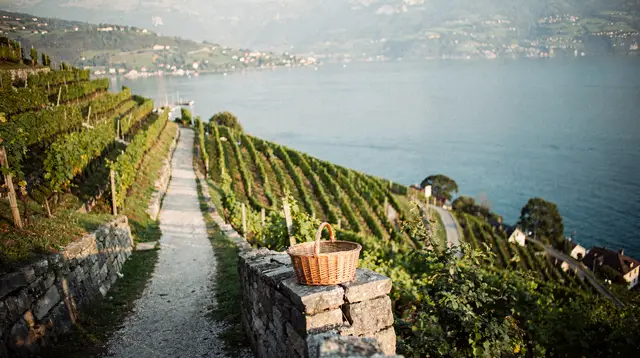
Between Lausanne and Montreux, the north shore of Lake Geneva climbs steeply away from the water, and for nearly 30 kilometres that slope is cut into narrow, stacked terraces held up by dry-stone walls. This is Lavaux, a wine landscape that has been shaped by hand since monks began terracing the hillside in the medieval period, long before mechanised farming made such steep, labour-intensive vineyards seem impractical anywhere else. UNESCO inscribed Lavaux as a World Heritage Site in 2007, recognising it as an outstanding example of a landscape produced by centuries of continuous human effort rather than any single monument or building.
What makes the terraces work is orientation. The vines face almost due south, catching direct sun for most of the day, while the lake itself acts as a heat reservoir, reflecting light back up onto the slopes and moderating temperatures through the growing season. Locally this triple exposure — to the sun above, the lake’s reflection, and the warmth retained in the stone walls themselves — is often described as growing grapes under “three suns.” It’s a real physical effect, not just a marketing phrase, and it’s a large part of why this particular stretch of hillside produces wine of a quality and consistency that flatter land nearby does not.
The dominant grape is chasselas, a white variety that in less favoured sites can produce fairly neutral wine, but that in Lavaux is considered one of its best expressions anywhere in the world — light-bodied, dry, and markedly mineral, often described as tasting faintly of the stone terraces it grows on. Producers here work small plots, frequently by hand on the steepest sections where machinery simply cannot go, which is part of why Lavaux wine rarely appears cheaply outside the region.
Getting there from Geneva
Lavaux sits close enough to Geneva for a comfortable day trip. Regional trains run from Geneva’s main station to Vevey, Lausanne or Cully, with journeys typically landing at around an hour depending on the exact stop and connection. Vevey and Cully both sit at the eastern and western edges of the terraced zone, respectively, making either a sensible arrival point before continuing on foot or by local train into the vineyards themselves.
From Lausanne, the villages of Lavaux are even closer, reachable by short regional trains or buses in a matter of minutes. Travellers based in Montreux have the same advantage from the opposite direction, with Vevey and the eastern Lavaux villages just a short ride away. For visitors without a fixed base yet, our Geneva day trips guide and Montreux day trips guide both cover Lavaux alongside other options from each city.
Driving is possible but not obviously better: the villages are small, parking is limited, and the whole point of a Lavaux visit — walking the terraces at your own pace — is easier without a car to return to.
The villages: Rivaz, Épesses, Saint-Saphorin, Cully and Chexbres
Lavaux isn’t a single site to check off but a string of small wine villages threaded along the lakeshore and up the slope behind it, each with a slightly different character.
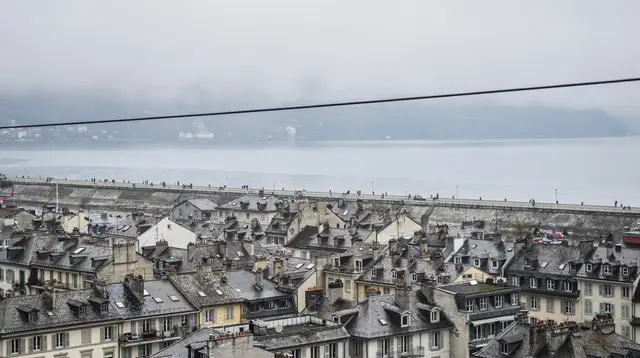
Cully is the largest of the lakeside villages and a natural starting point, with a small harbour, a Saturday market, and enough cafés and tasting rooms to make it a reasonable base for a half-day. Épesses and Rivaz, both a short walk or train stop further east, are smaller and quieter, largely given over to vines that come right up to the edges of the narrow streets. Saint-Saphorin is often singled out as the most picturesque of the group, a tightly packed cluster of stone houses surrounded on nearly every side by terraces climbing toward the ridge above.
Chexbres, set higher up the slope rather than at the lake, offers the classic panoramic view over the whole terraced landscape and the lake beyond — it’s the village most visitors photograph even if they don’t stay long. Because Chexbres sits above the steepest terraces, reaching it on foot from the lakeside villages involves real climbing; travellers who’d rather see the view without the ascent can reach it directly by train.
Each village has its own small producers and tasting rooms, and the character of a Lavaux visit changes considerably depending on which villages you link together — a flat lakeside walk between Cully and Rivaz is a very different outing from the climb up toward Chexbres.
Walking the vineyard paths
The classic way to experience Lavaux is on foot, along the network of signed paths collectively known as the Chemin du Vignoble, which thread between and through the terraces connecting the lakeside villages. These paths are free to walk and well marked, ranging from flat, easy lakeside stretches to steeper sections climbing toward Chexbres and the upper terraces. A popular option is to walk the roughly 90-minute to two-hour stretch between Lutry or Cully and Rivaz or Saint-Saphorin, weaving through the vines at a walking pace that no train or car ride replicates. The paths pass directly among working vineyards year-round, so the experience shifts considerably by season — green and full in summer, bare stone-and-wire structure in winter.
For visitors who prefer not to walk the slopes, or who are short on time, the Lavaux Express is a small open-air tourist train that loops through the terraces from Cully or Chexbres on a fixed route. It runs on a seasonal schedule rather than year-round, so it’s worth checking the current timetable before building a day around it — it is not guaranteed to be running on any given visit, particularly outside the warmer months.
| Way to explore | Best for | Notes |
|---|---|---|
| Walking (Chemin du Vignoble) | Independent pace, photography, wine stops | Free; some sections steep; seasonal look changes |
| Lavaux Express tourist train | Limited time or mobility, quick overview | Seasonal schedule, not year-round |
| Guided wine tour | Structured tastings, local context | Combines several producers/villages in one outing |
| Lake cruise past Lavaux | Views from the water, no walking | See terraces from the lake without going ashore |
Tasting chasselas in the villages
Lavaux’s small producers are scattered through Cully, Épesses, Rivaz and Saint-Saphorin, many working plots too steep and narrow for anything but hand cultivation. Some village tasting rooms keep regular public hours, particularly in the warmer months when visitor traffic is highest, but it would be a mistake to assume every cellar is open to walk-in visitors — many smaller producers pour by appointment only, or open specifically for scheduled open-cellar weekends rather than daily. Checking ahead, even informally, saves a wasted stop at a shuttered door.
For visitors who’d rather have the itinerary and introductions handled for them, a guided route through several producers in one outing removes that guesswork. A guided wine tour through the Lavaux terraces in the canton of Vaud typically covers several tasting stops with a local guide explaining the terracing and grape-growing methods along the way, useful for visitors who want context alongside the wine itself. There’s also a private van tour from Montreux pairing Lavaux wine with local food tastings, which suits travellers based on the Montreux side who’d rather not manage trains and walking directions between stops.
Travellers who want the landscape and the UNESCO story more than a structured tasting circuit can join a tour focused on the terraced vineyards as a UNESCO World Heritage site, which tends to spend more time on the history and construction of the terraces themselves.
Day tours from Geneva
Not everyone wants to manage regional trains and village-hopping alone, and a few tour options run directly out of Geneva rather than requiring a first stop in Vevey or Lausanne. A day tour from Geneva combining Lavaux, Chexbres and Valais wine tasting is useful for travellers who want to see two of the region’s distinct wine landscapes — the Lavaux terraces and the Valais vineyards further up the Rhône valley — in a single guided outing rather than planning separate day trips. It also removes the need to work out train connections and tasting-room hours yourself.
For a more active alternative, a Geneva countryside e-bike tour with wine tasting covers ground closer to the city itself, on electric bikes rather than on foot, and pairs cycling through vineyard countryside with a tasting stop — a different pace from walking the Lavaux terraces directly, but a reasonable option for visitors who want a wine-and-scenery outing without leaving from Vevey or Cully. It’s worth checking the specific route before booking, since not every countryside e-bike tour covers Lavaux itself rather than vineyards closer to Geneva.
Travellers who’d rather combine a boat and a vineyard walk in one booking can look at a Lavaux wine and vineyard experience that includes a boat cruise, which folds the two classic ways of seeing the terraces — from the water and on foot among the vines — into a single organised day rather than two separate outings.
Best time of year to visit
Lavaux is walkable in every season, but the character of a visit changes considerably depending on when you go. Late spring through early autumn is when the vines are fullest and greenest, tasting rooms keep the most consistent hours, and the Lavaux Express is most likely to be running on its seasonal schedule — this is also, unsurprisingly, when the villages are busiest and parking and popular viewpoints see the most visitors. Early autumn, around harvest, adds the activity of the grape picking itself to the walk, though it’s also when producers are busiest and least likely to have time for casual tastings.
Winter strips the vines back to bare stone-and-wire structure, which some visitors find less picturesque but which also lays the dry-stone terracing itself more clearly bare — worth considering for anyone more interested in the landscape engineering than in greenery. Tasting rooms keep shorter or more irregular hours outside the warmer months, and the Lavaux Express does not run year-round, so a winter visit leans more toward walking and viewpoints than organised tastings. Whichever season, checking current opening hours and train timetables before setting out saves the most common disappointment: arriving at a shuttered cellar or a train that isn’t running that day.
Photography and viewpoints
Lavaux’s combination of stacked terraces, lake and distant Alps has made it one of the most photographed agricultural landscapes in Switzerland, and a handful of spots consistently draw photographers. The path above Rivaz and Saint-Saphorin gives close, textured views of individual terrace walls with the lake as backdrop, while the approach into Chexbres opens onto the wide panoramic view that takes in the full sweep of the terraced slope alongside the lake and, on a clear day, the mountains of the French shore beyond. Early morning and late afternoon light, common advice for shooting any south-facing slope, tends to bring out the layered texture of the dry-stone walls more than the flatter light of midday.
Because so much of Lavaux’s appeal is about the relationship between the terraces, the lake and the light, the paths connecting the villages are worth walking slowly rather than rushing between fixed viewpoints — some of the most striking outlooks are unmarked stretches of the Chemin du Vignoble rather than named lookout points.
Combining Lavaux with the lake
Because the terraces run directly along the shore, several ways of seeing Lavaux involve the water as much as the vines. A cruise along this stretch of Lake Geneva shows the terraces rising directly from the shoreline in a way that’s hard to appreciate from inside the villages themselves — from the water, the scale of the slope and the sheer number of stacked terraces becomes obvious in a way it isn’t on foot.
A two-hour Riviera cruise departing from Vevey passes directly along the Lavaux shoreline and is a straightforward way to combine a lake outing with a village visit before or after. Our dedicated lake cruises guide and Montreux lake cruises guide cover the wider range of CGN boat routes along this shore, including the historic paddle steamers that call at several Lavaux villages.
Planning a day in Lavaux
A realistic Lavaux day starts with an early regional train from Geneva to Cully or Vevey, leaves the late morning and early afternoon for walking through two or three villages, and reserves late afternoon for a tasting stop or two before the train back. Trying to cover the entire terraced stretch from Lutry to Montreux on foot in a single day is ambitious for most visitors; picking one section — either the western villages around Cully and Épesses, or the eastern stretch through Rivaz and Saint-Saphorin toward Vevey — makes for a more relaxed outing.
Lavaux pairs naturally with a stop in Vevey or Montreux at either end of the day, and travellers building a longer itinerary around the lake’s wine and castle sights may also want to look at Château de Chillon, a short distance further along the shore past Montreux. For a fuller comparison of grape-growing regions reachable from Geneva, our Lavaux versus Valais wine country piece on the blog lays out how this terraced landscape differs from the wine country further up the Rhône valley.
Whatever combination of walking, train and tasting you choose, the terraces themselves are the real destination — a working agricultural landscape, still farmed by hand on its steepest slopes, that happens to also be one of the most photographed stretches of shoreline on Lake Geneva.
Lavaux Vineyard Tours
Verified deep-linked GetYourGuide tours. Book through these links and we earn a small commission at no cost to you.
GetYourGuide does not provide a product photo for this activity — the image shows the meeting point, photographed by us.