Gruyères Walking Tour: Exploring the Medieval Village on Foot
Can you walk around Gruyères village, and is it car-free?
Yes. The historic centre of Gruyères sits on a hilltop and is entirely pedestrian — cars are left in car parks below the walls. A single cobbled street runs the length of the old town up to the counts' castle, so the whole village is easily explored on foot in a couple of hours.
Gruyères looks, from a distance, exactly like the village on the cheese packaging: a cluster of grey-roofed stone houses climbing a green hill, a castle at the top, cows somewhere in the middle distance. Up close, on foot, it turns out to be something more specific — a genuinely well-preserved fortified hilltop settlement, laid out around a single street, that rewards slow walking more than it rewards a rushed cheese-and-photo stop. This guide covers the village itself: its layout, its architecture, its one unlikely modern resident, and how to actually get there. The dairy, La Maison du Gruyère, and the fondue side of a Gruyères day trip are covered in a separate guide to cheese and fondue in Gruyères — this one stays on the cobblestones.
Why Gruyères is built the way it is
Gruyères takes its name from the counts of Gruyère, who ruled the surrounding territory from the 11th century until the county went bankrupt in 1554 — an unusually blunt ending for a medieval dynasty, brought on by debt rather than war. The village that survives today is essentially their fortified seat: a defensible hilltop position, a single controlled entrance, and a castle anchoring the high end of the settlement. That layout is the reason Gruyères reads so clearly on foot now — there was never more than one main way through it.
After the counts’ fall, the canton of Fribourg took over the castle and used it as an administrative seat (a “bailliage”) for centuries, which is part of why the building and the village around it survived largely intact rather than being fought over or built out of recognition. Gruyères sits in the Gruyères-Fribourg tourist region, administratively and geographically distinct from Geneva — a detail worth keeping straight, since some visitors assume it as a short suburban hop rather than the more-than-an-hour trip it actually is.
Walking the village: what the one street actually contains
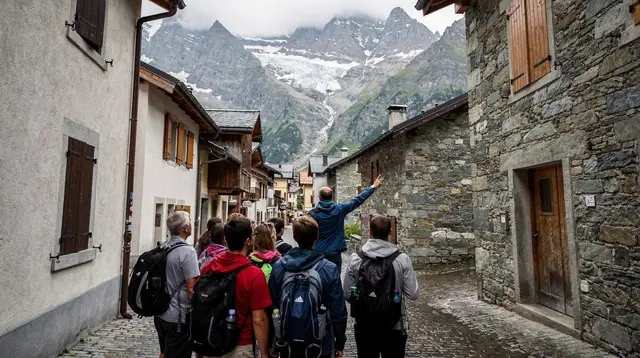
The entire pedestrian core of Gruyères is organised around a single cobbled street, the Rue du Bourg-Rue du Château, running from the lower gate up to the castle entrance. There is no grid to get lost in and no need for a map once you’re inside the walls — the street simply climbs, and everything of interest sits along it or just off it.
Near the lower entrance, the street is lined with stone townhouses from the 15th to 17th centuries, many with covered arcades at ground level — a practical feature in a village that sees real snow in winter, and a good visual cue for how old the building stock actually is. Wrought-iron signs hang over doorways advertising shops, restaurants and galleries, most now housed inside historic building shells rather than purpose-built. Fountains punctuate the route at intervals, fed by the same gravity-driven system that has supplied the village for centuries.
Walking uphill, the street narrows and the buildings close in slightly before opening onto the esplanade in front of the castle itself — the natural end point of the walk, and the best vantage point for the view back down over the roofs toward the Fribourg countryside and, on a clear day, toward the Moléson and the pre-Alps. Coming back down offers a different angle on the same street, since Swiss villages built for defence rarely have symmetrical sightlines in both directions.
Ramparts and a defensive wall walk are accessible at points around the village perimeter, giving a second, quieter route back if you don’t want to simply retrace the main street. These sections are less crowded and worth the short detour for anyone interested in how the fortifications actually worked, rather than just the market street inside them.
The castle at the top of the street
The Château de Gruyères, a 13th-century construction expanded over subsequent centuries, sits at the summit of the village and is the visual anchor of every photograph taken from below. The exterior — towers, curtain walls, the approach across the esplanade — can be appreciated at no cost as part of a walk through the village. Entering the castle interior, with its furnished rooms, painted ceilings and views from the ramparts, requires a separate paid ticket; it is not bundled automatically with simply walking the village streets, and it is a different purchase from the HR Giger Museum ticket described below. Visitors who want the interior should plan for it as a discrete stop on the walk rather than assuming a single village admission covers everything inside the walls.
The HR Giger Museum: the deliberate anomaly
Partway along the main street, inside a 19th-century château-style building, sits the HR Giger Museum — dedicated to the Swiss artist HR Giger, best known outside the art world for designing the xenomorph creature and biomechanical sets of the Alien film franchise. It holds the largest collection of his work anywhere, including paintings, sculptures and film-design pieces, and a linked bar next door continues the same visual style into its furniture and fittings.
The museum’s presence in Gruyères is not connected to the village’s medieval history — Giger was Swiss and the museum simply chose this building — and that’s largely the point for visitors who go: after several blocks of stone arcades and wrought-iron signs, the surrealist, biomechanical interiors are a genuine jolt of contrast. Treat it as an optional detour rather than an essential stop if 20th-century surrealist art isn’t of interest, but it’s worth knowing it’s there so the choice is deliberate rather than a surprise mid-walk. Visitors coming specifically for the combination rather than adding it on the fly can also book a day trip from Geneva that pairs the village walk with the HR Giger Museum as a single planned outing.
Trails and viewpoints beyond the village walls
The walk described above stays inside the fortifications, but Gruyères sits in genuine walking country, and the hillside below and around the village carries a network of marked paths distinct from the cobbled street itself. Anyone with an extra hour or two, good shoes and no interest in retracing the same street twice can extend the visit onto these trails rather than doing the rampart loop a second time; the guide to hiking routes around Gruyères covers the options in more detail, including paths that open up wider views of the castle from below than any angle available on the esplanade itself. These routes are a separate undertaking from the village walk — proper footwear rather than the smooth cobbles is the main practical difference — but they reward visitors who have already covered the main street and want a quieter, greener follow-on rather than a second pass through the shops.
For a comparison of Gruyères’ fortifications against other castles reachable from the Lake Geneva shore, the guide to Aigle, Chillon and the region’s other castles sets the counts’ hilltop seat alongside its lakeside counterparts — useful context for travellers deciding which castle interiors are worth the paid ticket on a trip that can’t fit all of them.
What a walking-focused visit does and doesn’t include
| Included in a village walk | Requires a separate paid ticket |
|---|---|
| Walking the full cobbled main street | Château de Gruyères interior |
| Exterior views of the castle and ramparts | HR Giger Museum |
| Browsing shop fronts and galleries | La Maison du Gruyère cheese dairy (covered separately) |
| Views over the Fribourg countryside | Any guided tour of the village |
Practical route: a simple loop
For a first visit with no particular time pressure, a straightforward approach works well: park (or arrive by train/bus) at the base of the hill, walk up through the lower gate, follow the main street at an unhurried pace, detour into the HR Giger Museum or castle interior if either interests you, continue to the esplanade at the top for the view, then take the rampart walk on the way back down instead of retracing the same street. That loop covers the architectural core of the village comfortably within two to three hours, including one paid interior stop.
Visitors combining the walk with a fondue lunch or a stop at the cheese dairy should budget extra time for those separately — they sit at the base of the hill near the station, a short walk from the old town gate but a distinct activity, detailed in the Gruyères cheese and fondue guide.
Getting to Gruyères from Geneva
Gruyères is not a short suburban trip from Geneva — it sits over an hour away by car and typically 1.5 to 2 hours by train, with at least one change, commonly via Fribourg or Bulle. It falls outside the Canton of Geneva entirely, in the Gruyères-Fribourg region, which is worth setting expectations around before planning a half-day dash.
By car: Geneva to Gruyères runs via the A12 motorway, a little over an hour depending on traffic and time of year. Parking is in signed lots just outside the village walls — there is no driving into the historic centre itself, regardless of how close a hotel or restaurant reservation might be.
By train: Swiss rail (CFF/SBB) connects Geneva to Gruyères with a change, most commonly at Fribourg or Bulle, in roughly 1.5-2 hours each way. The station at Gruyères sits at the base of the hill, a walkable but uphill approach to the village gates.
On an organised tour: For visitors who’d rather not manage connections or parking, a full-day excursion to the Gruyère region from Montreux or Bern or a guided day trip to Gruyères from Montreux or Bern covers the transport logistics directly.
From Geneva itself, a private day trip pairing Lausanne and Gruyères combines the village with a stop on the Lake Geneva shore, and travellers who want the castle, cheese and chocolate sides all handled in one outing can look at a private tour covering the castle, cheese and chocolate together. For a walking-first visit with a local guide setting the pace, a guided walk through Gruyère village is the most direct match for the architecture-focused approach in this guide.
Combining Gruyères with nearby stops
Gruyères pairs naturally with Fribourg, a larger medieval town roughly 30 minutes away with its own old town and cathedral, covered in a separate Fribourg walking tour guide — visitors with a full day sometimes combine a morning in one with an afternoon in the other. Broc, home to a well-known chocolate producer, sits a short drive from Gruyères and is the setting for a private chocolate and culture tour by car covering Broc and Gruyères together — a practical option for anyone who wants the architectural walk in Gruyères and a chocolate stop without self-driving between the two.
Travellers approaching from other Swiss towns can also build Gruyères into a broader regional day: Neuchâtel and its own old town lie further north, reachable via a 60-minute guided walk through Neuchâtel with a local for those extending a trip in that direction, while a very different kind of Fribourg outing — an urban golf experience through the streets of Fribourg — offers a lighter, activity-based way to see that town’s old quarter before or after Gruyères.
Visitors extending toward the Swiss Riviera can also work Gruyères into a stop on the way to or from Montreux, using a day trip from Geneva that links Gruyères’ castle, cheese and chocolate with Montreux — a practical option for a single long day that covers both the hilltop village and the lakefront. For those with more time, the three-day Swiss Riviera itinerary and the shorter two-day cheese and chocolate itinerary both show where a Gruyères walk fits alongside Montreux, Vevey and the region’s other stops without turning the whole trip into a single rushed day.
Beyond the walk: activities inside the village
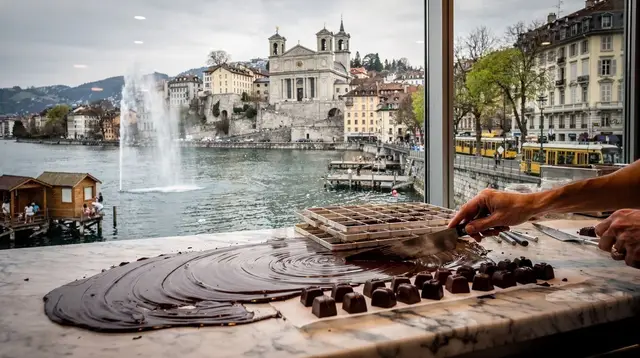
Not every stop along the main street is architectural. Several buildings inside the walls house hands-on activities rather than shops or museums, and the guide to games and workshops in Gruyères covers the options for visitors who want something more active than looking at towers and arcades — useful for families or groups who have already done the walk once and want a different reason to return. Chocolate is a related draw in its own right, distinct from the cheese side covered elsewhere: the Gruyères chocolate tours guide details tastings and workshops in and around the village, including the Broc option already mentioned above.
What Gruyères is not
It’s worth being direct about a few points, since Gruyères’ cheese-packaging fame creates some predictable confusion. The village is not reachable by car all the way to its centre — driving stops at the walls, always. Gruyère AOP cheese is not the only thing the area produces or is known for; chocolate producers, the castle, and the HR Giger Museum are all part of the same small territory, and none of them involve dairy. And Gruyères itself, walkable in well under an hour end to end, is not Geneva-adjacent — it’s a genuine excursion from Geneva, best planned as most of a day rather than squeezed into a half-day gap, particularly once train changes or driving time are factored in.
For a wider look at how a Gruyères stop fits into a longer Swiss itinerary, see the Gruyères day trips guide, which covers pairing options and timing beyond the walking route described here.
Old Town Walking Tours
Verified deep-linked GetYourGuide tours. Book through these links and we earn a small commission at no cost to you.
GetYourGuide does not provide a product photo for this activity — the image shows the meeting point, photographed by us.