Interlaken Day Trip from Geneva: What to Actually Expect
Can you visit Interlaken as a day trip from Geneva?
Yes, but it is a full-day commitment, not a half-day excursion. The train journey takes roughly 2.5 to 3 hours each way with a connection, so a day trip means around 5 to 6 hours on the train alone, leaving a shorter window in Interlaken itself than many visitors expect.
Why Interlaken from Geneva is a full day, not a quick hop
Interlaken sits on the far side of Switzerland from Geneva, in the Bernese Oberland, and reaching it takes real planning around train schedules rather than a spontaneous decision made over breakfast. Unlike closer excursions along Lake Geneva or across the nearby French border to Annecy, a visit to Interlaken means committing most of a day to travel alone before any sightseeing begins.
By train, the journey from Geneva to Interlaken typically takes about 2 hours 30 minutes to 3 hours each way, almost always with a connection along the way, commonly changing at Bern or Spiez. That means a round trip consumes somewhere between 5 and 6 hours of the day on trains, leaving a genuinely shorter window in Interlaken itself than the distance on a map might suggest. This is worth internalizing before booking: Interlaken is not a Chamonix-style excursion that can be squeezed into a half-day, and treating it that way leads to a rushed, unsatisfying visit.
None of this makes Interlaken a bad choice — the Jungfrau region it opens onto is genuinely spectacular — but it does mean the trip needs to be framed correctly from the outset. An early departure from Geneva and a realistic, focused plan for the hours actually spent in and around Interlaken make far more difference to how the day feels than trying to pack in extra stops.
Who this trip actually suits
Given the travel commitment, an Interlaken day trip from Geneva makes most sense for a specific kind of traveler: someone with a fixed short stay in Geneva who won’t get another chance at the Bernese Oberland, and who is comfortable spending a large share of the day on a train in exchange for a few focused hours of alpine scenery. It suits travelers who value seeing one genuine mountain viewpoint over ticking off several lighter stops, and who can handle an early start without it derailing the rest of the visit.
It suits this kind of traveler less well: anyone hoping to also fit in shopping, a long lunch, or a second sight the same day, or anyone traveling with young children who may struggle with 5 to 6 hours of round-trip train travel layered onto a full day of sightseeing. For families weighing that trade-off, a shorter excursion closer to Geneva — along the Lake Geneva shoreline or to Annecy — usually makes for a less exhausting day, even if it trades away the high-alpine payoff that Interlaken offers.
Interlaken’s setting: two lakes, not one
Interlaken’s name gives away its geography: the town sits directly between two lakes, Lake Thun (Thunersee) to the west and Lake Brienz (Brienzersee) to the east, both fed and drained by glacial meltwater that gives them a distinctive turquoise-green color in clear conditions. This double-lake position is part of what makes Interlaken visually striking, and it is also the reason the town has long functioned as a hub rather than a single self-contained sight — boats, trains, and mountain railways all radiate out from it in different directions.
This is a useful point of contrast with other long excursions from Geneva. A day trip to Lucerne centers on a single lake, Lake Lucerne, paired with a well-preserved medieval old town of covered wooden bridges and painted facades — a historic town center is the main draw. Interlaken, by contrast, has a more modest town center itself; its role is primarily as the access point to the Jungfrau region’s mountain excursions rather than as a historic destination to wander for its own sake. Travelers expecting an old town on the scale of Lucerne’s should adjust that expectation before arriving.
Don’t expect snow-capped views from the town center itself
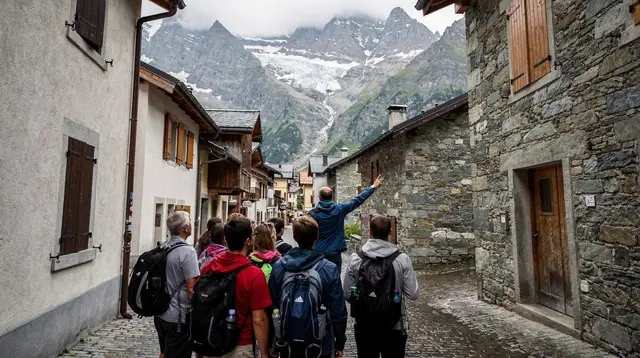
One of the most common misconceptions about Interlaken is that the town itself delivers postcard views of snow-covered peaks the moment you step off the train. In practice, Interlaken sits in a valley at a comparatively low altitude between the two lakes, and whether high, snow-capped summits are actually visible from the town center depends heavily on cloud cover, season, and time of day. On a hazy or overcast day, or outside of winter when snow lines retreat higher up the mountains, the town center can look pleasant and green without any dramatic snowy backdrop at all.
The reliable way to see the high alpine scenery the region is known for is to go up rather than to stay in the valley. Viewpoints and mountain trains that climb out of Interlaken toward the surrounding peaks are what deliver the panoramas seen in photographs — the town itself is better understood as a base and transit point than as the payoff. This guide deliberately does not promise a snow-capped view from the streets of Interlaken, because that promise would not hold up depending on when you visit.
Getting up: viewpoints reachable from the Interlaken area
Given the travel time already spent getting to the region, most one-day visitors do best focusing on a single well-chosen ascent rather than attempting several. Harder Kulm, reached by a funicular that climbs directly from Interlaken, is one of the more accessible options for a day trip, offering a panoramic viewing platform over the town and its two lakes without requiring a long onward train ride. It suits a schedule already tightened by the journey from Geneva.
Further afield, the Jungfrau region extends toward higher and more demanding excursions — including rack railways climbing toward glacier country — that typically require additional travel time beyond Interlaken itself and are better suited to visitors staying overnight in the region rather than those working within a single day trip from Geneva. Attempting one of these higher, more distant excursions on top of the outbound and return journey from Geneva is not realistic within a single day; it is worth being honest about that constraint rather than overloading the itinerary and returning to Geneva late and exhausted.
For a different kind of high-altitude excursion closer to Geneva’s side of the Alps, Glacier 3000 offers a cable car ascent from the Vaud Alps that some travelers prefer specifically because it does not require the long rail journey to the Bernese Oberland at all.
Interlaken versus Zermatt versus Lucerne: three different long excursions
Geneva-based travelers often weigh Interlaken against two other distant excursions, and it helps to be clear that these are three genuinely different destinations, not interchangeable variations on “a day in the Swiss Alps.”
| Destination | What defines it | Rough travel time from Geneva |
|---|---|---|
| Interlaken | Gateway to the Jungfrau region, set between Lake Thun and Lake Brienz | ~2.5–3 hours each way, with a connection |
| Zermatt | Car-free village beneath the Matterhorn, in the Valais | Comparable long journey, different rail route |
| Lucerne | Medieval old town on Lake Lucerne, covered wooden bridges | Comparable long journey, different rail route |
Zermatt leads to an entirely different mountain, the Matterhorn, in the Valais region, reached by a separate rail route from the one used for Interlaken — the two cannot be combined in a single day and should not be confused when planning. Lucerne, meanwhile, trades the Jungfrau’s mountain excursions for a genuinely historic old town on its own lake. None of the three is objectively “better,” but each answers a different kind of day: Interlaken for a base near high alpine viewpoints, Zermatt for the single most famous mountain silhouette in Switzerland, Lucerne for lake-town architecture and history.
A realistic one-day plan
Given the roughly 5 to 6 hours spent on trains for the round trip, a workable one-day plan from Geneva looks something like this: an early morning departure, arrival into Interlaken by late morning after the connection, a focused few hours combining one mountain viewpoint (such as Harder Kulm) with a short walk through the town between the two lakes, lunch in Interlaken, and a return train back toward Geneva in the mid-to-late afternoon to avoid a very late arrival home.
| Time block | Activity |
|---|---|
| Early morning | Depart Geneva, train with connection |
| Late morning | Arrive Interlaken |
| Midday | Harder Kulm viewpoint or short lakeside walk |
| Early afternoon | Lunch in Interlaken, time between the two lakes |
| Mid-to-late afternoon | Return train to Geneva |
| Evening | Arrive back in Geneva |
This is a full, busy day, and it leaves little slack for delays or a second excursion. Travelers who want to go deeper into the Jungfrau region — reaching the higher glacier excursions beyond Interlaken itself — are generally better served by an overnight stay rather than trying to compress it into a single day trip from Geneva.
Practical notes for the journey
Because the trip involves a connection, it’s worth checking the Swiss rail timetable in advance rather than assuming a fixed schedule, since connection points (commonly Bern or Spiez) and journey times can shift slightly by time of day. A Swiss travel pass covering unlimited train, bus, and boat travel can simplify a day that involves multiple legs — the outbound and return trains plus any local funicular or cable car up to a viewpoint — by consolidating several tickets into one.
Booking ahead for any cable car or mountain railway used during the visit is a sensible precaution, particularly in peak summer months and the winter season, when popular ascents can sell out and add avoidable friction to a day that is already built around fixed train connections. Given the length of the return journey, keeping a buffer before the last practical train back toward Geneva is worth more than squeezing in one more stop.
Given the early departure this trip requires, it’s worth building in some slack on the Geneva end too — confirming the first outbound connection the night before rather than checking it at the station, and packing a layer for altitude even if the day starts warm in Geneva. Food options in Interlaken itself are straightforward rather than extensive, so travelers who prefer a sit-down lunch may want to plan around the midday window in town rather than assuming options will be plentiful at a mountain viewpoint.
Guided, private, and specialty ways to make the trip
Because a self-planned Interlaken day trip depends entirely on hitting a tight sequence of connections, many Geneva-based travelers choose to hand that logistics problem to a guide rather than manage it solo. A guided option built specifically around the Jungfrau region, such as a Jungfrau and Interlaken day trip from Geneva, extends the day’s focus beyond Interlaken town itself toward the wider Jungfrau area for travelers who want more than the town and a single funicular ride.
Travelers who prefer not to share a group schedule at all have another private option beyond the two already mentioned: a private luxury day trip to Interlaken pairs the flexibility of a private itinerary with a more comfortable vehicle for the long road or rail portions of the day. For a genuinely different kind of Interlaken day, one built around an adrenaline activity rather than a viewpoint, a paragliding and Interlaken trip from Geneva combines a tandem flight over the valley with time in the town — worth considering for travelers who came to the Bernese Oberland specifically because it’s one of Switzerland’s best-known paragliding regions.
Some visitors prefer to treat the long journey west as an opportunity rather than dead time, breaking it up with stops along the way instead of riding straight through. a private day trip from Geneva taking in Lausanne, Bern, and Interlaken turns the transit portion of the day into its own mini-tour of the Swiss capital and the Lake Geneva shoreline. In the other direction, a private trip combining Interlaken with Aigle Castle, the Lavaux vineyards, and Montreux pairs the Bernese Oberland with the Swiss Riviera side of Lake Geneva in a single, longer private itinerary — an option worth considering for travelers with more than one day to give to this side of Switzerland.
Interlaken alongside Geneva’s other long excursions
Interlaken sits at the far end of what’s realistically achievable as a single-day trip from Geneva, alongside Zermatt and Lucerne as the region’s three classic “long excursion” options — each demanding a similar scale of rail commitment for a distinctly different payoff. Closer options within the same general direction of travel, such as Gruyères or the vineyard terraces of Lavaux, require far less travel time and can be paired more easily with other stops in a single day, which is worth weighing against Interlaken’s more singular, travel-heavy itinerary.
For travelers set on the Bernese Oberland specifically, the honest takeaway is this: budget the full day, expect one solid viewpoint rather than several, and don’t count on the town center itself delivering a snow-capped skyline — the payoff for that comes from going up, not from staying at lake level.
Booking the trip
a guided full-day excursion from Geneva to Interlaken handles the train connections and scheduling for you, which removes much of the planning friction described above. For a more personalized pace, a private day tour to Interlaken from Geneva allows the itinerary to flex around your own timing. To add the Harder Kulm viewpoint specifically, a day trip combining Interlaken with the Harder Kulm funicular ascent pairs the two most time-efficient elements of the day. Travelers planning multiple rail-heavy excursions from Geneva may also find a Swiss travel pass covering train, bus, and boat travel useful for consolidating tickets across a day with several connections.
For related planning, see the day trips guide to Geneva for other options within closer range, or compare against a day trip to Chamonix on the French side of the border, which involves a considerably shorter journey than Interlaken.
Day Trips from Geneva
Verified deep-linked GetYourGuide tours. Book through these links and we earn a small commission at no cost to you.
GetYourGuide does not provide a product photo for this activity — the image shows the meeting point, photographed by us.