Geneva Accessibility Guide: Getting Around for Reduced Mobility
Is Geneva accessible for visitors with reduced mobility?
Largely yes along the lake and on public transport: most TPG trams and buses are low-floor with ramps, and the lakefront promenades are flat and paved. The Old Town is the exception, with cobblestones, steep lanes, and steps that need checking case by case.
Planning an accessible visit to Geneva
Geneva is, in practice, two different cities for anyone travelling with reduced mobility. Down by the water, the lakefront is flat, paved, and genuinely easy: promenades run for kilometres with no steps, public transport is largely low-floor, and distances between major sights are short. Up on the hill above, the Old Town is a different proposition — cobblestones, gradients, and short flights of steps that were laid centuries before accessibility was a design consideration. This guide separates the two honestly, rather than promising a single blanket answer, so that a visit can be planned around what is realistic rather than what would be convenient to claim.
None of this should discourage a visit. A large share of what draws people to Geneva — the lake, the international district, CERN, Carouge, and most of the city’s museums — sits on flat or gently graded ground. The Old Town remains worth seeing even with limits on how much of it is reachable, and a bit of advance planning goes a long way toward avoiding an unpleasant surprise partway up a hill.
Public transport: mostly low-floor, with exceptions
Geneva’s public transport network, run by TPG (Transports Publics Genevois) and forming part of the wider Unireso system, is one of the city’s genuine accessibility strengths. Trams and the great majority of bus lines use low-floor vehicles: the vehicle floor sits close to platform or kerb level, and a ramp — either manually flipped down by the driver or, on some lines, automatically deployed — bridges the remaining gap. Each low-floor vehicle carries a marked wheelchair space inside, usually near a door, with a stop-request button positioned within reach.
That said, “mostly” is doing real work in that sentence. A smaller number of routes, particularly some older or more peripheral bus lines serving outlying parts of the canton, still run higher-floor vehicles without a ramp. If a specific connection matters — getting to the airport for a flight, say, or reaching a hotel on a tight schedule — it is worth checking the vehicle type for that particular line rather than assuming uniform access across the whole network.
Visitors staying in registered Geneva accommodation receive the free digital Geneva Transport Card, valid across Unireso for the length of the stay, including buses, trams, regional trains, and the small lake shuttle boats known as the Mouettes. It is worth collecting on arrival regardless of mobility needs, since it removes the friction of buying individual tickets while navigating a stop or a ramp.
a guided city discovery tour that introduces the layout of central Geneva by minibus and on foot is a practical way to get oriented on day one, before deciding independently which neighbourhoods to tackle on foot and which to see from a vehicle.
Regional and cross-border rail, including CFF/SBB services and the Léman Express linking Geneva to French towns such as Annemasse and Annecy, generally offers step-free or ramp-assisted boarding at the main stations, and staff assistance can be arranged in advance for a specific journey. CGN lake boats are more mixed: modern vessels tend to have level or ramped boarding, while the historic Belle Époque paddle steamers — built between 1904 and 1927 — have narrower doors, internal stairs, and decks connected only by steps. A short scenic option such as a 50-minute lake cruise from the city centre is worth confirming against the specific boat’s layout before booking if step-free boarding is a requirement.
The lakefront and Bains des Pâquis: Geneva’s flattest ground
The stretch running from around the Jet d’eau along the promenades past Bains des Pâquis and around toward the English Garden and the flower clock is, without qualification, Geneva’s most accessible corridor. It is flat, continuously paved, wide enough for wheelchairs and mobility scooters to pass comfortably, and largely free of kerbs or steps along the main route. Benches are frequent, and the pace of a lakefront walk can be set entirely by the visitor.
Bains des Pâquis itself, the bathing pier that has become one of the city’s best-loved public spaces, sits at lake level and is reached via a level walkway from the promenade. The pier surface is generally flat, though some of the specific bathing platforms and ladders leading into the water are not designed for independent wheelchair access — worth knowing if swimming, rather than simply visiting, is the goal.
This flat corridor also makes a natural spine for a first day: it connects easily to International Geneva and the Palais des Nations area to the west, and to Carouge further south via level streets, without needing to climb into the Old Town at all. A self-paced audio tour that can be followed along the lakefront and lower town suits this kind of flexible, flat-ground exploring particularly well, since it can be paused, slowed, or cut short without disrupting a group.
The Old Town: cobblestones, gradients, and steps
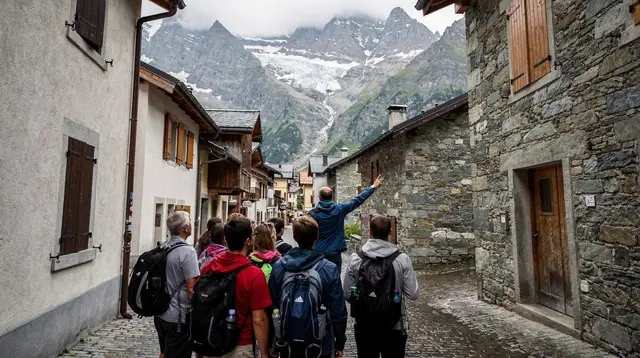
Geneva’s Old Town, centred on St-Pierre Cathedral, sits on a hill rising from the lakefront, and this is where accessibility becomes genuinely uneven. The streets are largely cobbled — attractive underfoot for walking shoes, considerably harder going for wheels or unsteady footing — and several of the connecting lanes between the lower and upper town are staircases rather than sloped streets. Some approaches are gentler than others: certain routes up from Place du Bourg-de-Four or along Rue de la Croix-Rouge are more gradual, while more direct shortcuts through narrow passages tend to include steps.
It would be misleading to claim that the Old Town can be seen in full without encountering a slope, a cobblestone stretch, or a set of steps somewhere along the way — that promise does not hold up on the ground. What is realistic is a partial visit: reaching key points via the gentler approaches, using a vehicle for the initial climb, and accepting that some narrow interior lanes and viewpoints will not be reachable by everyone. St-Pierre Cathedral’s nave is reached via a manageable approach from the main square, but the tower climb is a narrow spiral staircase with no lift alternative, and the archaeological site beneath the cathedral involves its own uneven, partly underground circuit — both are separate, optional add-ons rather than part of the core visit.
a tuktuk tour that covers the Old Town’s highlights by vehicle rather than entirely on foot is one practical way to see more of the upper town’s streets and viewpoints without committing to the full uphill walk, since the vehicle handles the gradient and cobblestones that would otherwise need to be crossed step by step. A private guide booked through a private walking tour of Geneva can also be asked in advance to plan a route around the gentlest available streets, rather than defaulting to the most direct but steepest path.
The comparison worth making explicitly: Geneva’s difficulty is concentrated in one hilltop district sitting above an otherwise flat lakeside city, which is a different shape of challenge than Lausanne, where the terrain is hillier across much of the wider city rather than confined to a single historic quarter — worth knowing if choosing between the two as a base.
Museums, sights, and international Geneva
Geneva’s larger, purpose-built venues generally handle accessibility well. The Palais des Nations, reached only via a pre-booked guided tour and requiring valid identification for entry, is a modern complex with step-free circulation on its public tour route. CERN’s Science Gateway exhibition centre, free to enter but best booked online in advance to guarantee a slot, is similarly modern and step-free throughout its public areas.
Away from these larger institutions, access becomes more variable. Geneva has many older buildings — smaller museums, historic residences converted into exhibition space, and some watchmaking venues — where step-free entry is partial, routed through a side door, or dependent on advance notice to staff so a ramp or lift can be arranged. Checking a specific venue’s own accessibility information, or calling ahead, is more reliable here than assuming a uniform standard across the city.
Carouge, the artisan district south of the centre, sits on flat ground and is comfortable to explore at a relaxed pace, with wide pavements along its main streets and squares — a good complement to the lakefront for a day that deliberately avoids the Old Town’s gradient.
Emergency numbers and practical essentials
For any visitor, but especially one relying on mobility aids or medical equipment, it is worth saving three numbers before setting out rather than searching for them under pressure:
| Situation | Number |
|---|---|
| General emergency (works from any phone) | 112 |
| Ambulance | 144 |
| Police | 117 |
The general European number, 112, reaches all emergency services and works even from a phone without a local SIM, which makes it the simplest single number to remember. The dedicated Swiss lines for ambulance (144) and police (117) can be faster to reach the right service directly if the nature of the emergency is already clear.
Electrical compatibility matters for anyone travelling with equipment that needs recharging — a power wheelchair, a mobility scooter, a CPAP machine, or other medical devices. Switzerland uses type J sockets at 230V: a three-pin, recessed socket that differs from the two-pin Schuko sockets (types E/F) common across much of continental Europe. A standard two-pin European plug (type C) fits into a type J socket without issue, but a Schuko plug with side earth clips typically will not seat properly. Bringing a universal adapter, or buying a Swiss-compatible one on arrival, removes any risk of arriving in Geneva unable to charge essential equipment overnight.
| Plug type in Switzerland | Compatible with |
|---|---|
| Type J (230V) | Type C (two-pin Europlug) fits directly |
| Type J (230V) | Type E/F (Schuko, with earth clips) generally does not fit |
A suggested one-day accessible route
For a first day that stays largely on flat, manageable ground, one workable order is: start at the lakefront near the Jet d’eau, walk or wheel the promenade toward Bains des Pâquis and the English Garden, continue on level streets toward International Geneva if a guided Palais des Nations visit has been booked in advance, and finish with a flat-ground stroll through Carouge in the afternoon. This keeps the day almost entirely off cobblestones and gradients while still covering several of Geneva’s defining sights. The one-day Geneva essentials itinerary covers a comparable route in more detail and can be adjusted around a specific mobility need.
For a broader stay that includes some version of the Old Town, treating it as a separate, shorter outing — ideally by vehicle for the uphill portion, as with a tuktuk or private guided option — rather than folding it into a long walking day works better in practice than trying to combine flat lakefront walking and Old Town gradients in a single continuous route.
A multi-activity option such as a Geneva city pass covering around 60 activities and attractions can be useful for building a flexible itinerary, since it allows swapping between flatter, easier sights on a given day without losing value on tickets already paid for.
For wider trip planning beyond accessibility specifically, the Geneva transport guide and Geneva planning guide cover the broader logistics of getting around and structuring a stay, while the Geneva Old Town walking tours guide lists guided options that can help navigate the hilltop district’s most demanding stretches with local knowledge. For families weighing similar terrain questions with strollers rather than wheelchairs, the Geneva family guide covers much of the same flat-versus-hilly territory from that angle, and the what to see in Geneva’s Old Town piece and free things to do in Geneva round out route planning with no-cost, mostly flat options along the lake.
Frequently asked questions about accessibility in Geneva
Are Geneva’s trams and buses wheelchair accessible?
Most of the TPG network — trams and the majority of bus lines — runs low-floor vehicles with a ramp that the driver or an onboard mechanism can deploy, plus a designated wheelchair space inside. A small number of older or peripheral bus routes still use higher-floor vehicles, so it is worth checking the specific line before relying on it for a tight connection.
Is Geneva’s Old Town accessible by wheelchair?
Only partly. The Old Town sits on a hill, with cobbled streets, uneven paving, and short staircases connecting different levels. Some of the flatter approaches and a few key sights are manageable with assistance, but a fully step-free route through the whole district cannot be promised — plan a specific path in advance rather than assuming full access.
Are the lakefront and Bains des Pâquis flat and easy to walk?
Yes, this is Geneva’s most reliably accessible stretch. The promenades along the lake, from the Jet d’eau area past Bains des Pâquis and around toward the English Garden, are flat, paved, and free of steps, making them a comfortable option for wheelchair users, visitors with strollers, or anyone who prefers level ground.
What is the emergency number in Geneva?
Dial 112 for the general European emergency number, which works from any phone and reaches all services. Switzerland also has dedicated lines: 144 for an ambulance and 117 for the police. Save all three before heading out, since coverage in some Old Town interior courtyards can be patchy.
What type of power plug does Geneva use, and does it matter for medical equipment?
Switzerland uses type J sockets at 230V, a three-pin recessed plug that is not the same as the two-pin Schuko (type E/F) sockets common in much of the EU. A standard two-pin European plug (type C) fits a type J socket, but a Schuko plug with side earth clips generally will not, so anyone recharging medical equipment such as a mobility scooter, CPAP machine, or power wheelchair battery should bring or buy a compatible adapter rather than assume their usual plug will work.
Do museums and major sights in Geneva have step-free access?
Most larger, purpose-built venues — including the international institutions and the main museums — offer step-free or lift access, but Geneva also has many older buildings where access is partial, via a side entrance, or requires advance notice to staff. Checking the specific venue’s accessibility page or calling ahead is the safer approach rather than assuming standard step-free entry everywhere.
Are the CGN lake boats and Léman Express trains accessible?
CFF/SBB trains and the cross-border Léman Express generally offer step-free or ramp-assisted boarding at Geneva’s main stations, with staff assistance available if booked ahead. CGN lake boats vary more by vessel: some of the modern boats have level or ramped boarding, while the historic Belle Époque paddle steamers have narrower doorways, internal steps, and decks connected by stairs, so checking the specific boat before booking is worthwhile.
Accessibility Guide
Verified deep-linked GetYourGuide tours. Book through these links and we earn a small commission at no cost to you.
GetYourGuide does not provide a product photo for this activity — the image shows the meeting point, photographed by us.