Geneva's Museums and Landmarks: A City-Only Guide
What are Geneva's must-see landmarks, and do they need advance booking?
Geneva's core sights are the Old Town and St-Pierre Cathedral, the lakefront Jet d'eau, and International Geneva (the Palais des Nations and CERN). The cathedral nave and the fountain are free to view; CERN's Science Gateway is free but should be booked online in advance; the Palais des Nations is guided-tour only and requires a passport or ID card.
What “Geneva itself” actually means
Most guides to this region point outward — to the Alps, to the French shore, to the vineyard terraces an hour up the lake. This one doesn’t. It stays inside the city limits and covers what a visitor can genuinely see between breakfast and dinner without a car, a train ticket out of town, or a booked excursion: the Old Town, the lakefront and its fountain, and International Geneva. Everything here is reachable on foot or on a Unireso tram or bus, which is also the free network covered by the digital Geneva Transport Card handed out at registered accommodation for the length of a stay.
One thing worth saying plainly before anything else: Geneva is not the capital of Switzerland. That’s Bern. Geneva is a cantonal capital, the seat of a dense cluster of international organisations, and — with roughly 200,000-215,000 residents in the city and around 500,000 across the canton — Switzerland’s second-largest city and the biggest in French-speaking Switzerland. It’s also worth knowing before arriving that this is a French-speaking city; German, which dominates in Zürich, Bern and Basel, isn’t the local language here.
The Old Town and St-Pierre Cathedral
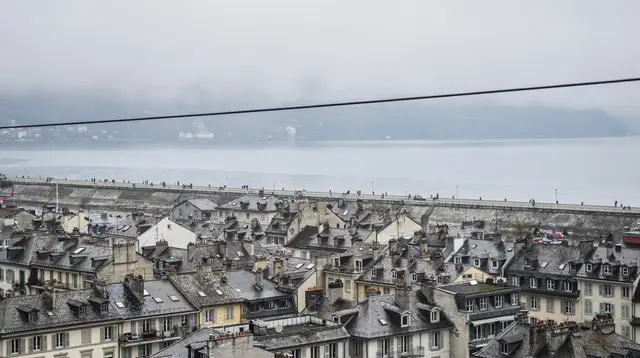
Geneva’s Old Town sits on a low hill above the lake, a tangle of cobbled streets, small squares and townhouses that has stayed largely intact since the 18th century. At its centre is St-Pierre Cathedral, a Gothic building with a later neoclassical facade, historically tied to the Reformation — Jean Calvin preached here.
Walking into the cathedral’s nave costs nothing. What isn’t free is climbing the towers, which reward the effort with a rooftop view over the Old Town and out to the lake, or visiting the archaeological site beneath the building — excavated foundations of earlier churches layered under the current one, going back to the 4th century. These are two separate paid tickets, bought at the cathedral itself, and they’re easy to underestimate on a first visit: budget an hour or more if doing both, since the archaeological site in particular is denser than it looks from the entrance.
A few minutes’ walk from the cathedral, the Reformation Wall runs along a stretch of old fortification inside the Parc des Bastions, its monumental statues of Calvin, Farel, Bèze and Knox marking Geneva’s role as a centre of the Protestant Reformation. It’s outdoors, unticketed, and easy to combine with a stroll through the park.
For a guided read on the Old Town’s layers — Reformation history, medieval streets, the cathedral’s archaeology — a walking tour fills in what’s easy to walk past otherwise.
a private walking tour through the Old Town covers this ground at a pace set by your own group, with a guide who can flag what’s ticketed and what isn’t before you’re standing at the till.
The lakefront: Jet d’eau and Bains des Pâquis
Geneva’s best-known image is the Jet d’eau, the jet of water rising from the lake just off the promenade. It’s free to view from the shore, and on a clear day it’s visible from much of the city and the surrounding hills. What it isn’t is a permanent fixture: it runs roughly 9am to after sunset in summer, lit up after dark, but only about 10am-4pm in winter, and it’s switched off outright in strong wind or near-freezing temperatures, as well as for routine maintenance. Plan to see it, don’t plan around a specific hour expecting it to be there — check before building a tight itinerary on it, especially outside summer or on a blustery day.
Along the same shoreline, Bains des Pâquis is a public bathing pier jutting into the lake — a genuinely local spot rather than a tourist set piece, with a small beach, a sauna, and a no-frills restaurant. It’s free to walk onto and use, and it’s one of the better places to see the Jet d’eau from water level rather than the promenade above.
The lakefront promenades themselves link the Old Town, the Jet d’eau, and the English Garden with its flower clock — the horloge fleurie, a free outdoor landmark that doubles as a small nod to the city’s watchmaking history. For a longer look at that history, the Patek Philippe Museum is a paid, indoor counterpart to the flower clock, tracing watchmaking from early mechanisms through to contemporary pieces.
For a different angle on this stretch of the city — one that covers more ground faster than walking — a tuktuk tour through the lakefront and Old Town highlights strings the Jet d’eau, the promenades and the Old Town together in a single loop.
Carouge: the artisan district
South of the centre, across the Arve, Carouge feels distinct from the rest of Geneva — Italianate architecture, courtyard gardens, and a concentration of independent workshops, galleries and cafés that gives it a slower, more residential pace than the lakefront. It’s a short tram ride from the centre and works well as a half-day add-on rather than a full destination in itself: browsing artisan studios, sitting at a café terrace, and walking streets that look more Mediterranean than Alpine. A themed walking tour is the more efficient way to see the district’s history if time is short, since Carouge’s appeal is more in its details than in a single obvious sight.
International Geneva: Palais des Nations and the Red Cross Museum
International Geneva is the part of the city built around diplomacy — the cluster of UN and NGO buildings north of the centre, along the lake. The centrepiece is the Palais des Nations, the UN’s European headquarters, set in landscaped grounds with the well-known giant chair sculpture outside.
Visiting the Palais des Nations is not a walk-up experience. Entry is by guided tour only, and it needs to be booked in advance; on the day, a valid passport or national ID card is required to get through security — without one, there’s no way in, guided tour or not. Building this into a day plan means booking ahead and remembering the document, not assuming it can be added on impulse between other stops.
Nearby, the Red Cross Museum covers the history and work of the International Red Cross and Red Crescent Movement through a mix of archival material and more immersive, sometimes deliberately unsettling exhibits on humanitarian crises — it’s a paid museum, generally quicker to fit into a day than the Palais des Nations since it doesn’t require advance booking in the same way.
CERN: free, but not walk-up
CERN sits on Geneva’s western edge, straddling the Swiss-French border, and is one of the city’s most-requested stops thanks to its Science Gateway exhibition centre. Admission is free — but “free” here doesn’t mean “walk in whenever.” Individual visitors and families should register online, and CERN itself recommends doing so up to a month ahead, since slots are limited and demand is high; on-site registration exists as a fallback but depends on same-day availability, which is not something to count on. Larger groups need to plan much further out, booking up to nine months in advance.
Beyond the Science Gateway, some guided tours and access to working areas of the lab require a further, separate on-site reservation on top of the general registration — worth checking specifically if the goal is more than the exhibition halls. The practical takeaway: if CERN is a priority, register online as soon as travel dates are set, not the week before arriving.
Watchmaking heritage in the city
Geneva’s watchmaking history runs through several city-centre sites rather than one single museum. The Patek Philippe Museum, mentioned above, is the most complete paid option; the flower clock on the lakefront is the free, symbolic counterpart. For visitors who want the trade’s craft rather than its history behind glass, a more hands-on option exists.
a watch-themed tuktuk tour through Geneva’s watchmaking landmarks links these sites together with commentary on the industry that’s easy to miss walking past storefronts alone. It’s a reasonable way to structure an afternoon around a theme that otherwise doesn’t have an obvious single anchor point in the city.
A realistic one-day plan, city only
The temptation is to try to fit the Old Town, the lakefront, CERN and the Palais des Nations into one day. It’s tight, and something usually has to give — CERN and the Palais des Nations both sit some distance from the centre and both come with their own booking logistics, so combining both of them with a relaxed morning in the Old Town is optimistic rather than realistic.
| Stop | Time needed | Booking |
|---|---|---|
| Old Town + St-Pierre Cathedral (nave) | 1.5-2 hrs | None |
| Cathedral towers + archaeological site | +45-60 min | Pay on-site |
| Jet d’eau + lakefront promenade | 30-45 min | None (check it’s running) |
| Bains des Pâquis | 30-60 min | None |
| CERN Science Gateway | 2-3 hrs incl. transit | Book online, ideally a month ahead |
| Palais des Nations guided tour | 1.5-2 hrs incl. transit | Book ahead + bring passport/ID |
| Red Cross Museum | 1.5-2 hrs | Pay on-site |
A more workable single day pairs the Old Town and lakefront with one of CERN or the Palais des Nations, not both — and books that one in advance. For a broader look at pacing a Geneva visit, including whether one day is even the right amount of time, see the Geneva planning guide or the one-day Geneva essentials itinerary; for a version stretched over two days, the two-day Geneva city break itinerary has more breathing room for both.
If structuring the day yourself feels like a lot of moving parts, a city discovery tour covering Geneva’s main sights handles the logistics of stitching the Old Town, lakefront and key landmarks together in one outing, leaving CERN or the Palais des Nations as a separate booking for another slot in the trip.
Free versus paid, at a glance
| Landmark | Free part | Paid part |
|---|---|---|
| St-Pierre Cathedral | Nave | Towers; archaeological site |
| Jet d’eau | Viewing from shore (when running) | — |
| Bains des Pâquis | Access to the pier | Sauna; some services |
| Reformation Wall | Full site | — |
| Flower clock | Full site | — |
| Patek Philippe Museum | — | Full admission |
| CERN Science Gateway | Full exhibition (booking required) | Some guided tours/lab visits |
| Palais des Nations | — | Guided tour only |
| Red Cross Museum | — | Full admission |
An alternative: an audio-guided or private route
Not every visitor wants a fixed group tour schedule. For a self-paced version of the same city-centre ground, a self-guided audio tour through Geneva’s streets lets the Old Town, lakefront and surrounding landmarks be covered on your own timetable, useful for anyone juggling a CERN or Palais des Nations booking around it.
Common mistakes worth avoiding
A handful of assumptions trip up first-time visitors to Geneva specifically around its landmarks:
- Assuming the Jet d’eau is always on. It has defined operating hours that shrink in winter, and it’s shut down in wind or cold — see when the Jet d’eau actually runs for the specifics before building a photo stop around it.
- Turning up at CERN without registering. Free admission is not the same as guaranteed same-day entry; see what you can really see at CERN for how the registration windows work in practice.
- Forgetting a passport or ID card for the Palais des Nations. There’s no substitute document that works, and there’s no entry without a booking either.
- Calling Geneva the Swiss capital. It’s a natural assumption given the city’s global profile, but the federal capital is Bern — see why Geneva is not the Swiss capital for the fuller picture.
- Budgeting only for entry tickets. Geneva ranks among the world’s most expensive cities, and museum admission, at roughly CHF 15-25 for major sites, is often the smaller line item next to food and drink; a coffee alone runs CHF 4.50-6. See is Geneva really that expensive for a fuller price picture.
Frequently asked questions about Geneva’s museums and landmarks
Is Geneva the capital of Switzerland?
No. Geneva is a cantonal capital and Switzerland’s diplomatic hub, but the federal capital is Bern. Geneva is Switzerland’s second-largest city and the largest in French-speaking Switzerland.
Is the Jet d’eau always running?
No. It runs longer hours in summer (roughly 9am to after sunset, lit at night) than in winter (roughly 10am-4pm), and it is switched off in strong wind, near-freezing temperatures, or for maintenance. Treat it as a highlight you’re likely to see, not a guarantee.
Can I visit CERN without a reservation?
Not reliably. The Science Gateway exhibition is free, but individual visitors and families should register online, ideally up to a month ahead, since slots fill quickly. On-site registration exists but depends on availability. Groups need to book up to nine months in advance.
Do I need my passport to visit the Palais des Nations?
Yes. Entry to the Palais des Nations is only possible on a guided tour booked in advance, and a valid passport or national ID card is required to get in — there is no walk-up access.
How much does it cost to climb St-Pierre Cathedral’s towers?
The nave is free to enter, but climbing the towers and visiting the archaeological site beneath the cathedral are each separate, paid tickets, bought on-site.
Can I see Geneva’s main landmarks in one day without a car?
Yes — everything in this guide sits inside the city and is reachable on foot or by Unireso trams and buses, no car or excursion needed. A full day covers the Old Town, the lakefront, and either CERN or the Palais des Nations, but fitting in both is tight.
Is Geneva French-speaking or German-speaking?
French-speaking. Geneva is the largest city in Romandy, French-speaking Switzerland; German is the majority language elsewhere in the country, such as Zürich, Bern and Basel, not in Geneva.
Museums and Landmarks
Verified deep-linked GetYourGuide tours. Book through these links and we earn a small commission at no cost to you.
GetYourGuide does not provide a product photo for this activity — the image shows the meeting point, photographed by us.