Geneva Airport to Verbier: Transfer Options and Travel Times
How long does it take to get from Geneva Airport to Verbier?
Around two hours by road in normal conditions, longer in winter snow or holiday traffic. There is no shortcut: the route runs the length of the Rhône valley before climbing to the resort, so it takes roughly twice as long as a transfer to Chamonix or Megève.
Verbier is one of the more distant popular excursions in this guide’s territory, and the transfer from Geneva Airport reflects that. Where a trip to Chamonix or Megève across the French border takes roughly an hour to 75 minutes, reaching Verbier means following the Rhône valley for the best part of two hours before the road finally turns uphill toward the resort. Anyone comparing prices or booking times against the French-side transfers should expect a longer, different kind of journey — not a shorter Swiss version of the same thing.
Why the Verbier transfer takes longer than Chamonix or Megève
Geneva sits at the western tip of Lake Geneva, and Chamonix and Megève lie just across the nearby French border, reachable via fast, direct roads through Haute-Savoie. Verbier, by contrast, is deep in Swiss Valais, on the opposite side of the lake basin. The route from Geneva runs east along the Rhône valley, passing near Aigle and Sion, before climbing a mountain road to the resort itself. That valley approach, followed by a genuine mountain ascent, is what stretches the trip to around two hours in good conditions — and longer whenever winter weather, holiday traffic, or roadworks intervene.
It helps to think of the Geneva-region transfers as falling into two different distance bands. The short band — Chamonix, Megève, Morzine — sits just over the nearby French border and can be reached inside 60-90 minutes. The long band — Verbier, along with Crans-Montana, Zermatt and Gstaad — sits deep in Valais or the Bernese Oberland and realistically takes two hours or more. Verbier belongs firmly in the second group, and no transfer option changes that underlying geography.
Since the drive up to Verbier is a long one whatever you choose, leave slack between landing and pick-up, and give the driver your flight number so a delay does not leave you stranded. Check the meeting point, the luggage allowance for skis and bags, and the cancellation terms before paying, then look at Kiwitaxi transfers from Geneva Airport to Verbier.
The three ways to get from Geneva Airport to Verbier
Private transfer
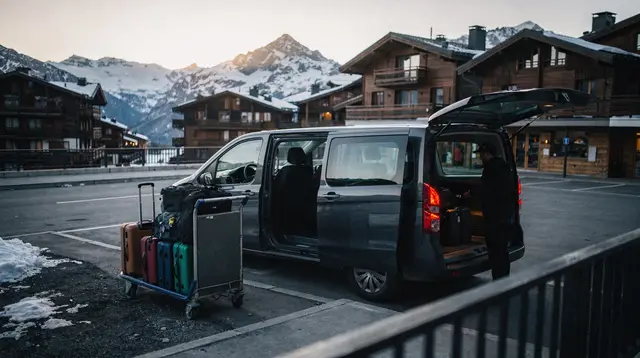
A booked private transfer is the simplest option for anyone arriving with luggage, ski equipment, or a fixed schedule. A driver meets arrivals at Geneva Airport and drives directly to a hotel or chalet door in Verbier, with no changes en route. For travellers who want to book this in advance, a private transfer between Geneva Airport and Verbier covers the full door-to-door journey in one vehicle.
Private transfers typically run CHF 250-450 for a standard car seating up to four passengers with normal luggage; larger groups or those travelling with ski bags will need a bigger vehicle, at a higher price. Booking ahead is strongly advisable in the winter season, when demand for the Geneva-to-Valais route peaks alongside flight schedules from major European and UK airports.
Shared shuttle
A shared shuttle costs less than a private transfer because the vehicle carries several travellers with overlapping arrival or departure times, usually with pre-agreed pickup windows rather than a fixed departure the moment you land. This suits travellers on a budget who can be flexible about timing, but it also means the two-hour drive can stretch further if the shuttle makes stops at other hotels along the way. Shared shuttles need to be booked in advance, in the same way as private transfers — there is no walk-up shuttle desk for Verbier at the airport.
Car rental
Renting a car at Geneva Airport gives full flexibility, and it is worth stating plainly: Verbier is reachable by car all the way into the village, unlike Zermatt. There is no equivalent of Zermatt’s car-free rule and no need to park at a lower station and change to another form of transport. Most hotels and chalets have parking, either on-site or nearby, though some central, pedestrian-oriented streets inside the village restrict traffic in peak season, and mountain parking within the resort itself can fill up on busy weekends.
The trade-off is the drive itself. The final approach to Verbier climbs a mountain road with switchbacks, which is manageable in a well-prepared car but genuinely different from a flat valley drive. In winter, this stretch is where snow and ice are most likely to matter. Rental cars picked up at Geneva Airport in the winter season are normally fitted with winter tyres as standard, but it is worth confirming this at the rental desk, and drivers unfamiliar with mountain roads in snow should build in extra time and caution on the final climb. Chains can become mandatory during heavy snowfall, so it’s sensible to check current road conditions before setting off in poor weather.
Train plus cable car or bus
The most economical route, and the one that requires no car at all, combines rail travel with a final lift or bus connection. From Geneva, a train runs to Martigny, where travellers change onto a narrow-gauge line to Le Châble, at the foot of the mountain. From Le Châble, a cable car (or, alternatively, a connecting bus) completes the ascent into Verbier village itself.
This is a genuinely different experience from the Zermatt approach at Täsch, where every visitor without exception must leave a car behind: Verbier’s train-and-lift route is one option among several, chosen by travellers who prefer not to drive or who want the lower cost, not a requirement imposed by the destination. The connections are covered by Switzerland’s CFF/SBB network and typically cost well under CHF 100 per person with a through ticket, a clear saving over a private transfer, but the journey involves at least two changes and is noticeably less convenient with heavy luggage, ski bags, or young children in tow.
Comparing the options
| Option | Approx. cost | Convenience | Best for |
|---|---|---|---|
| Private transfer | CHF 250-450 per vehicle | Door-to-door, no changes | Groups, luggage, fixed schedules |
| Shared shuttle | Lower than private, per person | Shared vehicle, flexible timing | Budget travellers who can be flexible |
| Car rental | Rental cost + fuel + parking | Full flexibility, mountain driving required | Independent travellers comfortable with mountain roads |
| Train + cable car/bus | Under CHF 100 per person | Multiple changes, no car needed | Solo travellers or those without heavy luggage |
What sets Verbier apart from Zermatt and the French-side resorts
Two comparisons are worth making explicit, since they’re easy to get wrong when planning around this territory.
First, Verbier is not a short transfer like Chamonix or Megève. Those French-side destinations sit close to the border and are reachable in roughly an hour to 75 minutes. Verbier’s two-hour drive is a genuinely different commitment, and it’s worth building that extra time into arrival-day and departure-day plans rather than assuming a similar schedule to a Chamonix trip.
Second, Verbier does not impose a vehicle restriction the way Zermatt does. At Zermatt, every visitor arriving by car must stop at Täsch and continue by shuttle train — there is no way to drive into the village itself. Verbier has no such rule: the access road runs directly into the village, and most accommodation offers parking. The two destinations sit at opposite ends of this particular spectrum among the region’s ski resorts, and travellers who have researched one shouldn’t assume the same restrictions apply to the other.
That said, Verbier is not entirely unrestricted either. Certain streets in the village centre are pedestrian priority or subject to local traffic rules, particularly in the height of the winter season, and visitors planning to drive should check with their accommodation about exactly where they can park and drop off luggage.
Planning the journey around flight times
Because the transfer takes around two hours regardless of the method chosen, it’s worth building a buffer into flight planning rather than booking the tightest possible connection. A private transfer booked to meet a specific flight is the most forgiving option if a flight is delayed, since most operators track arrivals and adjust pickup accordingly — confirm this policy when booking. A self-drive or train-and-lift itinerary depends more on the traveller managing their own connections, so a delayed flight can mean missing a planned train or arriving in Verbier well after dark, which matters more on unfamiliar mountain roads.
Travellers combining a Verbier stay with wider exploration of the Lake Geneva region or a stop in Sion on the way should factor the extra driving or train time into that day’s plans rather than treating it as incidental. For those interested in the broader ski experience once they arrive, options like a guided skiing and snowboarding day in the Swiss Alps or private ski lessons are worth booking ahead of the winter season, when instructor availability tightens.
Winter conditions and what to expect
Winter changes the calculus for every transfer option. Snow on the valley floor is manageable for most drivers, but the climb from the Rhône valley up to Verbier is where conditions can shift quickly, and the switchback sections near the resort are the most demanding stretch of the whole route. Travellers renting a car should confirm winter tyres are fitted, carry basic caution around chain requirements during active snowfall, and avoid attempting the final climb after dark in poor weather if it can be scheduled earlier in the day instead.
Rail travellers are less exposed to road conditions directly, but the Martigny-to-Le Châble line and the connecting cable car or bus can see reduced schedules or short delays during major snow events. Building slack into a winter arrival day, whichever option is chosen, avoids most of the stress this can cause.
A day trip alternative from Geneva itself
Not every visitor to this region needs to overnight in Verbier. Travellers based in Geneva or elsewhere on the lake who want a taste of the high Alps without committing to the full Verbier transfer might instead consider a day trip further south to the Matterhorn region — a day trip from Geneva to Zermatt covers similarly dramatic mountain scenery in a single guided outing, without the logistics of arranging a multi-day Verbier stay and its transfer separately.
Combining Verbier with the rest of Valais
Verbier sits within reach of several other Valais destinations, and travellers building a longer itinerary sometimes wonder whether it’s worth linking a Verbier stay with a side trip elsewhere in the region. Crans-Montana lies on the opposite side of the Rhône valley and shares a similar distance band from Geneva Airport — a private transfer between Geneva Airport and Crans-Montana follows a comparable route and travel time, which makes it a useful point of comparison for anyone weighing the two resorts against each other rather than a practical add-on to the same trip, since the two are not directly connected by a short local road. The same logic applies further south toward Zermatt: both are deep in Valais, both take roughly two hours or more from Geneva, and neither is a quick detour from the other once you’ve already committed to Verbier.
For those staying on the Lake Geneva side before or after a Verbier trip, it’s worth remembering how different the transfer times are. A private transfer to Lausanne or Nyon from Geneva Airport takes a fraction of the time a Verbier transfer does, since both towns sit directly on the lakeshore close to the city. Bundling a night in Lausanne or Nyon around a Verbier trip is a reasonable way to break up a long travel day, but it does mean an extra transfer leg rather than a single door-to-door journey.
Returning from Verbier to Geneva Airport
The return trip mirrors the outbound journey in distance and timing, but departure-day planning deserves its own attention. Whichever option was used to arrive, it’s worth booking the return with the same care — pre-arranging a private transfer for the exact departure date, or checking the last convenient train-and-cable-car connection down to Le Châble and Martigny, well before the day itself. Flights out of Geneva Airport, particularly the winter charter and low-cost schedules that serve Valais resorts, cluster on Saturdays, which is also when transfer demand peaks in the opposite direction; booking a return transfer early avoids being left without a vehicle on the busiest day of the week.
Travellers driving themselves should treat the descent with the same caution as the climb. Fatigue at the end of a ski week, combined with an early departure in the dark during winter months, is a common source of difficulty on the switchback sections above the valley floor. Building in extra time on departure morning, rather than cutting it close against a flight, applies just as much to the return leg as to arrival.
Booking ahead versus arranging locally
Nearly every option covered in this guide benefits from advance booking, but the degree varies. Private transfers and shared shuttles both need to be reserved ahead of arrival — there is no equivalent of a taxi rank for Verbier-bound passengers at Geneva Airport, and turning up without a booking in peak winter weeks can mean a long wait or no vehicle at all.
Car rental desks at the airport generally carry more stock, but winter-tyre-equipped vehicles and larger models suited to ski luggage can still sell out on the busiest arrival days, so booking a rental in advance is safer than assuming availability on the day. Train tickets are the most flexible of the four options and can usually be bought shortly before travel, though a through ticket covering the whole Geneva-to-Verbier route, including the cable car or bus connection, is worth arranging ahead simply to avoid working out the connections while jet-lagged and carrying luggage.
For travellers who haven’t yet decided between a private transfer and one of the other options, it’s worth weighing the number of people travelling together against the price difference. A group of three or four splitting the cost of a private transfer to Verbier often finds the per-person cost comparable to shared shuttle fares, with the added benefit of a direct, unshared journey — a calculation worth doing before defaulting to the cheapest-looking headline price.
Practical checklist before travelling
- Confirm which transfer option matches your luggage and schedule: private transfer for convenience, train-and-lift for cost, self-drive for flexibility.
- Book private transfers and shared shuttles in advance, especially during the winter season, when demand from Geneva Airport spikes with flight arrivals from the UK and elsewhere in Europe.
- If renting a car, confirm winter tyres are fitted between roughly November and April, and check current road conditions before the final climb in snow.
- Remember Verbier allows driving into the village itself — this is not a Zermatt-style car-free resort — but check with your accommodation about local parking and any pedestrian-priority streets.
- Build a buffer of at least 30-45 minutes beyond the baseline two-hour drive time for winter conditions, traffic, or train connections.
- Carry Swiss francs for any incidental costs along the way; the whole route from Geneva to Verbier stays within Switzerland, priced in CHF throughout.
Getting Around Geneva
Verified deep-linked GetYourGuide tours. Book through these links and we earn a small commission at no cost to you.
GetYourGuide does not provide a product photo for this activity — the image shows the meeting point, photographed by us.