Geneva Airport to Chamonix: Transfer Options Compared
How do you get from Geneva Airport to Chamonix?
The fastest and most common option is a pre-booked shared or private shuttle, taking roughly an hour on the autoroute blanche in normal conditions. Car rental gives more flexibility, while the train via the Arve valley is the slowest option, involving at least one change.
Getting from the airport to the Mont Blanc valley
For anyone flying into Geneva with Chamonix as the real destination, the airport-to-resort transfer is the first practical decision of the trip. Chamonix sits roughly 85 km from Geneva Airport, almost entirely by way of the A40 motorway — locally nicknamed the “autoroute blanche,” the white motorway — which climbs steadily up the Arve valley toward the foot of Mont Blanc. In clear conditions with light traffic, the drive takes close to an hour. That figure is a reasonable planning benchmark, not a promise: this is a mountain corridor, and both snow and seasonal traffic patterns regularly push the real travel time higher.
What makes this route different from the transfer to nearby French resorts like Megève or Morzine is Chamonix’s relative proximity to the airport and the sheer density of transport options built specifically around the Mont Blanc massif. Chamonix has functioned as a gateway to high-mountain tourism for well over a century, and a correspondingly large ecosystem of shuttle operators, private drivers and tour companies now specializes in exactly this one corridor. That density gives arriving travellers more real choice — and more room to pick an option that matches their budget, luggage, and tolerance for uncertainty — than most other Haute-Savoie destinations reachable from Geneva.
Because the A40 can run slower than the hour-long benchmark in snow or busy periods, leave some slack between your landing time and the pick-up, and check that the operator tracks your flight and confirms the drop-off address in Chamonix. Settle luggage and group size before paying, then you can reserve a private transfer with Kiwitaxi for the Mont Blanc valley.
The four realistic options
Pre-booked shared shuttle
A shared shuttle, booked online before arrival, is the default choice for most visitors flying in without a rental car reserved. Vehicles wait at the airport (often needing a short walk to a designated pickup point) and drop passengers at hotels or apartments across Chamonix and its outlying villages — Argentière, Les Houches, Les Praz. Because the van makes multiple stops, the journey typically runs somewhat longer than a direct drive, and departure times are often scheduled around flight banks rather than on demand. This is generally the most economical option for one or two travellers, and it removes the stress of navigating an unfamiliar motorway with luggage or ski equipment straight off a flight.
Private transfer
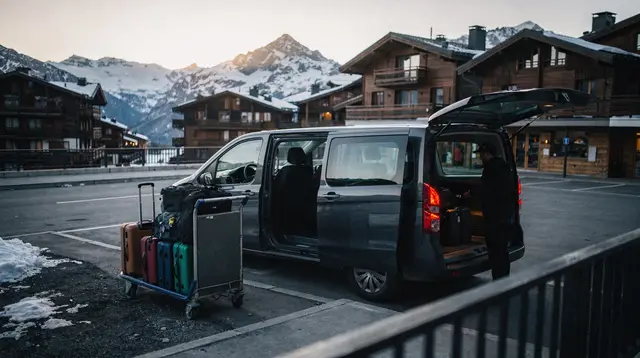
A private, pre-booked transfer — sedan, minivan or larger vehicle depending on group size — collects travellers directly from arrivals and drives straight to their accommodation with no intermediate stops. This is the most predictable door-to-door option and the most comfortable for families, groups travelling with ski gear, or late-arriving flights where a shared shuttle’s fixed schedule doesn’t line up. It costs more than a shared shuttle per person but is often comparable to, or cheaper than, a taxi once split across three or four travellers, and it can be booked well ahead so there’s no negotiation or searching for a driver on arrival.
a private day trip from Geneva into Chamonix and the Mont Blanc massif, which folds the transfer into a guided outing rather than a simple point-to-point ride, is worth considering for travellers who’d rather see sights en route than just get dropped off.
Car rental
Renting a car at Geneva Airport is the most flexible option, particularly for anyone planning to also visit Megève, Annecy or other parts of Haute-Savoie during their stay, or for a family travelling with ski equipment and general luggage that makes shuttle logistics awkward. The trade-off is the drive itself: the final stretch into Chamonix involves mountain-road conditions in winter, and anyone unused to driving on snow or ice, or unfamiliar with when chains are required, may prefer not to take this on directly after a flight. Parking in central Chamonix is also limited and often paid, which is worth factoring into cost comparisons against a shuttle or transfer.
Train via the Arve valley
A regional rail connection exists between Geneva and Chamonix by way of the Arve valley in France, but it is genuinely the slowest and least direct of the four options. It typically involves at least one change of train, adds meaningfully to total travel time compared with a road transfer, and is considerably less convenient for anyone carrying ski bags, large suitcases, or travelling with small children. It can suit budget-conscious travellers without heavy luggage who don’t mind the extra time, but it is not the practical default for most airport arrivals.
Scheduled public bus
Alongside the shared and private shuttle market, a smaller number of scheduled bus services also run the Geneva Airport-Chamonix corridor on fixed timetables rather than on-demand pickups. This tends to sit between the shared shuttle and the train on price, and because the timetable is fixed rather than matched to a specific flight, it works best for travellers with some buffer in their schedule rather than a tight same-day connection. a bus transfer between Geneva Airport and Chamonix is worth comparing against a shared shuttle price for solo travellers or pairs without much luggage, since the two can be close in cost depending on the season.
Comparing the options
| Option | Approx. journey time | Best for | Booking |
|---|---|---|---|
| Shared shuttle | 1-1.5 hours (multiple stops) | Solo/pair travellers, moderate luggage | Book online ahead |
| Private transfer | Around 1 hour, direct | Families, groups, late arrivals | Book online ahead |
| Car rental | Around 1 hour, self-driven | Multi-stop trips, full flexibility | Book at airport or ahead |
| Train (Arve valley) | 2+ hours, with a change | Light luggage, budget travel | No advance booking needed |
These are working estimates for planning, not fixed times — winter weather, French school-holiday traffic and roadworks on the A40 can all extend the journey regardless of which option is chosen.
The Franco-Swiss border crossing
Geneva Airport sits in Switzerland, and the drive to Chamonix crosses into France almost immediately after leaving the terminal. Because both countries belong to the Schengen Area, there is no routine passport check at this border in normal circumstances — shuttles, taxis and rental cars typically cross without stopping. That said, Switzerland is not part of the European Union, so occasional spot checks on either side, particularly for customs purposes, remain possible. Carrying a valid passport or national ID card is strongly recommended for every traveller in the vehicle, since some transfer operators require ID before departure and a spot check, while uncommon, can happen without warning.
Travellers flying specifically to reach France, rather than Switzerland, may also be able to use Geneva Airport’s French sector, which allows an exit directly into France without passing through Swiss customs — worth checking when booking a flight, though it changes little for the onward transfer to Chamonix itself.
Seasonal factors that change the journey
Chamonix is a genuine four-season destination, and the transfer from the airport looks different depending on when you travel. In winter, the A40 can be affected by snowfall, and Saturdays during French school-holiday periods routinely see heavy traffic as one week’s visitors depart and the next week’s arrive — a pattern locally known as the “changeover.” Pre-booked shuttles and private transfers generally build some buffer into their scheduling for this, but self-driving on a heavy changeover Saturday can mean a considerably longer journey than a quiet midweek arrival. In summer, the route is usually more predictable, though roadworks and the general rise in tourist traffic through the Arve valley can still add time.
No operator, shuttle service, or car-rental company can honestly promise a fixed transfer time in every season — anyone planning a tight connection, such as a same-day onward flight or a booked activity shortly after arrival, should build in a comfortable margin rather than counting on the best-case hour.
Luggage, ski equipment and group size
The right option often comes down less to price than to what’s being carried and how many people are travelling together. A solo hiker with a single backpack heading up in summer has very different needs from a family of four arriving in January with ski bags, boot bags and a stroller. Shared shuttles generally have a per-passenger luggage allowance and can struggle to accommodate a full set of ski gear for several travellers at once, which is part of why groups with heavy winter equipment often lean toward a private transfer instead. a private transfer from Geneva Airport to Chamonix sized to the group avoids the awkward calculation of whether everyone’s bags will actually fit alongside other passengers’ luggage in a shared van.
Group size also changes the maths on cost. Split three or four ways, a private transfer can end up costing about the same per person as a shared shuttle while removing the extra stops, so it’s worth pricing both before assuming the shared option is automatically cheaper for a group. For anyone continuing on to winter sports once settled in, the Chamonix winter sports guide and the Chamonix passes and tickets guide cover what to plan for beyond the transfer itself, including how lift passes and equipment rental typically work in the valley.
Once you’ve arrived
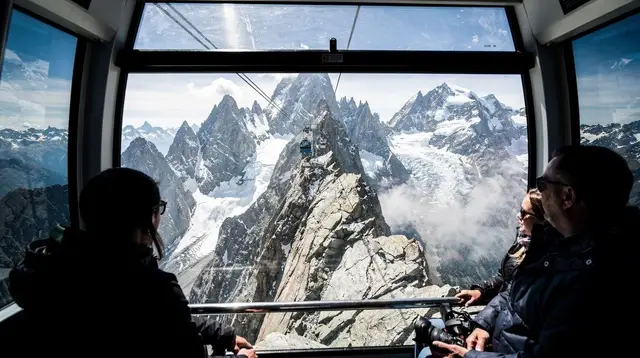
Chamonix’s transport hub sits close to the town centre, within easy reach of the departure points for the Aiguille du Midi cable car and the Mer de Glace railway, so most shuttles and transfers drop travellers within a short walk or a quick local bus ride of central accommodation. For a broader look at getting around once you’re there, the Chamonix transport guide covers local buses, the free navette network, and onward links toward Courmayeur and the Italian side of the massif.
Those arriving specifically to see Mont Blanc up close, rather than staying several days, might also consider building the transfer into a single outing rather than treating it as a separate logistics step. A guided day trip that starts and ends in Geneva, covering the transfer, sightseeing and return, removes the need to arrange a return shuttle separately: a guided excursion into Chamonix that also takes in Megève along the way is one way to combine the two valleys in a single day without renting a car.
Winter arrivals with an afternoon free before check-in sometimes prefer to ease into the mountain air gently rather than rush straight to a viewpoint: a snowshoeing outing paired with a local cheese and wine tasting is a low-key way to spend a first afternoon in the valley after an early flight.
Travellers whose itinerary includes a stop in Megève on the way to or from the airport — a common routing given Megève’s position along secondary roads south of Chamonix — can also look at a private guided tour of Megève as a way to break up the return journey.
Some visitors would rather use the day of arrival to get straight into the mountains rather than simply check in and rest. For travellers landing with enough of the day left, a full-day cable car and train tour from Geneva combines the airport-side transfer with a first look at the Aiguille du Midi and Mer de Glace on the same outing, which can be a practical way to make use of an early flight rather than losing the afternoon to a routine transfer. Families or travellers curious about the region’s mountain-rescue history might instead prefer a Geneva-to-Chamonix tour that includes the Mont Blanc Express train and a visit with Saint Bernard dogs, which turns the transfer day into something closer to a sightseeing excursion than a simple point-to-point ride.
Planning the rest of the trip
The transfer is only the first piece of a Mont Blanc trip. For a fuller sense of what the valley offers once you’ve arrived, the Chamonix day trips guide and the Mont Blanc excursions guide both lay out realistic one-day plans, while the Chamonix planning guide covers accommodation, altitude and general trip logistics beyond the airport transfer itself. Anyone deciding between Chamonix and other alpine bases reachable from Geneva, such as Zermatt or Verbier, may also find it useful to compare travel times side by side before booking.
Frequently asked questions about the Geneva-Chamonix transfer
How far is Chamonix from Geneva Airport?
Around 85 km by road, mostly via the A40 autoroute blanche. In free-flowing traffic and clear winter roads, the drive takes close to an hour, but this is not a fixed guarantee — snowfall, roadworks and peak ski-season traffic regularly stretch it well beyond that.
Do I need my passport to go from Geneva to Chamonix?
Both Switzerland and France are in the Schengen Area, so there is usually no systematic passport check at the border. Carrying a valid passport or national ID card is still strongly recommended, since French or Swiss authorities can and do carry out spot checks, and some shuttle and transfer operators ask to see ID before departure.
Is there a direct train from Geneva Airport to Chamonix?
No single direct train covers the full route. The realistic rail option runs from Geneva into the Arve valley in France with at least one change, making it noticeably slower and less convenient than a road transfer for anyone carrying luggage or skis.
Is it cheaper to take a shared shuttle or rent a car?
A shared shuttle is usually the cheaper per-person option for one or two travellers without much luggage, while a rental car often works out better value for a family or small group planning to also explore Megève, Annecy or other Haute-Savoie towns during the stay.
Can I book a private transfer in advance?
Yes. Several operators run private, pre-booked road transfers between Geneva Airport and Chamonix, picking travellers up directly at arrivals and dropping them at their Chamonix accommodation, with no need to find a taxi rank or navigate public transport with luggage.
Does snow affect the Geneva to Chamonix transfer time?
Yes, meaningfully. The autoroute blanche climbs into the Chamonix valley and can be slowed by snowfall, temporary chain requirements, or heavy traffic during French school holiday changeover weekends, particularly on Saturdays in winter.
Is Chamonix easier to reach from Geneva Airport than Megève or Morzine?
In practical terms, yes. Chamonix sits closer to the airport than Megève or Morzine and supports a denser network of shuttle operators dedicated specifically to the Mont Blanc massif, so pre-booked transfer options tend to be more frequent and more competitively priced.
Getting Around Geneva
Verified deep-linked GetYourGuide tours. Book through these links and we earn a small commission at no cost to you.
GetYourGuide does not provide a product photo for this activity — the image shows the meeting point, photographed by us.