Chamonix Winter Sports: Skiing Below Mont Blanc
What makes Chamonix different from other winter sports resorts near Geneva?
Chamonix sits in France, about an hour's drive from Geneva, directly beneath Mont Blanc, the highest peak in the Alps at 4,805 metres. Its terrain is split across separate ski areas rather than one linked domain, and it is known for serious off-piste and high-mountain terrain, including the Vallée Blanche, rather than for easy beginner skiing.
A French mountain town, not a Swiss one
It’s worth saying plainly before anything else: Chamonix is in France, not Switzerland. It sits in the Haute-Savoie department, at the foot of the Mont Blanc massif, and it is one of the most natural winter day trips or short bases from Geneva — but crossing to reach it means crossing an international border, even if that border rarely shows itself as a checkpoint.
Both Switzerland and France sit inside the Schengen Area, so there’s normally no routine passport check on the road between Geneva and Chamonix. That doesn’t mean the border stops mattering. Switzerland is outside the European Union, and customs rules on goods differ between the two countries — random controls do happen on this road, more often than visitors expect from a “borderless” trip. Carry a valid passport or national ID card, keep it accessible, and don’t assume the absence of a booth at the road means the absence of a border. For the wider context on why this distinction matters across the whole region, see why Switzerland is in Schengen but not the EU and crossing into France from Geneva.
How far is it, really
The honest answer is: about an hour by road, under normal conditions, following the Arve valley from Geneva into France. That’s a useful planning figure, not a promise. Winter changes things — snow on the pass roads, traffic around ski weekends, or conditions at the French border crossing can stretch that hour considerably. If you’re timing a day trip around lift opening hours or a booked cable car slot, build in a buffer rather than cutting it close. Details on the drive, and the alternatives to it, are covered in getting to Chamonix from Geneva airport and Chamonix transport basics.
Why Mont Blanc, not the Matterhorn
If you’ve read about winter sports elsewhere in this region — Verbier, Zermatt, Crans-Montana — the recurring landmark on the Swiss side is usually the Matterhorn. Chamonix is a different mountain story. The peak that defines this valley is Mont Blanc, at 4,805 metres the highest summit in the Alps, straddling the French and Italian border just south of the town. Nearly every panorama in Chamonix, on the slopes or off them, is oriented around that single massif — glaciated, genuinely high-altitude, and visibly bigger than the resort peaks around most other Alpine towns in this guide. It’s the reason Chamonix has such a strong pull for serious mountaineers and off-piste skiers, and also the reason weather here can turn faster and more dramatically than in gentler resort terrain.
The ski areas: not one linked domain
Unlike some large interconnected ski regions, Chamonix’s terrain is split across several separate areas along the valley, each with its own character and its own lift pass options.
Les Grands Montets, above the village of Argentière at the head of the valley, is the area most associated with Chamonix’s reputation for serious skiing — higher altitude, steeper terrain, and access points into some of the valley’s off-piste. It’s not the place to start if you’re new to skiing.
Brévent-Flégère sits on the opposite side of the valley from Mont Blanc, which means skiing here comes with the massif in view across the valley rather than underfoot. It’s generally more moderate than Grands Montets, though “moderate” in Chamonix still means real mountain terrain rather than a resort built primarily for beginners.
There are smaller sectors elsewhere in the valley too, and lift passes can be bought for a single area or for wider valley access — worth checking before you commit to a base village, since the areas aren’t seamlessly linked the way some larger ski regions are. A guided introduction that includes some of this terrain, without you having to plan the logistics yourself, is one way in:
a private day trip through Chamonix and the Mont Blanc valleyLift passes and getting around the valley
Because the ski areas aren’t linked into a single domain, choosing a pass is part of planning a Chamonix ski day rather than an afterthought. A pass bought for one area — Les Grands Montets alone, say — won’t carry you across to Brévent-Flégère, and moving between sectors generally means coming back down to the valley floor and using the free valley bus or the train that runs along the Chamonix valley floor, rather than skiing across on linked lifts the way you might in a bigger interconnected region like Verbier or Morzine’s Portes du Soleil. Multi-area passes exist for visitors who want to sample more than one sector across a stay, and they’re generally worth it if you’re basing yourself in the valley for several days rather than doing a single day trip.
For a first visit, or for anyone without their own car, letting someone else handle the border crossing, the parking and the choice of sector removes a layer of friction that can otherwise eat into a short day. Several operators run day trips from Geneva that combine transport with a guided introduction to the valley: a private Chamonix and Mont Blanc experience from Geneva or, for a smaller-group option that still keeps things flexible, a semi-private tour to Chamonix and Mont Blanc from Geneva
Both remove the need to drive yourself, which matters more in winter than in any other season here — snow tyres, chain requirements and unfamiliar mountain roads are a real consideration on the Geneva–Chamonix drive between December and March, even though the route itself is short.
Choosing terrain by ability, honestly
It’s worth being direct about who each part of the valley actually suits, rather than letting the scenery do the talking. Les Grands Montets rewards skiers who are already comfortable on steeper, more variable terrain — it is not the place to build confidence from scratch, and a beginner dropped into it on a first Alpine ski trip is likely to have a miserable day rather than a memorable one.
Brévent-Flégère is the more forgiving of the valley’s main areas, but “forgiving” here still means real mountain pistes with genuine altitude and weather exposure, not a gentle nursery slope. Riders looking for that kind of easier, purpose-built beginner terrain are generally better served elsewhere in the region — Crans-Montana and parts of the Verbier domain have more of it — and coming to Chamonix specifically for the Mont Blanc scenery and the Aiguille du Midi, while treating serious skiing as a secondary goal, is a completely reasonable way to plan the trip.
Families and mixed-ability groups tend to do best by splitting the day rather than forcing everyone onto the same terrain: stronger skiers take Grands Montets or explore further afield, while others spend the day around Brévent-Flégère, on the Aiguille du Midi, or off the slopes entirely in the town and its museums. Chamonix rewards this kind of flexible, non-uniform day more than resorts built around one continuous linked piste network.
The Vallée Blanche: for confirmed skiers with a guide, not a run to wander onto
The Vallée Blanche is probably the single most famous off-piste descent in the Alps, and it deserves to be described accurately rather than romantically. It’s a long descent that begins from the Aiguille du Midi and crosses genuine glacier terrain on the way down toward Chamonix — not a groomed or patrolled piste, not marked the way resort runs are, and not something to attempt on the strength of confident piste skiing alone.
It is reserved for skiers and snowboarders who are already technically confident off-piste, and it should only be done accompanied by a qualified mountain guide who knows the current glacier conditions, crevasse locations and route for that specific day. Conditions on a glacier change season to season and week to week. This guide will not tell you the Vallée Blanche is suitable for beginners or intermediate skiers looking for a bucket-list add-on — it isn’t, and treating it that way is a real safety risk, not an exaggeration.
The Aiguille du Midi: extraordinary, and weather-dependent
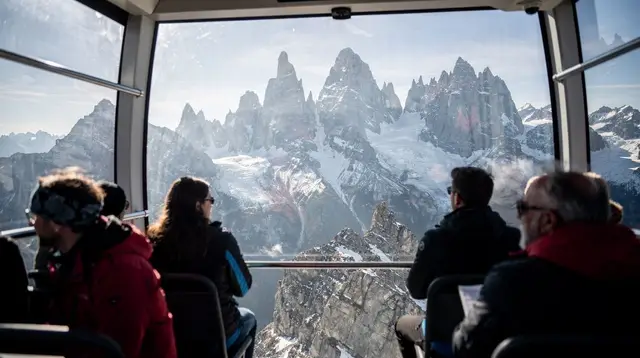
The Aiguille du Midi cable car climbs from Chamonix to 3,842 metres, one of the highest-altitude cable cars anywhere, and it runs year-round — not just for skiers accessing the Vallée Blanche, but for anyone who wants the view. On a clear day, it’s genuinely one of the most dramatic panoramas reachable this easily from Geneva: Mont Blanc close at hand, glaciers underfoot, the whole massif laid out.
The honest caveat: that view is not guaranteed. At this altitude, weather can close in fast, and cloud or storms can reduce visibility to nothing even when the town below looks fine. The cable car itself can be delayed or closed in poor conditions. There’s no way to book certainty into a mountain view, whatever time of year you go — check conditions on the day, and treat a clear summit as a bonus rather than an assumption.
The altitude itself is worth taking seriously too. At 3,842 metres the air is thin enough that even fit visitors often notice shortness of breath, and temperatures run far colder than in the valley, usually with real wind chill on top. Warm layers, a windproof jacket and gloves matter here regardless of whether you’re skiing or just visiting for the view. For the connected glacier experience nearby, the Mer de Glace, reached separately by rack railway from Chamonix, adds another angle on the same ice fields — covered in more detail in the Mont Blanc excursions guide and the Aiguille du Midi guide.
A quick comparison with other winter bases near Geneva
| Resort | Country | Approx. drive from Geneva | Known for |
|---|---|---|---|
| Chamonix | France | ~1 hour | Mont Blanc, Grands Montets, Vallée Blanche off-piste |
| Verbier | Switzerland | ~1.5–2 hours | Extensive linked terrain, freeride reputation |
| Zermatt | Switzerland | ~3–4 hours (car-free village) | Matterhorn views, year-round glacier skiing |
| Morzine | France | ~1–1.5 hours | Large linked Portes du Soleil domain, family-friendly |
| Megève | France | ~1–1.5 hours | Traditional village feel, gentler terrain |
Travel times are approximate and depend on conditions; treat them as ordering, not precision.
If skiing isn’t the plan
Not every winter visit to Chamonix needs to involve skis. The Aiguille du Midi cable car is open to sightseers year-round, and there’s a genuine range of non-ski winter activity in the valley: guided snowshoe walks through quieter parts of the terrain, mountain restaurants reachable without a lift pass, and simply spending time in a town built around one of the most striking mountain backdrops in Europe. A guided snowshoe outing that pairs the walk with a local tasting is a low-pressure way to spend a half-day here without needing prior ski experience:
a guided snowshoeing outing with a local cheese and wine tastingFor an evening version of the same idea, a sunset walk followed by fondue keeps things simple and doesn’t require any skiing at all:
a sunset hike with fondue in the Chamonix valleyIf you’re staying in nearby Megève rather than Chamonix itself, a short excursion connects the two rather than requiring a separate trip from Geneva:
an excursion from Megève into ChamonixFood and warming up after the cold
Winter sports days in Chamonix tend to end the same way they do across this whole alpine region: something warm, cheese-based, and unhurried. Fondue, raclette and tartiflette are all standard valley fare in winter, and multi-day food-focused visits are a genuine alternative to a purely ski-focused trip, especially if the group includes non-skiers.
a winter food tour through the flavors of ChamonixFor planning a longer stay around food rather than lift tickets, see Chamonix cheese and fondue and, more broadly, Chamonix day trips for how to structure a visit that mixes mountain time with valley time.
Planning the trip from Geneva
Most visitors either do Chamonix as a long day trip from Geneva or base themselves in the valley for a few nights during ski season — a day trip works for the Aiguille du Midi and a taste of the resort, but a proper ski day, given lift queues, changeable weather and the drive itself, tends to sit more comfortably as an overnight or multi-night stay. A structured single day is mapped out in one day: Mont Blanc from Geneva, and a longer version, aimed at a full winter weekend, is in winter weekend from Geneva. For a more ambitious multi-day mountain trip that goes beyond Chamonix into the wider Mont Blanc and Valais terrain, see four days hiking Mont Blanc and Valais.
Whichever pace you choose, plan around the two things this valley won’t compromise on: the mountain sets the weather, not the schedule, and its most serious terrain — the Vallée Blanche above all — is guide territory, not a place to improvise. For a wider look at what else the valley offers beyond winter sports, things to do in Chamonix and the Chamonix planning guide are useful starting points, alongside the broader winter sports category across the region.
Winter in Geneva
Verified deep-linked GetYourGuide tours. Book through these links and we earn a small commission at no cost to you.
GetYourGuide does not provide a product photo for this activity — the image shows the meeting point, photographed by us.