Zermatt Winter Sports: Skiing Below the Matterhorn from Geneva
Can you ski Zermatt as a day trip from Geneva?
Technically yes, but it means roughly 4 hours each way by train with a change, so most of a single day disappears in transit. Zermatt works far better as an overnight or multi-day trip from Geneva, leaving a full day on the slopes rather than a few rushed hours.
What makes skiing Zermatt from Geneva different
Most winter sports guides on this site cover resorts you can reach from Geneva in an hour or two — Mont Salève for a quick afternoon, Chamonix for a fuller but still single-day outing. Zermatt is a different proposition. It sits at the far end of the Valais, roughly 220 km and about 4 hours from Geneva by train, with at least one change along the way. That distance, combined with a genuinely car-free village and a ski area that climbs onto glacier terrain, is what sets Zermatt apart from the closer options in this guide series — and it’s also what this page focuses on, rather than repeating the practicalities already covered for nearby resorts like Verbier or Crans-Montana.
If your time in the Geneva region is limited to a single day, Zermatt is honestly not the easiest match. If you can give it an overnight, or better, two or three days, it becomes one of the most rewarding winter trips within reach of the city — just not a casual add-on to a Geneva itinerary the way Glacier 3000 or the Lavaux vineyards can be.
Getting there: the 4-hour train, not a road trip
The standard route from Geneva to Zermatt runs by train on the Swiss CFF/SBB network, heading east along the Rhône valley through Sion and on to Visp, where a change is usually required onto the narrower-gauge line that climbs into the Mattertal valley and terminates at Zermatt. Door to door, budget around 4 hours each way — closer to a full working day once you account for the walk to the station in Geneva and the last stretch into the resort.
Driving covers similar ground but doesn’t actually get you into Zermatt itself: you drive as far as Täsch, the last village accessible by private car, and finish the journey on the shuttle train described below. For most visitors, taking the train the whole way from Geneva is simpler than driving to Täsch and switching anyway.
A few practical notes for planning the trip:
- There is no direct Geneva-Zermatt train; build in time for the change at Visp and don’t cut connections too tight, especially with ski luggage.
- Trains run frequently enough that a missed connection isn’t a disaster, but it does eat into your day on the slopes.
- If you’re combining Zermatt with a broader loop through French-speaking Switzerland, it pairs naturally with stops in Sion or Fribourg on the way out or back, rather than as a pure there-and-back trip.
For a guided option that handles the logistics, a day trip from Geneva to Zermatt takes care of the train connections and timing, which takes some of the pressure off a first visit — though given the distance, treat it as a long, full day rather than a leisurely one.
Zermatt is car-free — what that actually means
Zermatt has no private cars in the village at all. Visitors leave their vehicle at the car park in Täsch, about 5 km before the resort, and continue on a dedicated shuttle train that runs every 20 minutes or so and takes roughly 12 minutes to reach Zermatt. This isn’t a minor inconvenience to route around — it’s a structural fact of visiting the resort, and it shapes everything from where you can park luggage to how ski transfers work within the village (small electric taxis and hotel shuttles cover the last mile).
If you’re arriving by train from Geneva, this is irrelevant — you’ll simply ride the same line straight into Zermatt without needing to think about Täsch at all. It only matters if you’re driving from elsewhere in the region.
The skiing: altitude is the whole story
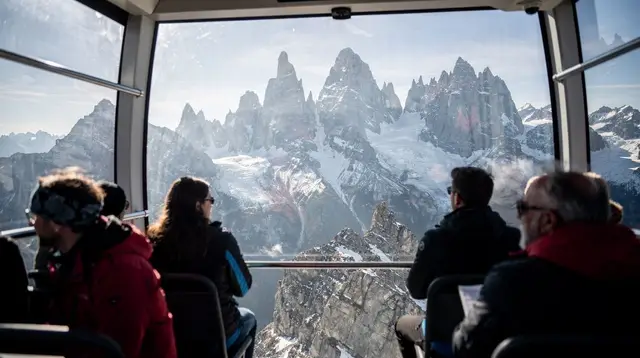
Zermatt’s ski area is built around genuinely high terrain, with lifts reaching up toward the Klein Matterhorn at close to 3,900m — among the highest lift-served points in the Alps. That altitude is what gives Zermatt its long season: part of the area sits on glacier, which keeps snow reliable well outside the core winter months, including summer skiing that most lower French resorts near Geneva, such as Morzine or Megève, simply cannot offer.
For a visitor coming from Geneva, this is the trade-off worth understanding clearly: you’re giving up a full day of travel time in exchange for terrain that starts higher and holds snow longer than almost anywhere else reachable from the city. If your priority is convenience, a resort like Chamonix or Morzine, closer to Geneva, will get you on snow faster. If your priority is altitude and reliability, Zermatt is hard to match.
A few figures worth keeping straight, since they’re commonly confused:
| Feature | Zermatt | Note |
|---|---|---|
| Highest lift point | ~3,900m (Klein Matterhorn) | Among the highest in the Alps |
| Matterhorn summit | 4,478m | Visible from the resort, not from Geneva |
| Mont Blanc summit | 4,805m | Highest peak in the Alps; near Chamonix, not Zermatt |
| Travel time from Geneva | ~4 hours by train | With at least one change |
Skiers looking to combine or compare terrain sometimes ask about pairing Zermatt with a lesson or two, particularly if it’s a first visit to glacier skiing. A private ski lesson booked locally is one way to get oriented to the higher pistes without guesswork, and travellers building a broader ski trip across the region sometimes book a multi-resort Swiss Alps skiing and snowboarding experience that spans more than one stop.
The Matterhorn myth, corrected
The Matterhorn is one of the most photographed mountains in the world, and its pyramid silhouette above Zermatt is genuinely one of the best reasons to make the trip. But two things about it are worth correcting before you go, because both mistakes are common among first-time visitors planning from Geneva:
You cannot see the Matterhorn from Geneva. The mountain sits more than 200 km from the city, behind several intervening ranges. It only becomes visible once you’re well into the Valais, close to Zermatt itself — so don’t expect any glimpse of it on the outward train journey until quite late in the approach.
The Matterhorn is not the highest peak in the Alps. At 4,478m it’s instantly recognisable and genuinely enormous, but the tallest Alpine summit is Mont Blanc, at 4,805m, standing above Chamonix in France — a different massif entirely, and one you can read more about in our guide comparing Chamonix and Zermatt as day trips from Geneva. If your trip includes both regions, it’s worth seeing them as two distinct mountain systems rather than parts of the same range.
Zermatt versus the closer options
Because Zermatt takes real effort to reach from Geneva, it’s worth being honest about how it stacks up against nearer alternatives before committing a day or two of a Geneva-based trip to it.
| Resort | Distance from Geneva | Best suited to |
|---|---|---|
| Chamonix (France) | ~1-1.5 hours by road | Single-day trips, highest peak in the Alps |
| Verbier | ~2.5-3 hours | Long day trip or overnight, off-piste terrain |
| Crans-Montana | ~2.5-3 hours | Long day trip or overnight, sunny plateau skiing |
| Zermatt | ~4 hours by train | Overnight or multi-day, glacier altitude |
If your trip to the Geneva region is short, closer resorts will simply cost you less travel time. Zermatt earns its place on an itinerary when you can dedicate real time to it — which is also why it pairs poorly with a single-day Geneva sightseeing plan and much better with a winter weekend built around it.
Planning a Zermatt trip around Geneva
Given the distance, most visitors handle Zermatt one of two ways: as a long single day accepting that roughly 8 hours go to travel, or as an overnight that turns it into a proper two-day ski trip. The overnight option is the one we’d recommend for anyone who actually wants meaningful time on the slopes rather than a few rushed runs before the train back.
If Zermatt doesn’t fit your schedule this trip, it’s worth knowing what else in the region offers a similar high-altitude, longer-season feel with a shorter commute. Verbier and Crans-Montana both sit roughly 2.5-3 hours from Geneva and make reasonable long-day or overnight alternatives, while Gstaad, a little further east, has its own character worth considering if your dates allow more flexibility. For travellers weighing up a couple of stops in the same trip, a photo session in Verbier’s alpine scenery or a private ski lesson in Gstaad can round out a broader Valais-and-Bernese-Oberland loop without the full commitment of the Zermatt trip.
For onward planning once you’re in Zermatt, our dedicated pages on glacier and snow terrain, passes and tickets and airport transfers go deeper than this overview can. And if winter in the wider Geneva region is what you’re weighing up more generally — including what actually stays open and snowy close to the city — our guide to Geneva in winter is the better starting point.
Common mistakes to avoid
- Don’t plan Zermatt as a casual day trip the way you would Chamonix. The 4-hour train each way makes a same-day round trip technically possible but genuinely tiring, and it leaves only a few hours of actual skiing.
- Don’t expect to drive into the village. Zermatt is car-free; you park in Täsch and finish by shuttle train, even if you’ve driven the whole way from Geneva rather than taken the train.
- Don’t expect to see the Matterhorn from Geneva. It only comes into view once you’re deep into the Valais, near Zermatt itself.
- Don’t confuse the Matterhorn with the Alps’ highest peak. That’s Mont Blanc, at 4,805m, above Chamonix — a separate massif in France.
- Don’t underestimate the cost of the trip as a whole. Between Zermatt’s own pricing, the train fare from Geneva, and likely a hotel night, this is one of the pricier outings covered on this site, and worth budgeting for accordingly.
Frequently asked questions about skiing Zermatt from Geneva
How long does it take to get from Geneva to Zermatt?
Around 4 hours by train, with at least one change (typically at Visp), covering roughly 220 km through the Rhône valley. There is no direct train, and driving takes a similar amount of time before you even reach Täsch, the last village you can drive into.
Can you drive into Zermatt?
No. Zermatt is car-free. Visitors leave their vehicle in the car park at Täsch and cover the final stretch on a shuttle train that runs every 20 minutes and takes about 12 minutes. There is no way for an ordinary visitor to drive a private car into the village itself.
Can you see the Matterhorn from Geneva?
No. The Matterhorn stands well over 200 km from Geneva, on the far side of several mountain ranges, and is not visible from the city at any point. It only comes into view once you are well into the Valais region, close to Zermatt itself.
Is the Matterhorn the highest peak in the Alps?
No, and this is a common mix-up. At 4,478m, the Matterhorn is one of the most recognisable peaks in the Alps, but the highest is Mont Blanc, at 4,805m, on the French side of the Chamonix valley — a separate mountain range from Zermatt’s.
Why does Zermatt have such a long ski season?
Because part of its ski area sits on glacier terrain reaching close to 3,900m at the Klein Matterhorn, which stays cold enough for snow well beyond the winter months. This gives Zermatt genuine summer skiing on the glacier, something most lower-altitude French resorts near Geneva cannot offer.
Is Zermatt better than Chamonix for a day trip from Geneva?
For a single day, Chamonix is the more realistic choice — it is roughly 1-1.5 hours from Geneva by road, against Zermatt’s 4 hours by train. Zermatt rewards a longer stay with genuinely higher, glacier-fed terrain, but it is not built for a same-day round trip in the way Chamonix is.
Do I need a Swiss travel pass to reach Zermatt?
Standard Swiss rail tickets or a Swiss Travel Pass cover the Geneva-Visp-Täsch-Zermatt route on the CFF/SBB and connecting narrow-gauge networks. It’s worth checking current pass conditions before travelling, since coverage details are updated from season to season.
Is Zermatt expensive compared to other Swiss ski resorts?
Zermatt sits at the upper end of Swiss ski resort pricing, reflecting both its altitude and its international reputation. Combined with the cost of getting there from Geneva and, in most cases, a hotel night, it is a more expensive outing than a closer French resort like Chamonix or Morzine.
Winter in Geneva
Verified deep-linked GetYourGuide tours. Book through these links and we earn a small commission at no cost to you.
GetYourGuide does not provide a product photo for this activity — the image shows the meeting point, photographed by us.