Aiguille du Midi: Tickets, Altitude and What You'll Actually See
What exactly is the Aiguille du Midi and how do you get there from Geneva?
The Aiguille du Midi is a 3,842m rock spire above Chamonix, France, reached by a two-stage cable car with viewing platforms and a glass skywalk. From Geneva it's about 1h15 by road to Chamonix, plus the cable car ride itself; tickets are priced separately from the nearby Mer de Glace and are best booked for a timed slot in high season.
Of all the day trips within reach of Geneva, the Aiguille du Midi is the one that puts you highest, fastest, with the least effort - and the one most likely to disappoint if you arrive without understanding what you’re actually buying a ticket for. This isn’t a general guide to Chamonix or to the Mer de Glace glacier down in the valley; it’s specifically about the cable car up to the 3,842m summit station, what the ride and the platforms involve, and how to avoid the two most common disappointments: no view, and no ticket.
What the Aiguille du Midi actually is
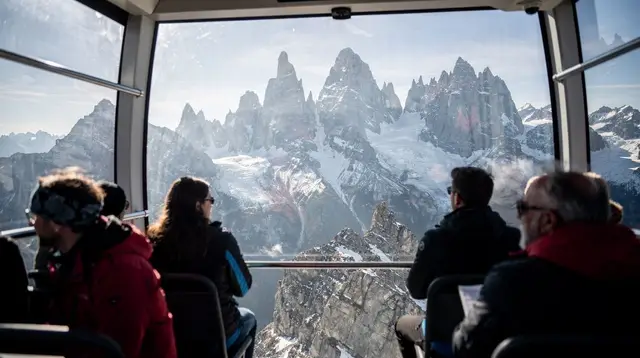
The Aiguille du Midi is a granite spire rising above the town of Chamonix, reached by a cable car (téléphérique) that climbs in two stages from the valley floor at around 1,035m to a summit station at 3,842m - among the highest-altitude cable cars anywhere in the world. The first stage stops at Plan de l’Aiguille (2,317m), a popular hiking junction in its own right; the second stage continues to the top station, where a network of platforms, tunnels and a glass-floored skywalk (the “Step into the Void”) let visitors stand at nearly 3,900m without any climbing.
This is a single, specific lift - not a hop-on tour of the whole Mont Blanc massif, and not the Mer de Glace glacier, which sits below on the other side of the valley and is reached by a completely different train. The two attractions are often paired in a single day by visitors, and some tour operators and ticket bundles combine them, but they remain two separate lifts with two separate tickets, and conflating them at the ticket counter is the single most common source of confusion for first-time visitors.
Getting there from Geneva
From Geneva, the road to Chamonix takes roughly 1h15, crossing from Switzerland into France en route - one of the region’s classic short international border crossings, alongside trips to Annecy and Mont Salève. Self-driving, guided minibus tours and public transport (train plus local connections) are all viable; a guided day tour removes the parking and border-logistics questions and often bundles the cable car ticket, which matters more than it might seem given how often tickets sell out (more on that below).
Once in Chamonix, the Aiguille du Midi cable car departs from its own station in the town centre - allow time to park or be dropped off, then queue, even with a pre-booked slot. Budget the full day: 1h15 each way on the road, time at the ticket gate and in the cable car queue, the two-stage ascent itself, and at least an hour or two at altitude to make the outing worthwhile. Trying to compress an Aiguille du Midi visit into a half-day alongside other stops usually means rushing the part of the trip that justified the whole outing.
Tickets: separate from the Mer de Glace, and priced in euros
Because this is a French attraction, prices are set in euros, not Swiss francs - a useful reminder that Chamonix pricing runs on French cost levels, generally lower than Geneva’s. A round-trip adult ticket to the summit station typically runs in the rough range of €75-€90 in high season, with a cheaper fare for those who only want to go as far as Plan de l’Aiguille, and reduced rates for children. These figures move with the season and with the operator’s own pricing updates, so treat them as an order of magnitude to plan around rather than a quote to hold anyone to.
The critical point: this ticket does not include the Mer de Glace. The Montenvers rack railway to the glacier is a different line, from a different station, with its own separate fare. Combined tickets covering both do exist and can be worth it for visitors planning to do both in one day, but they have to be deliberately chosen - the default Aiguille du Midi ticket covers only the Aiguille du Midi.
| Ticket | Covers | Typical approach |
|---|---|---|
| Aiguille du Midi round-trip | Cable car to 3,842m summit station | Book online for a timed slot in high season |
| Aiguille du Midi to Plan de l’Aiguille only | First stage to 2,317m | Cheaper; popular with hikers, not summit visitors |
| Mer de Glace (Montenvers) | Separate rack railway to the glacier | Bought and boarded independently |
| Combined Aiguille du Midi + Mer de Glace | Both lifts | Available as a bundle; confirm it’s genuinely combined before buying |
Book a timed slot - especially in July and August
In peak season, the Aiguille du Midi cable car sells departures in timed slots, and those slots regularly sell out days in advance. Arriving in Chamonix without a booking in July, August or during French and Swiss school holiday weeks can mean a wait of several hours at the ticket window, or - on the busiest days - no ticket at all for that day. Outside peak season, same-day availability is far more common, but nothing here is guaranteed, and a visitor who has driven 1h15 from Geneva specifically for this cable car has a lot riding on a ticket that may simply not be there.
Guided tours that include a pre-booked Aiguille du Midi ticket remove this risk entirely, which is a large part of why they’re popular for this specific excursion even among travellers who’d normally prefer independent sightseeing. If booking independently, buy online well ahead for any summer date, and check the operator’s own site for the current booking window rather than assuming last year’s lead time still applies.
What altitude actually feels like up there
At 3,842m, the summit station sits close to 2,800m above Chamonix and roughly 3,600m above Geneva - and the cable car covers that difference in around 20 minutes of riding time, not the days of gradual acclimatization that mountaineers build in when climbing to similar altitudes on foot. The result is genuinely felt by most visitors to some degree: shortness of breath on stairs and even standing, a mild headache, or lightheadedness. For the great majority this is mild and passes quickly, especially by resting and descending if needed, but anyone with a heart or lung condition should check with a doctor before planning the trip, and everyone should expect to move a little slower up there than the walk from the valley suggested they would.
Cold is the other constant. Summit temperatures typically run 20-30°C colder than the valley floor and are frequently below freezing even in the height of summer, often with real wind on the exposed platforms. Visitors who show up in the T-shirt and shorts they wore in Geneva or Chamonix that morning are a familiar sight at the top, and not a comfortable one - a proper jacket, hat and gloves make the difference between an outing and an endurance test. There are cafés and a restaurant at the mid-station and near the summit complex for anyone who underestimates this and needs to warm up, though prices reflect the location.
The view is not guaranteed
The entire point of going up, for most visitors, is the panorama - out across the Mont Blanc massif, at 4,805m the highest summit in the Alps, and on a clear day toward the Matterhorn and the Bernese Alps far to the east. That view depends entirely on the weather on the day, and there is no way around this: Mont Blanc can sit wrapped in cloud even when Chamonix town below is sunny and warm, because mountain weather and valley weather are genuinely different systems. No cable car operator, guide or tour company can promise a clear summit view, and tickets are not typically refunded for weather - buying a ticket is buying access to the platforms, not a guaranteed sight of the mountain.
The practical response is to check a mountain-specific forecast (not just the general Chamonix forecast) the morning of the visit, and to build in flexibility where the itinerary allows it - a day trip with no slack for a weather-driven change of date is a day trip that accepts the risk of a grey-out at the top. Early morning ascents, before afternoon cloud tends to build over the massif, generally improve the odds, though they’re not a guarantee either.
Aiguille du Midi versus the Mer de Glace: the real difference
Both sit above Chamonix and both are reachable in a single day from Geneva, which is exactly why they get confused. The distinction that matters when deciding what to book:
- Aiguille du Midi: a single, very high summit (3,842m) reached by cable car, built around panoramic views, high-altitude platforms and the glass skywalk. The draw is height and panorama, not the glacier itself, though the Mer de Glace glacier is visible from up there in the distance.
- Mer de Glace: a lower-altitude excursion by rack railway to visit France’s largest glacier up close, including a walk-in ice cave dug fresh each year. The draw is standing on and inside the ice, and seeing - starkly - how far the glacier has retreated as the entry staircase has grown to several hundred steps over the years.
Visitors with time and budget for only one should pick based on what they actually want: height and panorama, or glacier up close. Visitors doing both should budget a genuinely long day and check whether a combined ticket makes sense, rather than assuming the two are interchangeable or automatically bundled.
Tips for a smoother visit
- Book the timed slot ahead for any July-August or school-holiday-week visit; don’t rely on walk-up availability.
- Dress for winter, even in summer - a proper jacket, hat and gloves belong in the bag regardless of the Chamonix-level forecast.
- Check a mountain forecast, not just a valley one, and go early in the day if the itinerary allows flexibility.
- Confirm your ticket type at booking - summit round-trip, Plan de l’Aiguille only, or a genuine combined ticket with the Mer de Glace - since these are priced and sold separately by default.
- Pace yourself at altitude - move slowly on stairs, and head down if you feel unwell rather than pushing through.
- Budget the full day from Geneva: roughly 1h15 each way on the road plus queuing and the ride itself, before any time actually spent at altitude.
- Bring a passport or ID, since the trip crosses from Switzerland into France.
A guided option such as the guided tour to the Aiguille du Midi and Montenvers or the half-day Aiguille du Midi excursion handles the ticket-booking risk directly. For a single day that combines the cable car with the glacier railway, the Geneva departure covering both the Aiguille du Midi and Mer de Glace is built around exactly that pairing, while travellers who’d rather have a private guide explaining the massif from the platforms can look at the private guided visit to the Aiguille du Midi.
Aiguille du Midi FAQ
How much does the Aiguille du Midi cable car cost?
A round-trip adult ticket to the 3,842m summit typically runs roughly €75-€90 in high season, with lower rates for the mid-station only (Plan de l’Aiguille) and reductions for children. Prices are set and published in euros by the operator and change by season, so treat any figure as an order of magnitude and check the current fare before booking.
Is the Aiguille du Midi ticket the same as the Mer de Glace ticket?
No. The Aiguille du Midi cable car and the Montenvers rack railway to the Mer de Glace are two separate lifts, from different stations in Chamonix, with separate tickets. A combined pass covering both exists, but buying one does not automatically include the other.
Do I need to book a time slot in advance?
In July, August and school holiday weeks, yes in practice - the cable car sells timed departure slots that regularly sell out days ahead, and walk-up visitors can face waits of several hours or simply not get on. Outside peak season, same-day tickets are more often available, but there is no guarantee.
Will I actually see Mont Blanc from the top?
Only if the weather cooperates. The summit view depends entirely on cloud cover and visibility on the day, and Mont Blanc can be completely hidden in cloud even when Chamonix town is sunny. No operator or guide can promise a clear view, and refunds are not typically issued for weather.
Is it very cold at the top, even in summer?
Yes. At 3,842m the temperature is routinely 20-30°C colder than in Chamonix or Geneva, often below freezing even in July and August, frequently with wind. A warm jacket, hat and gloves are genuinely necessary, not optional extras.
Can altitude sickness be a problem on a short visit?
The rapid ascent from valley level to nearly 3,900m in minutes can cause shortness of breath, lightheadedness or headache in some visitors, even those who are otherwise fit, simply because the body has no time to acclimatize. Symptoms are usually mild and pass on descent, but anyone with heart or lung conditions should check with a doctor before going.
How long should I plan for the whole outing from Geneva?
Realistically a full day: about 1h15 each way on the road between Geneva and Chamonix, plus queuing, the two-stage cable car ride, and at least an hour or two at altitude to make the trip worthwhile - more if paired with the Mer de Glace or a Chamonix town visit.
Is there anywhere to eat at the top?
Yes, there are cafés and a restaurant at the mid-station and near the summit complex, though prices are high, as is typical at altitude tourist sites, and options can be limited at peak times.
Mont Blanc Excursions
Verified deep-linked GetYourGuide tours. Book through these links and we earn a small commission at no cost to you.
GetYourGuide does not provide a product photo for this activity — the image shows the meeting point, photographed by us.