The roof of the Alps, seen from Geneva’s doorstep
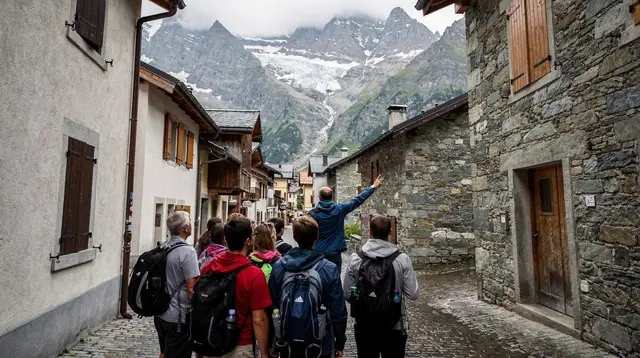
Mont Blanc is not a single overlook or a ticketed attraction — it’s a massif, a cluster of glaciated peaks straddling the French-Italian border, crowned by the highest summit in the Alps at 4,805 metres. This page is about the mountain itself: where it sits, what it looks like from different angles, and what a visitor without mountaineering experience can realistically expect to see. For the two specific sites most people use to get close to it, the Aiguille du Midi cable car and the Mer de Glace glacier, each has its own dedicated page covering tickets, timing and logistics. Here, the focus is on the massif as a whole and on setting realistic expectations before you plan a day around it.
The massif sits entirely in France (with its eastern flank brushing Italy near Courmayeur), roughly 1 to 1.5 hours by car or bus from Geneva, depending on border traffic and the route through the Arve valley. Most visitors approach it via Chamonix, the mountaineering town that has sat at its base since the golden age of alpinism in the 19th century, though Megève and Morzine on the range’s outer slopes offer different, quieter angles on the same high country.
What “seeing Mont Blanc” actually means
It’s worth separating three very different experiences that all get called “visiting Mont Blanc”:
Distant views from the Geneva basin. On a genuinely clear day, the Mont Blanc massif is visible from parts of Geneva and the surrounding hills, especially from elevated spots like Mont Salève just across the French border. This is a glimpse from roughly 80km away, weather permitting, not a close-up.
Close panoramas from Chamonix and its cable cars. Riding up from the valley floor, most commonly on the Aiguille du Midi cable car, puts you at 3,842m with the glaciated flank of Mont Blanc directly in front of you, and the Mer de Glace glacier reachable separately by rack railway. These are the closest views a non-climber gets, and they require no technical skill, just a ticket, warm layers, and clear weather.
Standing on the summit. This is a different undertaking entirely — a multi-day, technical, glaciated climb with crevasse crossings, altitude, and serious objective hazards, done with a certified mountain guide and appropriate training. It is not something arranged on a day trip, and this page will not pretend otherwise: reaching 4,805m is an expedition, not an excursion.
Geography: how the massif is laid out
The Mont Blanc massif extends roughly 45km along the French-Italian border, with a secondary ridge reaching into Switzerland near its western end. The summit itself sits above the town of Chamonix on the French side and Courmayeur on the Italian side, connected historically by the Mont Blanc Tunnel and, for those willing to combine cable cars and a cross-border gondola, by the Panoramic Mont-Blanc route from the Aiguille du Midi to Pointe Helbronner in Italy.
The massif’s glaciers feed the Arve river, which flows down through the Chamonix valley and joins the Rhône at Geneva — the same water that eventually passes the Jet d’eau on Geneva’s lakefront started as ice and snow on these slopes. The Mer de Glace, France’s largest glacier, is the most visited of these ice fields, though like glaciers worldwide it has retreated markedly in recent decades — a fact made physically visible by the growing staircase visitors now descend to reach the ice.
Around the core massif, a ring of resort towns each offers a different relationship with the mountain: Chamonix sits closest and most dramatically underneath it; Megève, a more understated, chalet-style resort, looks toward it from a gentler angle to the north; and Morzine, further out in the Portes du Soleil area, trades a direct Mont Blanc view for its own extensive ski and hiking terrain.
What you can do without climbing
None of the following require mountaineering experience, ropes, or a guide for the ascent itself — only a cable car, gondola, or rack railway ticket, and cooperative weather:
- Ride the Aiguille du Midi cable car from Chamonix to 3,842m in two stages, arriving at a viewing platform and a glass-floored “Step into the Void” installation directly facing Mont Blanc’s summit ridge. See the Aiguille du Midi page for tickets and booking windows.
- Take the Montenvers rack railway from Chamonix to the Mer de Glace, then descend the staircase to the ice cave dug fresh into the glacier each year. Full details on the Mer de Glace page.
- Walk marked valley and mid-mountain trails around Chamonix, Argentière, and Les Houches with the massif as a backdrop, without any glacier travel or technical terrain.
- View the range from a distance at Mont Salève above Geneva, or from vantage points around Megève and Morzine, on a clear day.
- Take a scenic flight or cable-car panorama tour booked through a local operator, which covers ground a walker couldn’t reach in a day, still without technical climbing.
What stays out of reach for a day visitor
To be direct about it: the summit of Mont Blanc is not accessible to visitors without mountaineering training, proper acclimatization, and a certified guide. The standard route (via the Goûter Hut) typically takes two to three days, involves glacier travel with crampons and rope, crosses sections with real rockfall risk, and turns back a meaningful share of even experienced, guided climbers due to weather or conditions. It is not comparable to a cable car ride, and no legitimate operator sells it as a same-day or beginner activity.
It’s also worth being honest about weather. The Alps generate their own cloud cover, and Mont Blanc’s summit is frequently wrapped in cloud even when the valley below is sunny — this is normal alpine weather, not bad luck. No cable car ticket, tour, or clear morning in Geneva guarantees an unobstructed summit view. Operators do their best to read forecasts, and cable cars sometimes close in high wind regardless of season, but the mountain decides on the day. Building in flexibility, or a second day, is the realistic way to raise your odds — not a promise anyone can make in advance.
Getting there from Geneva
| Method | Approx. time | Notes |
|---|---|---|
| Car | 1h-1h15 | Via the Arve valley; French border crossing, no passport checks under Schengen but keep ID handy |
| Public bus | 1h-1h30 | Direct services run between Geneva Airport/city and Chamonix |
| Guided day tour | Varies | Transport, commentary and sometimes cable-car tickets bundled |
| Train | Longer, with a change | Less direct than road transport for this specific route |
A private guided transfer removes the guesswork around cable-car ticket timing and parking; the Chamonix Mont Blanc private day trip and the private Chamonix and Mont Blanc day trip departing from Geneva both build the drive and a viewpoint stop into one booking, useful if you’d rather not navigate French mountain roads or French-language ticket counters yourself.
Building a day (or two) around the massif
A realistic one-day plan from Geneva: an early departure to Chamonix, a cable-car ascent timed for the clearest part of the morning before afternoon cloud tends to build, lunch in the valley, and either the Mer de Glace or a lower-altitude walk in the afternoon before heading back. See the Mont Blanc excursions from Chamonix, Aiguille du Midi excursions guide, and Mer de Glace excursions guide for how to sequence these.
If your schedule allows it, a two-day version — with Chamonix as an overnight base — gives you a weather backup: if the first day is cloudy, the second may clear. This also opens up Megève, reachable for panoramic e-bike routes and a quieter, chalet-resort pace, on the Megève e-bike tour to panoramic Mont Blanc viewpoints or a private guided walking tour of Megève, and Morzine on the far side of the Portes du Soleil, covered by a 60-minute local walking tour of Morzine for travelers extending beyond the Chamonix valley itself.
For a full sample itinerary rather than a standalone destination page, see one day from Geneva to Mont Blanc and, for a longer alpine loop, four days hiking Mont Blanc and Valais.
Mont Blanc in each season
Summer (late June-September) brings the longest days, the highest odds of clear morning views, and full operation of hiking trails around the valley floor and mid-mountain. It’s also the busiest season, so cable-car tickets for the Aiguille du Midi are worth booking well ahead.
Winter (December-March) turns the massif into a ski destination, with Chamonix’s terrain among the most storied in the Alps for experienced skiers, and Megève offering gentler, more family-oriented slopes. Clear winter days can produce exceptionally sharp views, since cold air holds less haze than summer air, though shorter daylight hours and occasional lift closures in high wind are part of the trade-off.
Spring and late autumn are shoulder seasons: some lifts and trails may be closed for maintenance, and cloud cover is statistically more frequent. They can still work well for travelers prioritizing lower crowds over guaranteed views.
Common mistakes to avoid
- Assuming Mont Blanc is in Switzerland. The summit and Chamonix both sit in France, even though the massif is closely associated with, and visible from, the Geneva region.
- Booking a day trip expecting to reach the summit. Standing on top of Mont Blanc requires a multi-day guided technical ascent — it is not part of any cable car, gondola, or day-tour itinerary.
- Assuming a clear morning in Geneva means a clear summit. Alpine weather forms its own cloud cover around high peaks; a sunny lake and a clouded-in Mont Blanc summit can happen on the very same day.
- Skipping a plan B. Because views aren’t guaranteed, travelers who build in a second day, or a flexible morning departure, come away far less disappointed than those committed to a single fixed slot.
- Confusing the massif with a single site. “Mont Blanc” isn’t one ticketed attraction — the Aiguille du Midi and Mer de Glace are two distinct, separately bookable ways to approach it, each with its own logistics.
Frequently asked questions about visiting Mont Blanc
Can I climb Mont Blanc without experience?
No. Reaching the 4,805m summit is a multi-day technical climb involving glacier travel, crampons, and rope work, typically done over two to three days with a certified mountain guide. It is not attempted by inexperienced visitors and isn’t sold as a day activity by legitimate operators.
How far is Mont Blanc from Geneva?
Chamonix, the main gateway town at the base of the massif, is roughly 1 to 1.5 hours from Geneva by car or bus. The summit itself sits further into the mountains and is not reached by road.
Can I see Mont Blanc from Geneva itself?
On a clear day, parts of the massif are visible from elevated points around Geneva, including from Mont Salève just across the border. It’s a distant view of roughly 80km, and cloud cover often blocks it, so it isn’t something to count on for every visit.
Is Mont Blanc in France or Switzerland?
Mont Blanc and the town of Chamonix are in France. The massif’s eastern side touches Italy near Courmayeur, and a secondary ridge extends toward Switzerland, but the summit and the main approach valley are French territory.
What’s the difference between visiting Mont Blanc and visiting the Aiguille du Midi?
“Mont Blanc” refers to the whole massif and its summit; the Aiguille du Midi is a specific cable car and viewing platform at 3,842m that offers one of the closest non-technical views of the mountain. Most visitors who say they “visited Mont Blanc” mean they rode the Aiguille du Midi or the Mer de Glace railway, not that they reached the summit.
Is the view of Mont Blanc guaranteed if I book a tour?
No tour or cable-car ticket can guarantee a clear view, since high-altitude cloud is common around the massif regardless of valley weather. Operators time trips for the best statistical odds, typically clearer mornings, but conditions can change and lifts occasionally close in high wind.
What’s the best time of year to see Mont Blanc clearly?
Late June through September offers the longest days and generally good morning visibility, while clear winter days (December-March) can produce especially sharp views due to drier, colder air. Spring and late autumn tend to have a higher chance of cloud and some lift closures for maintenance.
Do I need a passport to visit Mont Blanc from Geneva?
Switzerland and France are both in the Schengen Area, so there are typically no routine passport checks at the border. Carrying valid ID is still recommended, since Switzerland is not an EU member and spot checks can occur.