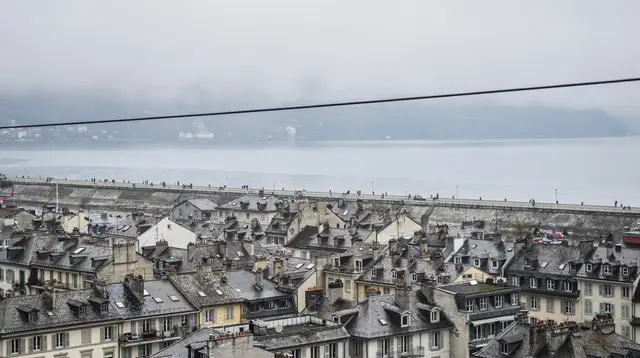
Geneva by Bike and E-Scooter: Flat Lakefront Rides
Is Geneva a good city for cycling or e-scootering?
Yes — central Geneva is flat, lake-level, and compact, so a bike or e-scooter comfortably covers the lakefront, Old Town, Bains des Pâquis and Carouge in a few hours with no significant climbing. Rental bikes and scooters are paid separately from the free Geneva Transport Card, which covers public transport only.
Most of the destinations covered on this site involve some climbing — a cable car up to a viewpoint, a winding mountain road, a funicular that does the hard work for you. Geneva itself doesn’t. The city sits right at lake level, at the western tip of Lac Léman, and its most interesting central districts — the lakefront, the Old Town, Bains des Pâquis, Carouge — are all within a few flat kilometres of each other. That combination makes Geneva one of the easiest cities in this region to see properly by bike or e-scooter, no fitness test required.
This guide covers what a typical ride looks like, what’s genuinely flat versus what has a short rise, how the free Geneva Transport Card fits in (and where it doesn’t), and where bike and e-scooter tours make sense versus renting and riding on your own.
Why Geneva works so well for two wheels
Central Geneva’s geography does most of the work. The city wraps around the point where the Rhône flows out of Lake Geneva, and its historic core and lakefront promenades sit at, or very close to, the water’s own elevation. Unlike Lausanne, twenty minutes up the lake, which is famously built on a series of hills and valleys, Geneva’s core neighborhoods present almost no meaningful gradient. A rider who wants to avoid effort can string together the lakefront, the flat approach to the Old Town, Bains des Pâquis and Carouge without hunting for a route around hills — because there mostly aren’t any.
That’s not true everywhere on this site. If you’re comparing Geneva to Lausanne’s bike and scooter routes, the difference is real: Lausanne’s rides are scenic but involve genuine climbs between the lakefront and the upper town, and e-bikes there are less a convenience than a near-necessity on some legs. In Geneva, an e-bike is a comfort upgrade, not a requirement — a standard rental bike or a shared e-scooter handles the terrain just as easily.
The classic route: lakefront, Jet d’eau, Old Town, Pâquis, Carouge
A typical self-guided or guided ride threads together Geneva’s best-known central sights in a loop of a few hours, almost entirely on flat ground.
Start on the lakefront promenades. The quays on both sides of the lake are wide, largely separated from traffic, and make for easy, scenic riding — glimpses of the Alps on a clear day, sailboats on the water, and a steady flow of walkers, joggers and other cyclists to share the space with.
Ride toward the Jet d’eau. Geneva’s landmark fountain, visible from much of the lakefront, is the natural anchor point of a lakefront ride. It’s worth knowing before you set out that it isn’t always running: the Jet d’eau is switched off in strong wind and near-freezing temperatures, and shut down for scheduled maintenance, so treat “photo with the fountain at full height” as a bonus rather than a guarantee. It also keeps shorter hours in winter than in summer. For more on the practical pattern, see when the Jet d’eau actually runs.
Detour into the Old Town. This is the one section of the ride where flat gives way to cobblestones and a few short slopes, particularly around St-Pierre Cathedral. Most riders dismount here and walk the bike through the historic core rather than ride it — the streets are narrow, pedestrian-heavy, and more rewarding explored on foot anyway. For a dedicated walking route through this part of the city, see the Old Town walking tours guide.
Continue to Bains des Pâquis. This bathing pier and public swimming spot on the lake, a short ride from the Old Town, is a good midpoint stop — a place to lock up, get a coffee, and watch the lake traffic before continuing.
Finish in Carouge. Geneva’s artisan district, sometimes called the city’s “Little Italy” for its Sardinian-influenced 18th-century architecture, sits a short ride south of the center across the Arve. It’s flat, walkable-scale, and dense with small workshops, boutiques and cafés — a relaxed final leg after the busier lakefront and Old Town sections. For more on exploring it on foot, see the Carouge walking tours guide.
Covered at an easy pace with stops, this loop typically takes two to four hours — comfortably shorter than a full day, and easy to compress into a half-day if you’re short on time, or stretch out with longer breaks at Bains des Pâquis or in Carouge.
What actually has a gradient
“Flat” doesn’t mean perfectly level everywhere. A few honest exceptions:
- The Old Town core, especially the streets climbing toward St-Pierre Cathedral, has real (if short) slopes and cobblestones — most riders walk this section.
- Streets set back from the lakefront, away from the water, can have gentle rises as the city grades up from the shoreline, though nothing like Lausanne’s hills.
- Longer rides out toward the countryside, such as vineyard or wine-region routes, introduce more rolling terrain than the central lakefront loop — the guided countryside e-bike option below is built with exactly that in mind.
For the central sightseeing loop described above, though, these are minor exceptions rather than the rule.
E-scooter versus bike: which to pick
Both cover the central loop equally well, so the choice mostly comes down to how far you plan to range and how much luggage or gear you’re carrying. A shared e-scooter suits short, single-purpose hops — lakefront to the Old Town edge, or Old Town to Bains des Pâquis — where you’ll dock it and walk the rest. A rental bike, standard or electric, is the better pick if you’re stringing together the full lakefront-to-Carouge loop in one outing, want a basket or pannier for bags, or plan to detour further out along the lake toward Nyon or Coppet. Neither requires much effort on Geneva’s flat core, so the practical difference is really about range and carrying capacity rather than fitness.
Both are typically available as walk-up rentals through dock-based or app-based operators around the city center and lakefront, with no advance booking needed for casual use — reserve ahead only if you’re set on a specific guided tour slot in peak season, as noted above.
Renting versus booking a guided tour
Casual bike and e-scooter rental is straightforward in central Geneva, and self-guided riding along the lakefront needs no special planning — the routes are well signed and hard to get lost on. A guided tour adds value in a few specific ways: a fitted e-bike so effort is never an issue, a set route that hits the Old Town, international district and lakefront without backtracking, and often skip-the-line or bundled entry to a sight along the way.
an e-bike tour through the Old Town that bundles in free museum entry covers this exact central loop with a guide, useful if you’d rather not plan the route yourself. For a version that swings past Geneva’s international institutions as well as the lakefront, an e-bike tour combining the United Nations district, Old Town and lake adds the Palais des Nations area to the standard route. Riders who want to get out of the city center entirely can look at a countryside e-bike route with wine tasting or a museum stop, which trades the flat lakefront for gently rolling vineyard country beyond the city.
Not every way to see central Geneva involves pedaling. a tuktuk tour focused on Geneva’s watchmaking heritage covers some of the same ground — lakefront, Old Town approaches — while sitting down, which is worth considering on a hot day or with less mobile travelers in the group.
A car for the vineyard day beyond Geneva
The lakefront, the Old Town and the international district are all easy on two wheels, so a car adds nothing while you stay in the centre. It only starts to make sense if you decide to leave the city for the vineyards and want to set your own pace instead of following a fixed tour.
In that case, hire the car for that single day and collect it after your bike days are done. Agree beforehand who will drive, because a tasting and a steering wheel do not go together, and the driver may prefer the museum stop. Check the fuel rule and the pick-up point before paying, and choose one that is easy to reach from where you sleep. For that vineyard day, you can look at car hire through Localrent in Switzerland.
Practical tips for riding in central Geneva
A few things worth knowing before you set off. Traffic along the main lakefront quays is generally light for cyclists thanks to dedicated paths, but Geneva’s city-center streets away from the water carry normal car and tram traffic, so treat the lakefront and pedestrian zones as the comfortable default and stay alert on any street shared with vehicles. Helmets aren’t mandatory for adult riders in Switzerland but are worth wearing regardless, and most rental operators can provide one on request.
Lock bikes or dock e-scooters properly at every stop — Bains des Pâquis and Carouge both get busy on weekends, and leaving a rental unattended and unlocked, even briefly, is asking for trouble. Mornings tend to be the most pleasant time to ride the lakefront loop, with softer light for photos of the Jet d’eau and the Alps beyond, and noticeably fewer pedestrians to weave around than in the afternoon.
If you’re combining a ride with one of Geneva’s other signature experiences, several guided options fold sightseeing into the route rather than treating it as a separate errand. a chocolate-focused Old Town tour that includes a boat ride covers the walking side of the Old Town at a slower pace with tastings built in, a natural pairing for a day that starts with a bike loop and ends on foot once the cobblestones make riding impractical. For a broader introduction that pairs the international district with the historic core, a city tour combining International Geneva and the Old Town is worth considering if you’d rather have the full lay of the land explained before setting out on two wheels.
What the Transport Card covers — and doesn’t
Visitors staying in registered Geneva accommodation receive a free digital Geneva Transport Card, valid on the Unireso network for the length of their stay. That covers city buses and trams (run by TPG), regional trains, and the small lake shuttle boats known as the “Mouettes” — including, usefully, the ride in from Geneva Airport.
It does not cover bike-share, e-bike rental or e-scooter rental. Those are booked and paid through separate rental operators or tour providers, on top of (or instead of) using the Transport Card for the rest of your stay. If your plan mixes a bike ride with public transport — say, riding the lakefront loop one day and taking the train out to Nyon or Lausanne the next — budget for the two separately. More detail on what the card includes is in what the Geneva Transport Card actually covers.
A quick note on Geneva’s status
It’s a common assumption worth correcting before you arrive: Geneva is not the capital of Switzerland. The Swiss federal capital is Bern. Geneva is a cantonal capital, Switzerland’s second-largest city, and its diplomatic hub — home to the UN’s European headquarters and hundreds of international organizations — but not the seat of the federal government. It doesn’t change how you’d plan a bike ride around the city, but it’s a fact that comes up often enough in conversation that it’s worth having straight. For more, see why Geneva isn’t the Swiss capital.
Planning your ride: a quick comparison
| Route section | Terrain | Typical time | Notes |
|---|---|---|---|
| Lakefront promenades | Flat | 30–45 min | Wide paths, shared with walkers and joggers |
| Jet d’eau approach | Flat | 15–20 min | Not always running — see note above |
| Old Town | Cobbled, short slopes | 30–45 min (walking) | Most riders dismount here |
| Bains des Pâquis | Flat | Stop as long as you like | Good midpoint break |
| Carouge | Flat | 45–60 min | Cafés, boutiques, relaxed pace |
| Option | Format | Good for |
|---|---|---|
| Self-guided rental | Ride at your own pace | Flexible timing, no fixed route |
| E-bike Old Town + lake tour | Guided, few hours | First-time visitors wanting the highlights covered |
| UN + Old Town + lake e-bike tour | Guided, few hours | Interest in International Geneva as well as sights |
| Countryside e-bike + wine tasting | Guided, half-day | Riders wanting to leave the city center |
| Watchmaking tuktuk tour | Guided, seated | Reduced mobility, hot weather, watch enthusiasts |
Getting oriented before you go
If Geneva is a stop on a longer itinerary, the one-day Geneva essentials itinerary covers how a bike loop fits alongside the city’s other headline sights, and the Geneva planning guide is a useful starting point for logistics beyond cycling — transport, timing, and what to prioritize on a short visit. For families weighing whether a bike ride works with kids in tow, the Geneva family guide has more specific guidance than this page can cover.
Frequently asked questions about biking and e-scootering in Geneva
Is Geneva flat enough for casual cyclists?
Yes. The lakefront, the approach to the Old Town, and the route down to Carouge all stay close to lake level with only gentle rises — unlike hillier Swiss cities such as Lausanne. It’s genuinely one of the easiest Swiss cities to cover by bike without much effort.
Does the Geneva Transport Card cover bike or scooter rental?
No. The free Geneva Transport Card, issued by registered hotels and hostels, covers Unireso public transport — buses, trams, regional trains and the lake shuttle boats — for your stay. Bike-share, e-bike and e-scooter rental are booked and paid separately.
Will the Jet d’eau definitely be running when I cycle past?
Not guaranteed. It’s switched off in strong wind, below around 2°C, and during maintenance, and runs shorter hours in winter than in summer. Plan to enjoy the lakefront ride regardless of whether the fountain happens to be on.
Is Geneva the capital of Switzerland?
No. Geneva is a cantonal capital and international hub, but the Swiss federal capital is Bern.
How long does a lakefront-to-Carouge ride take?
A relaxed loop from the lakefront through the Old Town to Bains des Pâquis and on to Carouge typically takes two to four hours at an easy pace, including stops.
Do I need a reservation for bike or e-scooter rental in Geneva?
Walk-up rental is usually possible, but booking a guided e-bike tour ahead is worth it in peak season, when popular time slots can fill up, and it guarantees a fitted bike and set route.
Is cycling in Geneva’s Old Town easy?
Not especially — the cobbled streets and short slopes near St-Pierre Cathedral are more comfortable walked than ridden. Most rides treat the Old Town as a walking interlude between flatter sections.
Bike and Scooter Tours
Verified deep-linked GetYourGuide tours. Book through these links and we earn a small commission at no cost to you.
GetYourGuide does not provide a product photo for this activity — the image shows the meeting point, photographed by us.