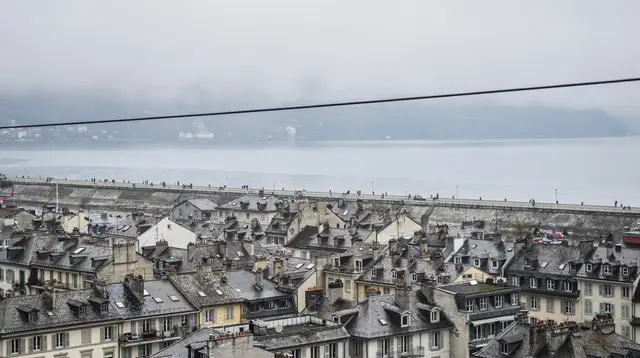
Lausanne by Bike and E-Scooter: Riding a Hillside City
Is Lausanne good for cycling or e-scootering?
Lausanne works well by bike or e-scooter, but it is genuinely hilly, not flat like Geneva, so electric assistance matters more than in most lakeside towns. The classic ride runs downhill from the old town to the lakefront at Ouchy, with the m2 metro line available to skip the climb back up.
Lausanne looks, on a map, like a simple lakeside city — but anyone who has walked from the railway station toward the water knows it is nothing of the sort. Built across a series of ridges cut by streams that have long since disappeared underground, Lausanne rises and falls in a way that catches visitors off guard, especially those arriving from flat, low-lying Geneva less than an hour away by train. That terrain is exactly what makes Lausanne interesting to explore by bike or e-scooter: the descent from the upper town to the lakefront is genuinely enjoyable, the electric assistance does real work on the way back up, and the city rewards a wheeled visit in a way a purely on-foot itinerary struggles to match in the same amount of time.
This guide is about riding Lausanne specifically — where the hills are, what the classic route looks like, how to handle the climb if it is more than you bargained for, and how this compares to two other rides in the region that get mentioned in the same breath: a flat cruise around Geneva, and a rural pedal through the vineyard terraces of Lavaux.
Why Lausanne’s hills change the equation
Geneva, at the western tip of Lake Geneva, sits on essentially flat ground along the water and a gentle rise into its old town — a city where a standard bike or a basic e-scooter gets the job done without much strain. Lausanne is a different proposition. The city centre sits roughly 150 metres above the lakefront district of Ouchy, and the streets connecting the two are not a single gentle slope but a series of genuine climbs and descents, some steep enough that even confident cyclists downshift.
This matters for anyone planning to ride here. A standard rental bike will get you down to the lake without any trouble at all — gravity does the work. Getting back up is another matter, and it is the point at which a lot of visitors on non-electric bikes decide to walk the last stretch, or abandon the idea of riding back altogether. An e-bike or e-scooter with reasonable battery charge removes that problem almost entirely, which is why electric assistance is worth prioritising here far more than it would be in a flat town.
The classic route: old town to Ouchy
The standard ride follows the natural shape of the city. Most people start near Saint-François square, Lausanne’s central hub and a natural meeting point for rentals and tours, or a little further up near the cathedral, which sits on one of the city’s highest points and offers a preview of the descent ahead. From there, the route drops through a mix of streets, staircases-turned-ramps, and green spaces down toward Ouchy, the lakefront district with its promenade, small harbour, and open views across the water toward the French shore.
The descent itself is short — well under an hour of actual riding at an easy pace, even with stops — but it covers a real change in elevation, and riders should expect braking more than pedalling on the way down. Ouchy is a natural place to pause: the promenade is flat and pleasant to wander, there are lakefront cafés, and boats depart from here for excursions across the lake, including toward Évian-les-Bains on the French shore.
The return leg is where the character of the ride changes. Climbing back to Saint-François or the cathedral on a standard bike is a serious effort — this is not a casual pedal, and visitors who are not regular cyclists often find it more taxing than expected. This is the single biggest difference between riding Lausanne and riding almost anywhere else around the lake, and it is worth planning for rather than discovering partway up a hill.
Skipping the climb: the metro option
Lausanne has a genuine escape hatch for the uphill return: the m2 metro line, which runs directly between Ouchy and the upper town, including the main railway station, with several stops in between. Outside the busiest commuting hours, compact bikes and scooters can often be brought aboard, making it entirely possible to ride down through the city, enjoy the lakefront, and then let the metro carry both you and your equipment back up rather than fighting the gradient a second time.
This is not a guarantee — capacity and rules can vary by time of day and how busy the carriages are — but it is the standard workaround locals and repeat visitors use, and it is worth building into any plan from the outset rather than treating it as a last resort. For visitors who are not confident on a bike or scooter under load, or who are simply not looking for a workout, riding down and metro-ing up is the most realistic way to see both halves of the city on wheels without the return climb dominating the experience.
Guided or self-guided
Two approaches work in Lausanne, and which one suits you depends on how much you want commentary versus flexibility.
A guided city tour on bike or scooter, such as the photogenic city tour that threads through Lausanne’s most scenic corners, sets the route and pace for you and typically includes some narration about what you are passing — useful for a first visit when you would otherwise spend time figuring out where to go. It also tends to come with equipment already sorted, which removes the availability question entirely.
Riding self-guided means renting independently and following your own route, stopping wherever looks interesting, and adjusting on the fly if the hills prove tougher than expected. This suits visitors who already have a sense of the city, or who would rather explore loosely than follow a fixed plan. If self-guided riding does not appeal and you would rather walk the same ground on foot, a guided walking tour of the old town or a private guided walking tour of the city covers similar ground at a pace with no gears to worry about.
Bike or e-scooter: which suits Lausanne better
Both options exist in Lausanne, and the choice matters more here than in a flat city because the terrain punishes the wrong pick. An e-bike keeps the pedalling motion, which most riders find more natural on a long, winding descent where balance and control matter as much as speed — the pedals give a point of reference the legs understand, even when the motor is doing most of the work on the way back up. An e-scooter is lighter, easier to dismount and carry up a flight of steps if the route narrows, and quicker to pick up and drop off if you are only riding one direction, but its smaller wheels are less forgiving on the cobbled sections around the old town and on some of the older stepped streets that lead toward the cathedral.
Neither is clearly better across the board. Visitors planning to ride down and take the metro back tend to prefer scooters, since a compact scooter is easier to fold or wheel onto a carriage than a full-size bike. Visitors who want to ride both directions, or who plan to continue along the lakefront toward Ouchy’s boat departures and back, generally get more comfort out of an e-bike’s steadier ride and better traction on the climb. If you already know which format you prefer from riding elsewhere, that preference should carry over here; if you have never tried either, a short guided outing is a lower-stakes way to find out than committing to a full self-guided loop on unfamiliar streets.
Best time of day to ride
Lausanne’s hills are more forgiving in cooler conditions, and the difference is noticeable enough to plan around. Riding the climb back from Ouchy in the middle of a hot summer afternoon is a different experience from doing the same stretch in the morning or early evening, even with electric assistance doing most of the work — battery drain is faster under sustained heat and heavy use, and the sun exposure on some of the more open uphill stretches adds to the effort. Mornings also tend to have quieter streets around the station and Saint-François square, before pedestrian traffic builds up in the old town, which makes the initial descent easier to navigate without weaving around crowds.
There is a practical rental angle too: arriving early improves the odds of finding equipment at the busiest pickup points, since fleets that run short later in the day — described above — are usually still fully stocked first thing. A rider who starts by mid-morning, spends an unhurried stretch at Ouchy, and rides or metros back before the late-afternoon lull gets a smoother version of the same route than one squeezed into a hot midday window.
Rental availability: don’t assume it
It is tempting to assume a city the size of Lausanne always has bikes and scooters on hand, but rental fleets — whether dockless, app-based, or through a fixed rental point — are finite, and popular pickup spots near the station or Ouchy can run short during busy periods: summer weekends, local events, or simply mid-afternoon on a sunny day when demand peaks. This guide will not promise that equipment will be waiting for you without any planning; it is worth checking a rental app for real-time availability before setting out, or booking a guided option in advance if the date matters.
Lausanne is not flat — and that’s not a flaw
It is worth stating plainly, because it trips up visitors who ride Geneva first and expect the same experience: Lausanne is not a flat lakeside town, and no honest guide should promise a level ride here. The hills are real, they are part of what gives the city its layered, terraced character, and treating them as a minor inconvenience rather than planning around them is the most common way a Lausanne bike outing goes wrong. Choose electric assistance if there is any doubt about fitness, and keep the metro option in mind as a genuine plan B rather than an afterthought.
Getting there from Geneva
Lausanne sits on the Swiss shore of Lake Geneva, connected to Geneva by direct trains that take a little under an hour and run frequently throughout the day, making this an easy and comfortable day trip. It is worth being clear about the geography here, since the lake has shores on both sides of the Franco-Swiss border: Lausanne is Swiss, priced in Swiss francs, on the northern shore — not to be confused with towns like Thonon-les-Bains or Évian-les-Bains across the water in France, which use the euro and sit on the opposite, French shore.
For visitors combining a ride with other things to see, Lausanne’s old town, cathedral and lakefront museums are all within reach of the same route, and a boat trip from Ouchy is an easy add-on — the three-hour cruise along the Riviera and Lavaux region departs from the same harbour where the downhill ride ends, making it a natural way to rest your legs after the descent.
Lausanne versus Geneva versus Lavaux, for this kind of ride
The following comparison is worth reading before choosing where to ride, since the three options nearby differ more than they might seem to on a map.
| Terrain | Setting | Electric assistance | |
|---|---|---|---|
| Geneva | Flat | Urban lakefront and old town | Helpful but not essential |
| Lausanne | Steep, layered hills | Urban, station to lakefront | Strongly recommended |
| Lavaux | Gentle rural slopes | Vineyard terraces between towns | Useful, not decisive |
Riders looking for an easy, low-effort pedal along the water should look to Geneva’s bike and scooter routes instead, where the ground barely tilts. Riders drawn to open countryside and vine-covered terraces rather than city streets should look at cycling through Lavaux, which trades Lausanne’s urban descent for a quieter, rural gradient between villages. Lausanne itself is the pick for visitors who specifically want a city ride with genuine elevation change, sweeping views opening up as the road drops toward the water, and a clear sense of the city’s layered geography that walking alone conveys more slowly.
Planning a Lausanne visit around the ride
A bike or scooter outing pairs naturally with the rest of what Lausanne offers. The cathedral and old town sit at or near the top of the route, so a stop to look around before or after the descent costs little extra effort. Ouchy, at the bottom, has enough on its own — a lakefront promenade, small harbour, cafés, and boat departures — to justify lingering rather than immediately turning back. Visitors who want a fuller sense of the city beyond the ride itself can look at the broader Lausanne day trip guide for how to structure a full day, or a traditional food walking tour for a slower-paced way to see the same streets with a meal built in.
For those extending beyond Lausanne itself, the city is also a launch point for excursions further into the Alps — the day trip to Glacier 3000 and Les Diablerets from Lausanne is a popular add-on for visitors staying more than a day, and reaching the Riviera towns of Montreux and Vevey is straightforward from the same station where a Lausanne ride typically begins or ends.
Whichever way you approach it — guided or independent, cycling or scootering, riding both directions or taking the metro home — the point to hold onto is simple: Lausanne is a hillside city built around a lake, not a lakeside city that happens to have a hill. Plan for the climb, and the ride down becomes one of the more memorable ways to see it.
Bike and Scooter Tours
Verified deep-linked GetYourGuide tours. Book through these links and we earn a small commission at no cost to you.
GetYourGuide does not provide a product photo for this activity — the image shows the meeting point, photographed by us.