Lausanne Museums and Landmarks: The Olympic City on Lake Geneva
What are the must-see museums and landmarks in Lausanne?
Lausanne's headline sights are the Gothic Notre-Dame Cathedral and its hilltop Old Town, the Escaliers du Marché stairway linking the old city to the lakefront, and the Olympic Museum in the lakeside district of Ouchy. Together they give Lausanne a very different character from Geneva, about 40-50 minutes away by train.
A hillside city with its own identity
Lausanne sits on the Swiss, northern shore of Lake Geneva, roughly 40 to 50 minutes from Geneva by train depending on the service. That’s close enough for an easy day trip, but Lausanne is not a miniature Geneva and it isn’t a quick add-on to a Geneva itinerary. It’s a genuinely hilly city, built in tiers running down from a cathedral-topped ridge to a lakeside port, and its landmarks are spread across those levels in a way that rewards a half-day or full day rather than a rushed hour between trains. If your mental map of the region lumps every lakeside town together, Lausanne is the one that will correct it fastest: it has its own cathedral, its own Old Town, its own funicular-fed metro, and — thanks to being headquarters of the International Olympic Committee — an entire museum devoted to the Olympic Games that has no counterpart anywhere in Geneva — not even in Geneva’s own Old Town.
This guide focuses on what to actually see and how the pieces fit together: the Gothic cathedral and the Old Town around it, the historic stairway that ties the upper and lower town together, and the Olympic Museum down at the lakefront in Ouchy. For a same-day comparison of how Lausanne differs from its smaller lakeside neighbour, see our guide to Vevey’s museums and landmarks; for a step-by-step day itinerary, our Lausanne day trips guide lays out timing in more detail.
Getting there and the one thing to get right
Lausanne is reached from Geneva by regular Swiss Federal Railways (CFF/SBB) trains, and journey times generally fall in the 40-to-50-minute range depending on whether you catch a direct InterCity service or one with a stop or two. It’s worth checking the timetable for the specific day you travel rather than assuming a fixed number — some runs are faster, some slower, and connections can add time.
The one thing worth being clear about before you go: Lausanne’s trains are not part of the same city transport network as Geneva’s buses, trams and Unireso system. It’s a separate SBB rail journey requiring its own ticket (or coverage from a Swiss travel pass, if you’re carrying one), not an extension of a Geneva-area transit pass. Once you arrive at Lausanne’s main station, the city itself has its own local metro line — the M2 — which is genuinely useful for covering the vertical distance between the station, the Old Town, and the lakefront at Ouchy, since Lausanne’s terrain is steep enough that walking every leg on foot, while entirely possible, adds real time to a visit.
The Old Town and Notre-Dame Cathedral
Lausanne’s Old Town sits on a ridge above the lake, arranged around Place de la Palud and the cathedral square. Narrow streets, a 15th-century town hall, and a lively covered market (on market days) give the upper town a compact, walkable core that’s easy to explore without a plan — though a guided walk is a good way to catch details a casual pass misses; a guided walk through the Old Town covers this part of the city with a local guide who can point out what’s easy to miss on your own.
Presiding over it all is the Cathédrale Notre-Dame de Lausanne, widely considered one of the finest examples of Gothic architecture in Switzerland, dating largely from the 13th century. The nave itself is free to enter, and its rose window and carved portal are worth lingering over. Climbing the cathedral’s tower for a view over the rooftops and the lake beyond is a separate, paid activity with its own more limited hours — factor that in if a tower climb matters to your visit, since it isn’t automatically included with a look inside the nave.
The Escaliers du Marché: the stairway that explains the city
If one single feature captures how Lausanne is built, it’s the Escaliers du Marché — a covered wooden staircase, with sections dating back to the 1700s, that climbs directly from the lower town near Place de la Palud up to the cathedral square. Walking it costs nothing and takes only a few minutes, but it’s the clearest, most physical way to understand Lausanne’s layout: a city stacked in levels rather than spread across a flat grid. Locals still use the stairs as a genuine shortcut, not just a photo stop, and the covered wooden structure itself — worn smooth by centuries of foot traffic — is a minor landmark in its own right.
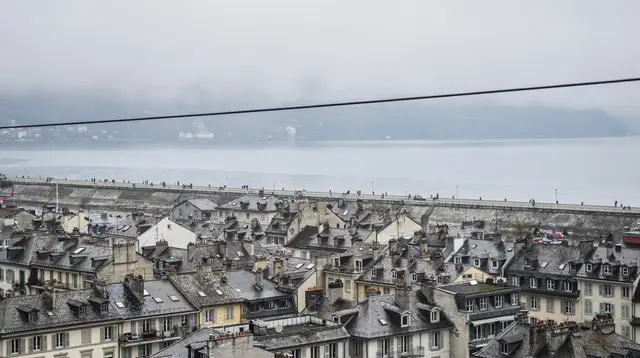
From the top of the stairs, the cathedral square opens out with a view back down over the rooftops toward the lake, which is a useful orientation point before continuing to explore either the Old Town above or the lakefront districts below.
Down at the water: Ouchy and the Olympic Museum
Ouchy, Lausanne’s lakeside port district, sits at the bottom of the hill and has a completely different feel from the Old Town above — palm-lined promenades, a small marina, and boats departing across the lake. It’s reachable from the upper town by the M2 metro line in a few minutes, or on foot downhill in twenty to thirty.
The headline attraction at Ouchy is the Olympic Museum, run by the International Olympic Committee, which has been headquartered in Lausanne since the 1910s — the reason the city carries the informal title “Olympic Capital.” The museum traces the history of the modern Games through torches, medals, athlete equipment and interactive exhibits, set in a building and garden directly on the lakefront. It’s a paid, standalone attraction, worth budgeting a couple of hours for on its own, and it has no equivalent anywhere in Geneva — a genuine point of difference between the two cities, since Geneva’s international institutions (the Palais des Nations, the Red Cross Museum) cover a different kind of history entirely.
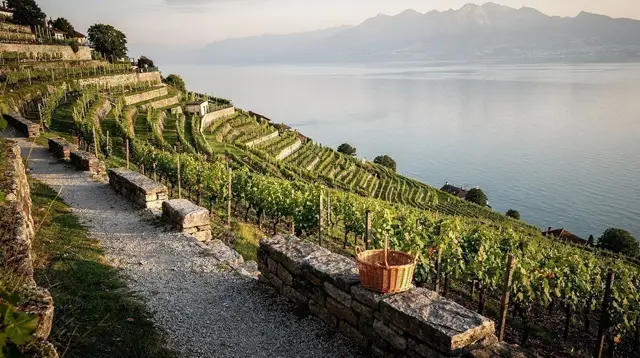
From Ouchy’s harbour, boats also depart for lake crossings and longer cruises; a three-hour cruise along the Riviera and Lavaux vineyard coastline is a scenic way to see the terraced Lavaux vineyard shoreline toward Montreux from the water, and a self-guided boat trip across to Évian-les-Bains makes for an easy half-day crossing to the French shore, with the currency switch from francs to euros as a reminder you’ve left Switzerland. For more on getting out onto the water from Lausanne, our Lausanne lake cruises guide covers the full range of departures, and travellers continuing further along the Swiss shore can also read up on Château de Chillon, the lakeside castle near Montreux.
Lausanne versus Vevey: two different lakeside personalities
It’s easy to blur Lausanne together with the smaller towns further along the lake, but the contrast with Vevey — about fifteen minutes further by train — is a useful way to tell them apart. Lausanne is urban and vertical: a real Swiss city of well over 100,000 people, with a cathedral, a metro system, university campuses, and an Olympic identity built around the IOC’s headquarters. Vevey, by contrast, is smaller and more intimate, shaped by its history as headquarters of a major food company and by its Charlie Chaplin connections rather than by international sport. If your time only allows one lakeside stop beyond Geneva, deciding between “city with landmarks and museums” (Lausanne) and “compact, food-and-film-flavoured town” (Vevey) is the real question — our Vevey museums and landmarks guide covers that side of the comparison in full.
Beyond the city: a mountain excursion from Lausanne
Lausanne is also a practical launch point for reaching higher ground without going all the way to Chamonix or Zermatt. A day trip to Glacier 3000 above Les Diablerets combines a scenic mountain cable car with genuine glacier and alpine scenery, departing directly from Lausanne rather than requiring a detour back through Geneva first — useful if Lausanne is your base for a night or two rather than a same-day round trip.
Other ways to see the city
Beyond the cathedral, the stairway and the Olympic Museum, a handful of tour formats suit different paces. A photogenic city tour is built around the most visually striking corners of the Old Town and lakefront, useful if photography is part of the point of your visit. For a slower, more personal pace, a private guided walking tour lets you set the route and linger where you like, whether that’s the cathedral, the market stairs, or the lakefront at Ouchy, and a traditional food walking tour pairs the sightseeing with tastings along the way — a good option if a proper Swiss meal is on the agenda for the day — our Lausanne food tours guide has more on that front, and chocolate lovers can check our Lausanne chocolate tours guide for a sweeter angle on the same neighbourhoods.
Anyone planning to combine several paid sights in one visit should also glance at our Lausanne passes and tickets guide, which covers whether a combined ticket makes sense for the cathedral tower and the Olympic Museum together. For a broader look at guided options around the Old Town, cathedral and lakefront, our Lausanne walking tours guide rounds up the full range.
Practical notes for visiting Lausanne’s landmarks
| Landmark | Cost | Time needed |
|---|---|---|
| Old Town streets and squares | Free | 1-2 hours |
| Notre-Dame Cathedral (nave) | Free | 30-45 min |
| Cathedral tower climb | Paid, separate ticket | 20-30 min |
| Escaliers du Marché | Free | 5-10 min to walk |
| Olympic Museum, Ouchy | Paid | 2-3 hours |
| Ouchy waterfront and marina | Free | 30-60 min |
A realistic day in Lausanne pairs the Old Town and cathedral in the morning with Ouchy and the Olympic Museum in the afternoon, using the M2 metro to move between levels rather than walking every stretch uphill. Trying to compress all of it into a single hour on the way to somewhere else isn’t realistic — the terrain alone works against it. For a fuller day-by-day plan that fits Lausanne alongside other lakeside stops, see our one-day Lausanne and Lavaux itinerary, and for wider context on the lake’s Swiss shore, our Lausanne day trips guide and Lausanne lake cruises guide cover the surrounding options in more depth.
Frequently asked questions about Lausanne’s museums and landmarks
How far is Lausanne from Geneva?
By train it’s roughly 40 to 50 minutes, depending on which service you take. Frequent trains run throughout the day, but it’s a separate rail journey requiring its own ticket, not a same-network extension of Geneva’s city transport.
Can Lausanne be visited in a single hour or as a quick stopover?
No. Lausanne is built on a hillside, with the Old Town, cathedral and lakefront district of Ouchy spread across distinct levels connected by stairs, streets and a short metro line. Seeing the cathedral, the old city and Ouchy properly takes a half-day at minimum, and a full day if the Olympic Museum is included.
Is Lausanne on the same side of Lake Geneva as Geneva?
Yes, both are on the lake’s Swiss, northern shore, unlike the French towns of Yvoire, Thonon-les-Bains and Évian-les-Bains, which sit across the water on the French side. Lausanne and Geneva share a shoreline but are separate Swiss cities roughly 60 km apart by road.
What is the Olympic Museum and where is it?
It’s the International Olympic Committee’s museum, tracing the history of the modern Games through exhibits, torches, medals and athlete memorabilia, and it sits directly on the lakefront in Ouchy, Lausanne’s port district. It’s a paid, standalone attraction with no equivalent in Geneva itself.
What is the Escaliers du Marché?
It’s a covered wooden stairway, parts of it dating from the 1700s, climbing from the lower town up to the cathedral square. Walking it is free and is one of the most direct ways to feel the hillside layout that defines Lausanne’s Old Town.
Is Lausanne better than Vevey for a day trip from Geneva?
They suit different moods rather than one being simply better. Lausanne is urban, hillside and Olympic-themed, with a bigger cathedral and more museums; Vevey, a short ride further along the lake, is smaller and quieter, known for its food-industry heritage and Chaplin connections.
Do I need a ticket to climb Lausanne Cathedral’s tower?
The cathedral nave is free to enter, but climbing the tower is a separate, ticketed activity with its own opening hours, which are shorter than the cathedral’s own hours and vary by season.
Is Lausanne expensive compared to Geneva?
Lausanne is priced in Swiss francs like Geneva and sits in a similar bracket for food, coffee and museum tickets, though it doesn’t carry quite the same reputation for extreme prices as Geneva’s most central districts.
Museums and Landmarks
Verified deep-linked GetYourGuide tours. Book through these links and we earn a small commission at no cost to you.
GetYourGuide does not provide a product photo for this activity — the image shows the meeting point, photographed by us.