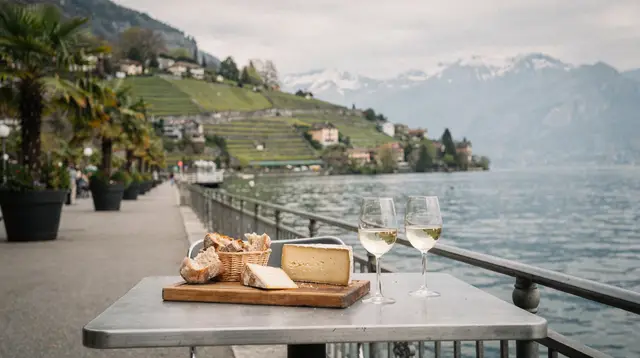
Lausanne Food Tours: A Gourmet Walk Through the Vaud Capital
Is Lausanne worth a food-focused day trip from Geneva?
Yes. Lausanne is about 45 minutes to 1 hour from Geneva by train, with a compact but steeply hilly Old Town, a Wednesday and Saturday market at Place de la Palud, and the reconverted Flon district for casual dining. A half-day covers the market and Old Town; a full day allows time to add the Lavaux vineyards nearby.
Why Lausanne, not just Geneva
Most visitors to Lake Geneva never leave Geneva itself, or they save the rest of the lakeshore for a quick glance at Montreux and Château de Chillon. Lausanne gets skipped in between — which is a mistake for anyone interested in food. Lausanne sits on the Swiss shore of the lake, in the canton of Vaud rather than the canton of Geneva, about 45 minutes to 1 hour away by direct train from Geneva. It has its own market, its own culinary habits, and a very different physical character: where Geneva’s Old Town is compact and largely walkable on the flat, Lausanne is a city stacked on hills, with a Gothic cathedral perched above everything else and streets that genuinely climb.
That elevation is not incidental to a food-focused visit — it shapes how the day works. A market crawl through Place de la Palud, a wander through the reconverted Flon district, and a climb up to the cathedral quarter add up to real physical effort, not a flat stroll between cafés. Lausanne also carries an identity Geneva doesn’t quite have: as the seat of the International Olympic Committee and home to a large student and research population (EPFL and the University of Lausanne both sit nearby), the food scene skews younger and more international than the more formal, internationally diplomatic tone of central Geneva.
This guide sets out a gourmet half-day to full-day route through Lausanne, anchored on the Place de la Palud market, the Flon district, and the Old Town around the cathedral, with an honest look at what it takes to extend the day into the Lavaux vineyards for wine tasting.
Getting to Lausanne from Geneva
Trains between Geneva and Lausanne run frequently — roughly every 15 to 20 minutes on the main line along the lake — and the journey takes about 45 minutes to 1 hour depending on the service. It’s one of the easiest connections in the region, with no need to book ahead in most cases. For a food-focused day, an early or mid-morning departure from Geneva works well, since it lands you in Lausanne in time for the market, which runs mornings on Wednesdays and Saturdays and is genuinely worth timing your visit around.
Lausanne’s main train station, Lausanne-Gare, sits below the Old Town and the market square, so the first thing most visitors do on arrival is start climbing. The city’s m2 metro line and a series of outdoor escalators connect the lower and upper parts of town, and using them rather than trying to walk every incline is a reasonable way to save energy for the eating part of the day.
Place de la Palud: the market at the center of the day
Place de la Palud is Lausanne’s historic market square and the natural starting point for a food-oriented visit. On Wednesday and Saturday mornings, stalls fill the square with produce, cheese, charcuterie, bread and prepared food from across the canton of Vaud — a different, more rural hinterland than Geneva’s largely urban and cross-border food supply. The square itself is worth lingering in even outside market hours: it holds the ornate 16th-century Fontaine de la Justice and Lausanne’s animated astronomical clock, the Lausanne-Moudon, whose figures perform on the hour.
A market crawl here works best with an empty stomach and a willingness to buy in small quantities from several stalls rather than a single big lunch — a wedge of Gruyère or a local Vaud cheese from one stall, saucisson vaudois or another regional charcuterie from another, seasonal fruit or vegetables from a third. It is also where the trip’s Vaud-specific dishes are easiest to encounter: papet vaudois, a leek-and-potato stew traditionally served with saucisson, is a canton specialty distinct from the fondue and raclette associated more broadly with Swiss mountain regions.
A guided food walking tour through Lausanne’s market and historic streets is the most efficient way to do this well on a first visit — it adds context on what’s being sold, arranges tastings that a solo walk-through wouldn’t easily produce, and keeps the pace realistic given the climb ahead.
Climbing to the cathedral and the Old Town
From Place de la Palud, the route into Lausanne’s Old Town leads upward toward Lausanne Cathedral, a Gothic building perched at the highest point of the historic center and one of Switzerland’s most significant medieval churches. The climb is steep enough that a night watchman still calls the hours from the cathedral tower, a tradition that has continued for centuries and is one of the small details that separates Lausanne from a flatter lakeside town.
The Old Town streets around the cathedral are narrow, cobbled and genuinely hilly — this is not a district to attempt on tired legs after a heavy lunch, which is one reason to front-load the market tastings and treat the cathedral climb as the day’s midpoint rather than an afterthought. From the cathedral terrace, the view stretches over the rooftops of the Old Town down toward the lake, with the French shore and, on a clear day, the Alps visible beyond.
For visitors who want a structured walk that ties the market, the cathedral, and the surrounding Old Town together with commentary, both a guided walking tour of Lausanne’s Old Town and a private guided walking tour with a local guide cover this ground, the second better suited to a family or small group wanting a pace and focus tailored to them rather than a fixed group itinerary.
Flon: Lausanne’s reconverted food and nightlife district
Downhill from the Old Town, on the opposite side from the lake, sits Flon — a former industrial and warehouse quarter that has been reconverted since the early 2000s into one of Lausanne’s most active districts for restaurants, bars and casual dining. Flon is reached from the upper town by outdoor escalators or by the automated m2 metro line, both of which make the elevation change between the two districts manageable without a long walk around.
Where the Palud market and Old Town lean toward traditional Vaud produce and historic architecture, Flon is the district that reflects Lausanne’s younger, more international character — a mix of casual eateries, bars and food spots shaped by the city’s large student population and its role as an Olympic and research hub. It’s a natural place for an early dinner or an afternoon coffee break after the climb to the cathedral, and it’s largely car-free and easy to wander without a fixed plan.
Extending the day: Lavaux and the vineyards
For visitors with a full day rather than a half-day, Lausanne sits right at the western edge of the Lavaux vineyard terraces — the UNESCO World Heritage-listed stretch of steeply terraced vines running along the lakeshore toward Vevey and Montreux. It’s tempting to assume Lavaux can be tacked onto the end of a Lausanne food tour as a quick stop, but that undersells what’s actually there: the terraces are extensive, the paths between villages involve their own elevation changes, and a proper tasting visit takes real time, not a rushed final hour before the last train back to Geneva.
The most efficient way to combine both in one day is by water. A 3-hour cruise along the Riviera and Lavaux region from Lausanne takes in the vineyard terraces from the lake itself, giving a sense of the scale of Lavaux without requiring a separate return trip on foot. Visitors who want to walk the terraces properly and taste wine at a producer are better served treating Lavaux as its own outing on a different day — see the dedicated guide to Lavaux’s vineyards and wine tasting for that version of the day.
A sample gourmet itinerary
| Time | Stop | What to do |
|---|---|---|
| Morning (arrive ~9-9:30am) | Place de la Palud | Market browsing and tastings (Wed/Sat only) |
| Mid-morning | Old Town climb | Walk or escalator/metro up toward the cathedral |
| Late morning | Lausanne Cathedral | Visit the Gothic cathedral and terrace views |
| Early afternoon | Old Town streets | Lunch at a bistro near the cathedral quarter |
| Afternoon | Flon | Coffee, browsing, or an early dinner in the reconverted district |
| Late afternoon (optional, full day only) | Lake cruise | Riviera and Lavaux cruise from the Lausanne waterfront |
This works comfortably as a half-day focused on the market, Old Town and Flon, or as a full day once the Lavaux cruise or a return train delay is factored in. Either way, it’s worth building in slack for the climb between the lower and upper town — Lausanne rewards a slower pace far more than a rushed checklist.
What sets Lausanne apart from Geneva and Montreux
It’s worth being explicit about why Lausanne earns its own food-focused day trip rather than being folded into a Geneva or Montreux itinerary. Geneva is flatter, more internationally diplomatic in tone, and sits in its own canton; Montreux, further along the lake, is smaller and more resort-like, built around its waterfront promenade and its proximity to Château de Chillon. Lausanne is a working Swiss city in its own right — the capital of the canton of Vaud, seat of the International Olympic Committee, and home to a substantial student population — with a market culture, an Old Town built on a genuine hill, and a reconverted industrial district that neither Geneva nor Montreux quite has an equivalent of.
For a traveler based in Geneva who has already covered the Old Town, the Jet d’eau and International Geneva, or who wants a lakeside day that isn’t simply “more Geneva,” Lausanne offers a distinctly different city on the same lake, under an hour away.
Practical notes for a Lausanne food day
Plan around the market days if the Place de la Palud market is the priority — Wednesday and Saturday mornings only, so a Sunday or Monday visit misses it entirely and should lean more heavily on Flon and Old Town restaurants instead. Wear comfortable shoes suited to hills and cobblestones, not just flat city walking, and budget more time than a map’s straight-line distances suggest, since the elevation between the lakeside, the market square, the cathedral and Flon adds real walking time on top of the horizontal distance.
Prices in Lausanne are in Swiss francs, the same currency as Geneva, and dining costs run broadly similar to Geneva’s — Switzerland-wide, expect a simple lunch in the CHF 20-30 range and a sit-down dinner higher, with no tip expected since service is included by law. This is a different pricing reality from the euro-denominated towns across the French border, such as Annecy or Évian-les-Bains, which run noticeably cheaper for comparable meals.
For visitors extending beyond food into a broader city visit, a photogenic city tour of Lausanne pairs well with a market morning, covering the visual landmarks — the cathedral, the Old Town streets, the lakefront at Ouchy — that a food-focused route alone doesn’t always reach.
Where to go next
A Lausanne food day pairs naturally with a broader look at day trips from Lausanne, a deeper dive into Lausanne’s Old Town on foot, or a chocolate-focused route through the city’s confectioners covered in the Lausanne chocolate tours guide. Those who want to weigh Lausanne against other Lake Geneva bases before committing a day to it can also read Geneva versus Zürich: which to visit for a wider sense of how Swiss cities compare, or consult the Lavaux vineyards wine guide before deciding whether to extend the day east along the terraces.
However the day is assembled, the core of it stays the same: start at the market, climb to the cathedral, drop into Flon, and treat Lavaux as a genuine extension rather than an afterthought — Lausanne’s food identity is built on that mix of market produce, altitude and reinvented industrial space, and rushing any one part of it is the easiest way to miss what makes the city different from its lakeside neighbors.
Geneva Food Tours
Verified deep-linked GetYourGuide tours. Book through these links and we earn a small commission at no cost to you.
GetYourGuide does not provide a product photo for this activity — the image shows the meeting point, photographed by us.