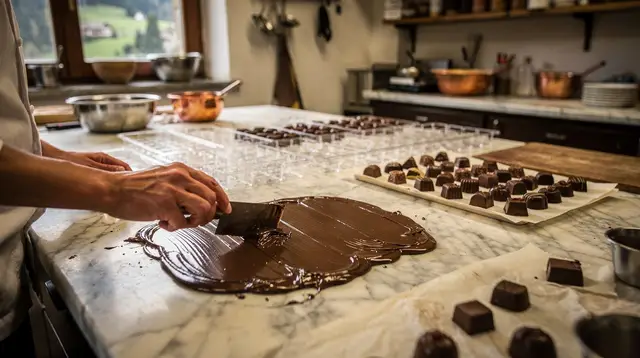
Chocolate Tours in Lausanne
Is Lausanne a good place for a chocolate tour?
Yes, though Lausanne is better framed as a chocolate stop within a lively university city than as a chocolate destination in its own right. Its compact old town holds several artisan chocolatiers and guided tastings, and the city sits about 45 minutes to an hour by train from Geneva, making it an easy add-on to a day that also takes in Lake Geneva or continues toward Montreux.
Chocolate as a reason to stop in Lausanne, not the reason to go
Lausanne rarely tops a list of Swiss chocolate destinations the way Gruyères or Zürich might, and that is roughly accurate. What Lausanne offers instead is a compact, walkable old town on a steep hillside above Lake Geneva, with a handful of genuinely good artisan chocolatiers tucked into its streets and arcades — the kind of shops locals actually use, not a manufacturing site built for tour buses. For a visitor coming from Geneva, that makes chocolate less a standalone trip and more a reason to build in an extra hour or two on a day that is already headed toward the lake, the cathedral steps, or onward to Montreux.
This page treats Lausanne’s chocolate scene on those terms: as a stop inside a lively university city, positioned about 45 minutes to an hour from Geneva by train, and easy to fold into a day trip rather than requiring a special journey of its own. If you want a factory tour with conveyor belts and viewing galleries, that experience belongs elsewhere in this region — Lausanne’s version is smaller, shop-based, and closely tied to the streets around it.
Getting to Lausanne from Geneva
Trains between Geneva and Lausanne run on the Swiss CFF/SBB network, with frequent direct departures throughout the day and a journey time of roughly 45 minutes to an hour depending on the service. That schedule makes Lausanne genuinely feasible as a half-day add-on: leave Geneva mid-morning, spend two to three hours in the old town including a chocolate stop, and either continue toward Montreux and Château de Chillon or head back to Geneva by early evening.
It’s worth being precise about this, because the three lakeside towns often get bundled together in trip planning. Lausanne’s rail time from Geneva is not identical to Montreux’s — Montreux sits further along the lake and takes longer to reach — so a day built around “Lausanne and Montreux chocolate” should budget separate legs rather than assuming one quick hop covers both. For the fuller picture of stringing these towns together, see Lausanne day trips and Montreux day trips.
What “chocolate tours” actually means in Lausanne
There is no single large chocolate factory open for public tours inside Lausanne. What exists is a cluster of independent chocolatiers in and around the old town, some offering their own small tastings, plus a handful of guided walking tours that link several shops together with commentary on Swiss chocolate-making and Lausanne’s food history along the way. These guided formats tend to run two to three hours, cover a short, walkable loop through the old town, and include tastings at multiple stops rather than a single sit-down demonstration.
That distinction matters for expectations. A chocolate tour here is closer in spirit to a food walk than an industrial visit — more about tasting a variety of pralines, truffles, and local specialties while moving through Lausanne’s steep, photogenic streets than about watching chocolate get made from bean to bar. If a factory-style visit with production lines is what you’re after, Gruyères’ dairy-focused site is a better comparison point for that kind of format, even though its own focus is cheese rather than chocolate.
a guided chocolate tasting and walking tour through Lausanne’s old town is the most direct way to sample several shops at once with a local guide explaining what makes each one distinct, rather than working it out shop by shop on your own.
Lausanne’s old town: the natural setting for a chocolate stop
Lausanne’s old town climbs a hillside above the lake in a series of steep streets, covered stairways, and small squares, with the Gothic cathedral anchoring the highest point. Because the chocolate shops sit within this same compact area, a tasting stop rarely requires a detour — it slots naturally into a walk that also takes in the cathedral’s viewpoint, the arcaded streets of the Palais de Rumine area, and the market squares that fill several mornings a week.
This is a meaningful difference from how chocolate tourism works in some other towns in the region. In Gruyères, the chocolate and cheese sites sit somewhat apart from the medieval town itself; in Lausanne, the shops are woven directly into the everyday fabric of a working city center, mixed in among bookshops, cafes, and university-adjacent businesses. The result feels less curated for visitors and more like stepping into how Lausanne residents actually shop.
For visitors who want a fuller walking route through this part of the city, a guided walking tour of Lausanne’s old town covers the cathedral, the historic squares, and the steep connecting streets, and can be paired with an independent chocolate-shop stop before or after.
Lausanne between Geneva and Montreux: the practical advantage
Lausanne’s position on the northern shore of Lake Geneva, roughly midway between Geneva and Montreux, is arguably its strongest advantage for a chocolate-focused stop. Rather than treating Lausanne as an isolated destination, it works well as a waypoint: a morning or early-afternoon stop with time for the old town, the cathedral, and a chocolate tasting, followed by a train onward to Montreux and the lakefront leading to Château de Chillon, or a return to Geneva by evening.
This also means a Lausanne chocolate stop pairs naturally with other lake-based activities without requiring a separate trip. Lausanne’s Ouchy district, at the bottom of the hill by the water, has its own lakefront promenade and boat connections — see Lausanne lake cruises — so a visitor could spend a morning on the water, walk up into the old town for lunch and chocolate, then continue toward Vevey or Montreux in the afternoon.
a walking tour that combines Lausanne’s metro and chocolate tastings is a useful option for visitors who want to see more of the city’s layout — Lausanne’s small, steep metro line is itself a minor curiosity — alongside the tastings, without having to plan the route themselves.
A note on the nearby Lavaux vineyards
Lausanne sits close to the western edge of the Lavaux vineyard terraces, the UNESCO-listed slopes that stretch along the lake toward Vevey and Montreux. It’s a common point of confusion worth clearing up: Lavaux is a wine region, not part of Lausanne itself, and a chocolate tasting inside Lausanne’s old town is a different outing from walking the vineyard trails or visiting the Lavaux Vinorama tasting center further east. The two can reasonably be combined into a single day — Lausanne in the morning, Lavaux in the afternoon, or the reverse — but they shouldn’t be assumed to be the same stop. For the wine side of that day, see wine touring in Lavaux.
Prices, VAT, and tipping in Lausanne
Switzerland, including Lausanne, prices everything in Swiss francs (CHF), and the country’s 8.1% VAT is already built into displayed prices — nothing is added at the till the way US sales tax is. Guided chocolate tasting and walking tours in Lausanne commonly fall in the CHF 50-90 per person range, depending on the number of tastings included and the length of the route; a simple lunch in the old town runs roughly CHF 20-30, and a sit-down dinner is typically CHF 50-75 per person.
No tip is expected. Service is included by law in Swiss restaurant, cafe, and tour prices, and rounding up the bill or leaving small change is the normal local practice — a 15-20% tip is neither customary nor necessary. Euros are sometimes accepted in Lausanne as in Geneva, but usually at an unfavorable rounded rate with change given in francs, so paying in CHF avoids losing money on the conversion.
| Item | Typical price (CHF) |
|---|---|
| Guided chocolate tasting walk (per person) | 50-90 |
| Simple lunch or fast-casual meal | 20-30 |
| Mid-range restaurant dinner (per person) | 50-75 |
| Coffee | 4.50-6 |
| Train from Geneva (one-way, standard class) | varies by ticket type |
A sample half-day: chocolate plus the essentials of Lausanne
A realistic structure for a Lausanne stop from Geneva looks something like this: arrive by mid-morning train, walk up into the old town and take in the cathedral and its viewpoint over the lake, break for a guided or self-guided chocolate tasting around midday, have lunch in one of the old town’s cafes, then either walk down to Ouchy for a lakefront stroll and boat views before heading back to Geneva, or catch an afternoon train onward toward Montreux and Chillon. This keeps the chocolate stop proportionate — a highlight within the visit rather than the entire reason for it — which matches how the activity actually works in Lausanne.
Travelers who prefer a broader food-focused walk rather than chocolate specifically can consider a small-group traditional food walking tour of Lausanne, which covers a wider range of local specialties alongside any chocolate stops.
For planning a longer stay that uses Lausanne as a base or a stop within a multi-day Lake Geneva itinerary, see two days on the Swiss Riviera and one day in Lausanne and Lavaux, both of which place a Lausanne stop within a wider regional route rather than treating it in isolation.
How Lausanne compares to Geneva and Montreux for chocolate
None of the three main lakeside stops in this region — Geneva, Lausanne, or Montreux — has a large chocolate factory open to casual visitors. All three rely on artisan chocolatiers and guided tastings woven into a walking tour of the town itself, which means the choice between them comes down more to setting than to the chocolate format.
Geneva’s chocolate stops sit within a more international, lakefront-promenade city with a strong watchmaking and diplomatic identity alongside the food. Montreux leans into its smaller, more resort-like “Swiss Riviera” character, with the lake and mountains close at hand and Château de Chillon nearby. Lausanne, by contrast, combines the tastings with a dense, hilly, genuinely lived-in university city — steep old-town streets, a working market, and direct access to both the lake below and the Lavaux vineyards to the east. None is clearly “better”; they suit different kinds of days, and Lausanne’s middle position on the rail line makes it the easiest of the three to combine with either of the other two.
What to look for in Lausanne’s artisan chocolatiers
Because Lausanne’s chocolate scene is built around independent shops rather than one branded attraction, the experience varies more from address to address than it would at a single large producer. Most of the old town’s chocolatiers make their pralines, truffles, and bars on site or nearby, in small batches, and many rotate seasonal flavors — chestnut and spice in autumn, fresh berry ganaches in summer — so what’s in the window in September won’t necessarily be there in February. That seasonality is part of what a guided tasting is useful for: a local guide knows which shop currently has its strongest selection, rather than a visitor guessing from the street.
Swiss milk chocolate, built around the country’s dairy tradition, remains the baseline most shops work from, but the better Lausanne chocolatiers also lean into darker, single-origin bars and fillings that lean away from pure sweetness — a useful thing to ask about if a heavier, more bitter chocolate is preferred over a milky one. Packaging is another small local detail: many shops sell compact boxes sized for travel, which makes a Lausanne stop a reasonable place to pick up a gift to take home, distinct from the larger export-oriented brands sold in Geneva’s international shops or at the airport.
Extending the day: Vevey, Aigle, and the Swiss Riviera
For visitors with a full day rather than a half-day to spend, Lausanne’s chocolate stop can anchor a longer loop along the Swiss Riviera rather than standing as the only stop. Continuing east from Lausanne along the lake leads toward Vevey, with its own food and market history, and further still toward Aigle, gateway to the vineyard slopes above the Rhône valley and a common stop for those also visiting Château de Chillon. a private day trip from Lausanne to Vevey, Montreux, and Aigle Castle covers this fuller stretch of the lakeshore in one outing for travelers who would rather not plan each rail connection themselves.
This kind of extended day works best when the Lausanne chocolate stop is treated as a morning opener rather than the centerpiece: a walk through the old town and a tasting before mid-morning, then a train or private transfer onward toward Vevey’s lakefront and Aigle’s vineyard-backed castle in the afternoon. It also pairs naturally with wine touring around Aigle for visitors who want to close the day with something other than sweets. Travelers building a full Geneva-to-Riviera itinerary rather than a single day trip may also want three days on the Swiss Riviera for a broader framework that places Lausanne, Vevey, and Montreux across multiple stops instead of one long day.
Getting oriented before you go
For getting further into the region from Lausanne itself — onward to Glacier 3000 via the Diablerets, or across the lake by boat — a look at broader planning resources helps: a day trip from Lausanne to Glacier 3000 and Les Diablerets is one option for visitors extending beyond the lakeside towns, and a self-guided boat excursion from Lausanne across to Évian covers the French shore for those with an extra afternoon. Either can follow a morning chocolate stop in the old town.
Swiss Chocolate Tours
Verified deep-linked GetYourGuide tours. Book through these links and we earn a small commission at no cost to you.
GetYourGuide does not provide a product photo for this activity — the image shows the meeting point, photographed by us.