Tandem Paragliding in Interlaken: Flying Above the Eiger's Lakes
Can I fly tandem paragliding in Interlaken as a day trip from Geneva?
Technically yes, but the train alone usually takes more than 3 hours each way with at least one change, so most visitors treat Interlaken paragliding as a long day or, better, an overnight rather than a light day trip. An organized tour that includes transport turns it into a single manageable outing.
Interlaken has built an entire adventure-sports economy on one piece of geography: a narrow strip of land squeezed between two lakes, ringed by mountains that include some of the most recognizable peaks in the Alps. Tandem paragliding is the activity that best captures that setting, because it’s the one that puts both lakes and the high peaks in the same view at once, something no viewpoint or train ride quite manages on its own. For visitors based in Geneva, though, it’s worth being clear-eyed from the start about what this trip actually involves, because Interlaken sits considerably further away than the region’s other paragliding spots, and treating it as a casual add-on to a Geneva stay tends to lead to disappointment.
Where the flights actually launch
Tandem paragliding around Interlaken is not flown from the town itself, which sits in the flat valley floor between Lake Thun and Lake Brienz. Instead, pilots and passengers are taken up to a launch site on the ridges above town, most commonly the Niederhorn or Beatenberg, both on the northern side of the valley looking south toward the high peaks. Getting to launch is usually part of the package: a cable car up the Niederhorn, or a short minibus transfer to a launch field near Beatenberg, with the paraglider, harness and helmet already waiting.
From either launch point, the flight profile is broadly similar — a short run downhill to get the wing airborne, then a long, gentle descent that typically lasts somewhere in the range of 15 to 25 minutes depending on thermals and wind, though exact timing is set by the pilot on the day rather than promised in advance. Passengers sit in a harness in front of or beside the pilot, who controls the wing throughout; no prior experience or particular fitness is expected beyond being able to jog a few steps at takeoff and landing.
The two launch sites aren’t quite interchangeable, even if the flight itself feels similar once airborne. The Niederhorn, reached by cable car, sits higher and looks almost straight down the length of Lake Thun, which tends to put more of the lake’s turquoise water in view during the early part of the descent. Beatenberg, reached by a shorter minibus transfer rather than a cable car, is a village-level launch a little lower on the same ridge, and is often the site operators default to when wind direction or cloud base makes the Niederhorn impractical on a given day. Which of the two is used on a booked flight is generally the pilot’s call, based on conditions that morning rather than a passenger’s preference — a detail worth knowing so the choice of launch site isn’t mistaken for a downgrade if it changes from what a tour description implied.
The view: two lakes, and the Eiger on a clear day
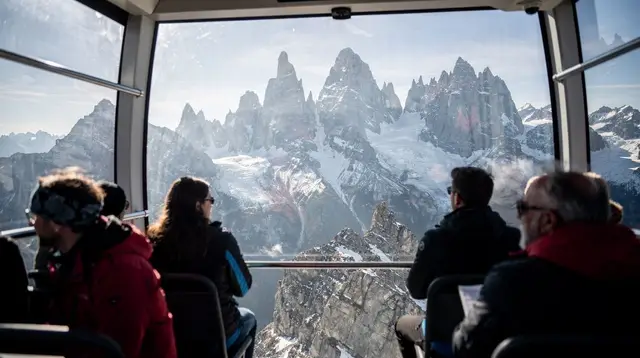
What sets Interlaken apart from lower-altitude paragliding spots is the combination in view during descent. Below, the flight path typically traces the ridge down toward the shore of Lake Thun or Lake Brienz — striking for their turquoise-green color, a result of glacial sediment suspended in the water. In the distance, on a clear day, the famous trio of the Eiger, Mönch and Jungfrau stands out along the southern skyline, their north faces catching the light in a way that’s hard to see from most valley-floor viewpoints.
It’s worth being honest about the word “on a clear day.” Alpine weather in the Bernese Oberland changes quickly, and cloud frequently sits on or around the higher peaks even when the valley below is sunny. Operators fly when conditions are safe for flying, which is a lower bar than conditions being ideal for photography — a flight can go ahead, and often does, without the Eiger, Mönch and Jungfrau being visible at all. Nobody selling a flight here can honestly promise that view; they can only describe what’s possible when the sky cooperates.
Landing near whichever lake the wind favors
Because paragliding depends on wind direction to be flown and landed safely, the landing field used on any given day is chosen by the pilot based on conditions, not fixed in advance. In practice that means a flight might end near the shore of Lake Thun on one day and near Lake Brienz on another, even for departures from the same launch site. Neither outcome is a downgrade — both lakeshores offer scenic landing areas with easy pickup back to town — but it’s a detail worth knowing so a booking isn’t made around the assumption of a specific lake.
The journey from Geneva: further than it looks on a map
This is the point that most distinguishes Interlaken paragliding from options closer to Lake Geneva. By train, Geneva to Interlaken generally takes more than 3 hours each way, almost always with at least one change, commonly around Bern or Spiez. That’s a meaningfully longer commitment than a trip to Verbier or Montreux, both of which also offer tandem paragliding within a much shorter radius of Geneva.
| From Geneva to | Typical one-way travel time | Paragliding available |
|---|---|---|
| Montreux | About 1 hour by train | Yes |
| Verbier | Roughly 2-2.5 hours (train + bus) | Yes |
| Chamonix | Roughly 1-1.5 hours by road, longer by rail | Yes |
| Interlaken | Generally over 3 hours, at least one change | Yes |
That travel time doesn’t rule out a day trip on paper — trains run frequently and the Swiss rail network is reliable — but stacking a 3-hour-plus train journey each way on top of a cable car transfer, a flight, and the return trip makes for a very long day with limited slack for weather delays or a missed connection. A rushed schedule also works against you here specifically, since paragliding is one of the activities most sensitive to wind and visibility: a flight can be postponed by an hour or more while conditions settle, which eats directly into a same-day return window.
For that reason, most visitors who prioritize Interlaken paragliding do one of two things: book a tour that bundles transport and the flight into a single organized day, removing the logistics of connections and timing from their own hands, or plan an overnight in the Interlaken area so the flight isn’t competing with a train timetable. An overnight also opens up pairing the flight with Harder Kulm or another Bernese Oberland excursion the same trip, rather than treating paragliding as the sole reason for the whole day.
a combined trip from Geneva that pairs the Interlaken excursion with a tandem paragliding flight is the more straightforward route for visitors who don’t want to plan the connections and cable car transfer themselves. For those handling transport independently, a direct transfer service between Geneva and Interlaken is an alternative to the standard rail connections, and it’s worth checking the current schedule and any change requirements before committing to a strict return time.
Interlaken beyond the flight
Because the journey from Geneva is substantial, it’s worth building the day — or better, the stay — around more than the flight itself. an organized day trip from Geneva that also stops at the Harder Kulm viewpoint pairs the classic panorama over Interlaken’s twin lakes with a look at the town itself, giving the day a second anchor beyond the paragliding window. The Harder Kulm funicular, reached directly from the town center, climbs to a ridge with a cantilevered viewing platform looking down over both lakes at once — a useful comparison point if weather grounds the paragliding flight, since it delivers a similar view without depending on wind conditions.
Travelers planning to combine Interlaken with other stops in French-speaking or central Switzerland on the same trip — Lucerne, for instance, is often paired with Interlaken as part of a longer central-Switzerland loop — may find a Swiss Travel Pass covering train, bus and boat travel worth pricing out against individual point-to-point tickets, particularly if the itinerary includes several rail legs beyond the Geneva-Interlaken run itself.
Typical pricing and what’s included
Prices for tandem paragliding in the Interlaken area vary by operator, flight duration and season, but a useful order of magnitude for a standard tandem flight is roughly CHF 170-220, with longer thermal flights or add-ons like photo and video packages pushing that higher. Most tandem packages include:
| Included | Notes |
|---|---|
| Transport to launch | Cable car or minibus from Interlaken up to Niederhorn or Beatenberg |
| Equipment | Harness, helmet, flight suit if needed |
| The flight itself | Typically 15-25 minutes airborne, weather dependent |
| Return to town | From the landing site near Lake Thun or Lake Brienz |
| Photo/video | Often a paid add-on rather than automatically included — check before booking |
Weather cancellations and rebooking policies differ by operator; because flying depends on wind and visibility at altitude, it’s normal for a scheduled flight to shift by an hour or, on a genuinely poor-weather day, to another day entirely if time allows.
Photo and video: what’s actually included
Most tandem operators around Interlaken separate the flight itself from any lasting record of it, and it’s worth checking exactly what’s covered before assuming a video is automatic. Some packages include a helmet-camera video or a set of photos as standard; others treat it as a paid extra, shot by the pilot on a mount or handed to the passenger to film themselves.
For travelers who want footage without a surprise line item at checkout, a tandem flight with one video option included at no extra charge is worth comparing against a standard booking, since it settles that question in advance rather than at the landing field. Whatever the format, a helmet-camera angle over Lake Thun or Lake Brienz, with the Eiger, Mönch and Jungfrau in the background on a clear day, tends to be the single most-shared souvenir of an Interlaken flight — which is part of why it’s worth confirming rather than assuming.
Pairing Interlaken with a longer Switzerland trip
Given how far Interlaken sits from Geneva, travelers who make the journey often fold it into a longer loop rather than treating it as an isolated outing. Lucerne, reachable from Interlaken without doubling back through Geneva, is a common next stop, and the two together form a natural central-Switzerland pairing for anyone extending beyond a single overnight.
For a trip built around exactly this kind of multi-stop itinerary — the Alps, Interlaken and onward to cities like Zurich — a seven-day tour covering the Alps, Interlaken and Zurich packages the logistics of a longer national loop into a single booking, which removes a meaningful amount of the connection-planning that makes an independent Geneva-Interlaken-and-back trip feel heavier than it looks on a map. Even travelers not booking a multi-day tour outright may find it useful groundwork for pricing an independent version of the same route, since it lays out roughly what such a loop covers.
How it compares to other paragliding spots in the region
Interlaken isn’t the only place within reach of Geneva to fly tandem — it’s simply the one furthest away, and the one with the most distinctive high-alpine backdrop. Chamonix, across the border in France, offers flights with Mont Blanc itself as the backdrop and a much shorter journey from Geneva. Verbier and Montreux both sit closer still, with Montreux reachable in about an hour, making either a genuinely light day trip in a way Interlaken generally isn’t. Annecy, across the border in Haute-Savoie, adds its own lake-and-mountain combination at a similarly short remove from Geneva.
None of these substitutes for the specific Eiger-Mönch-Jungfrau-and-twin-lakes view that makes Interlaken distinctive — but for visitors whose main constraint is travel time rather than a specific mountain panorama, it’s worth weighing that trade-off before committing a full day, or more, of a Geneva-based trip to the journey north.
Practical notes before booking
A few points worth confirming directly with an operator or tour provider before booking a flight:
- Season: flights run through much of the year, but winter conditions can add cancellation risk around snow and wind at launch altitude; shoulder seasons and summer generally offer the most consistent flying windows.
- Weight and age limits: most operators set minimum and maximum passenger weight limits and a minimum age for tandem flights — check current figures directly with the operator, since these vary and change.
- What to wear: layers and closed shoes, since temperatures at launch altitude on the Niederhorn or above Beatenberg run noticeably cooler than in Interlaken itself, even on a warm day in the valley.
- Language: Interlaken sits in German-speaking Switzerland, a contrast with French-speaking Geneva, but its adventure-sports operators work with international visitors daily and English is very widely spoken in bookings and briefings.
- Flexibility: because the flight depends on wind and cloud at altitude, building a buffer into the day — rather than a tight connection back to a same-evening train from Geneva — reduces the chance that a weather delay turns into a missed flight altogether.
Handled with that flexibility in mind, a tandem flight above Interlaken’s twin lakes is one of the more memorable ways to see the Bernese Oberland from the air — just one that, from a Geneva base, is better planned as its own dedicated outing than squeezed into the margins of a lighter day trip.
Paragliding Over the Alps
Verified deep-linked GetYourGuide tours. Book through these links and we earn a small commission at no cost to you.
GetYourGuide does not provide a product photo for this activity — the image shows the meeting point, photographed by us.