Chamonix Paragliding: Tandem Flights Over the Glaciers
What is tandem paragliding in Chamonix actually like?
You take off strapped to a certified pilot from Le Brévent or Planpraz, above the Chamonix valley, with the Aiguille du Midi, the Mer de Glace and the Mont Blanc massif in view. Flights last roughly 15-30 minutes and land near the town centre; everything depends on wind and weather on the day.
Why fly over Chamonix instead of just looking up at it
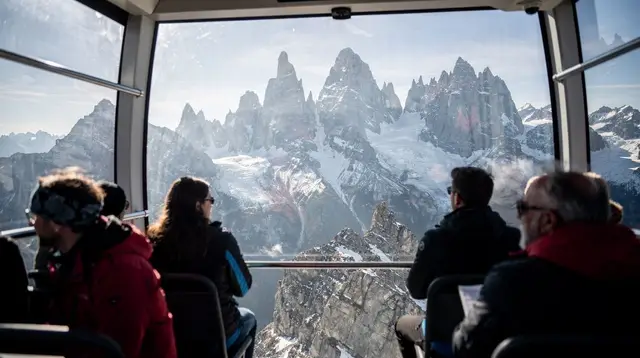
From the streets of Chamonix, Mont Blanc and its glaciers are already a spectacle — but they’re a spectacle seen from below, craning your neck at a wall of rock and ice. Tandem paragliding turns that relationship around. For fifteen to thirty minutes, you’re airborne over the valley, level with ridgelines instead of standing under them, watching the Aiguille du Midi and the tongue of the Mer de Glace recede below a paraglider wing instead of a cable car window.
This is what sets Chamonix apart from the other paragliding spots around Geneva. Megève and Annecy both offer genuinely good tandem flying — Annecy over its turquoise lake, Megève over greener, gentler Alpine pasture — but neither sits directly beneath the highest peak in the Alps. Chamonix does. The valley floor is at about 1,035m, the Aiguille du Midi cable car climbs to 3,842m a few kilometres away, and Mont Blanc itself tops out at 4,805m, the highest point in the Alps. No flight gets you up to that altitude or onto the glacier itself — but flying in front of it, wing tilted toward that skyline, is a different experience from any lakeside launch. If your priority is proximity to ice and granite rather than water, this is the valley for it.
It’s worth being clear from the outset about what this flight is not. It isn’t a glacier landing, a close pass over the Mer de Glace, or a flight that reaches the altitude of the Aiguille du Midi. Tandem paragliding here launches from around 2,000m and covers the valley’s airspace and slopes — spectacular, but still well below and in front of the high peaks, not among them.
A tandem flight over the Chamonix valley depends on wind and cloud, so the airline ticket into Geneva should leave a spare day or two around your plan, ideally with a fare you can change if the launch is postponed. Choose arrival and departure times that keep the flight itself away from your travel day, then look up fares on Aviasales for Geneva.
How a tandem flight actually works
Every tandem paragliding flight in Chamonix follows roughly the same sequence, whichever operator you book with.
Getting to the launch site. Most flights take off from Le Brévent (around 2,525m) or Planpraz (around 2,000m), both reached by cable car from central Chamonix. Your pilot usually meets you in town, rides up with you, and walks you the short distance to the takeoff point. This part alone gives you a preview of the view: Le Brévent’s cable car and the nearby Aiguille du Midi lift climb the opposite side of the valley, so even before you’re airborne you’re looking straight across at the massif.
The briefing and harness. Pilots give a short safety briefing and fit your harness at the launch site — this takes a few minutes, not a course. You’re clipped in front of or beside the pilot, who controls the wing throughout.
Takeoff. Tandem takeoff is a short run downhill until the wing catches air and lifts you both off the slope. It’s brief and, for most first-timers, less dramatic than it sounds — but it does require jogging a few steps on uneven ground, which is the main reason operators ask for sturdy shoes and reasonable mobility.
The flight. In the air, pilots typically alternate between smooth gliding — good for photos and simply taking in the Mont Blanc massif, the valley floor, and the town below — and, if you want it and conditions allow, some steeper turns or brief moments of near-weightlessness. Tell your pilot beforehand if you’d rather keep it purely scenic; tandem flying is fully adjustable to what the passenger wants.
Landing. Flights end with a landing in a designated field near Chamonix town centre, an easy walk back into the centre. Landings are typically light touches on the feet, occasionally a short slide, and pilots handle the approach and timing entirely.
The whole outing — cable car up, briefing, flight, walk back — usually takes two to three hours door to door, even though the flight itself is much shorter.
What you’ll actually see
The view is the entire point of flying here rather than driving straight past the valley, so it’s worth being specific about what’s in frame and what isn’t.
Expect, across a typical flight from Brévent or Planpraz: the full sweep of the Chamonix valley floor, the town itself laid out in miniature, the forested and rocky flanks of the massif opposite, the Aiguille du Midi’s needle-like summit and cable car line, and — glacier ice visible across the valley — the lower reaches of the Mer de Glace and neighbouring glacier tongues. On a clear day the Mont Blanc summit itself is visible in the distance beyond the closer peaks.
What you won’t get: a flight over the top of the Aiguille du Midi, a close pass along the Mer de Glace ice, or any view of the Matterhorn — that peak is roughly 100km away near Zermatt and simply isn’t visible from Chamonix airspace, tandem flight or otherwise. If the Matterhorn specifically is what you’re after, that belongs to a Zermatt trip, not a Chamonix one.
Weather and wind — read this before booking a fixed date
Paragliding is entirely weather-dependent, more so than almost any other activity in this guide. Pilots need a workable combination of wind direction, wind speed, visibility and cloud base to fly safely, and mountain valleys like Chamonix’s can shift from flyable to grounded within an hour.
In practice this means:
- Flights are commonly rescheduled to a later time the same day, the next day, or occasionally cancelled and refunded outright when conditions don’t improve within a trip’s timeframe.
- Morning and early-afternoon slots tend to be more reliable in summer, before afternoon thermal activity or storm buildup.
- Winter flights are possible and offer a genuinely different, snow-covered view of the valley, but are more weather-sensitive and depend on stable high-pressure conditions.
- No operator, however well-reviewed, can promise a flight will happen at a specific booked hour. Building at least one buffer day into a Chamonix itinerary — rather than flying in, booking a single slot, and flying out — meaningfully raises the odds of actually going up.
If your schedule genuinely can’t flex, treat paragliding as a “try for it” activity rather than a guaranteed centrepiece, and pair the trip with weather-independent alternatives like the Aiguille du Midi cable car (which also gets weathered out on bad days, but on different criteria) or a valley walk.
Booking options compared
Several tandem paragliding products cover Chamonix, differing mainly in launch site, flight length, and extras like video.
| Option | Launch point | What it adds |
|---|---|---|
| A standard scenic tandem flight over the valley | Brévent or Planpraz | Straightforward introduction, no extras required |
| A tandem flight departing specifically from Planpraz | Planpraz | Lower launch altitude, often shorter cable car queue |
| A flight oriented toward the Mont Blanc massif view | Brévent | Routing angled to keep Mont Blanc in view for more of the flight |
| A tandem flight bundled with a free onboard video | Brévent or Planpraz | Footage included at no extra cost, useful if you’d otherwise pay separately for it |
None of these is a “better” flight in a technical sense — a paraglider wing, once airborne over the valley, covers similar terrain regardless of which product you book. The real differences are launch point, whether video is bundled or an add-on, and how the route is framed toward the Mont Blanc side of the valley versus the town side. Read the specific listing for exact flight duration and cancellation terms before booking, since these vary by operator and season.
Cost, timing and what to bring
Budget roughly CHF 130-220 per person (around €140-230) for a standard 15-30 minute tandem flight, with longer flights, higher launch points, or video/photo packages pushing toward the upper end or beyond. This sits in a similar range to tandem flights over Annecy or Megève; you’re paying for the activity and the pilot’s expertise, not a premium for the Mont Blanc backdrop specifically.
Practical notes:
- Shoes: closed, sturdy trainers or light hiking boots. Sandals or open shoes are generally refused at takeoff.
- Clothing: layers. It’s noticeably colder at 2,000-2,500m than in the valley, even in summer, and wind chill in flight adds to that.
- Loose items: secure phones and cameras with a strap, or hand them to the pilot’s mount if offered — anything dropped mid-flight is gone.
- Fitness: no special fitness is required, but the short running takeoff and a similar effort at landing mean this isn’t ideal for anyone with significant mobility limitations; ask the operator directly if in doubt.
- Motion sensitivity: gentle gliding is comfortable for most people; if you’re prone to motion sickness, ask your pilot to keep the flight smooth rather than acrobatic.
Getting to Chamonix from Geneva
Chamonix is in France, not Switzerland — a detail worth flagging since it’s easy to forget when planning a trip that otherwise stays entirely inside the Geneva region. The drive from Geneva takes about an hour via the Mont Blanc side of the valley, crossing the Franco-Swiss border along the way (no passport checks under Schengen, but it is a genuine international crossing, and car rental cross-border terms should be checked).
Without a car, regular shuttle buses connect Geneva Airport and central Geneva to Chamonix in roughly an hour to 90 minutes, and some train routings work via Swiss and French rail with a change. Many paragliding operators include pickup from central Chamonix meeting points as part of the booking, which simplifies the day considerably if you’re not driving yourself. For the fuller range of ways to reach the valley and combine it with other stops, see Chamonix day trips and Mont Blanc excursions from Chamonix.
Pairing paragliding with the rest of a Chamonix day
Because a tandem flight itself only takes a couple of hours including transport, most visitors combine it with at least one other Mont Blanc activity on the same day trip from Geneva.
Common pairings: a morning flight followed by an afternoon ride up the Aiguille du Midi cable car (weather permitting on both counts, worth checking separately since flying and cable-car conditions don’t always align); a flight combined with the Mer de Glace via the Montenvers rack railway; or simply a flight plus a relaxed walk and lunch in Chamonix town, letting the valley views from the ground round out what you saw from the air. For structured pairings, see Mont Blanc excursions and Chamonix hiking.
Those staying longer or building a multi-day Alps itinerary from Geneva can also look at three days: lake and mountains or four days hiking Mont Blanc and Valais, both of which give paragliding room to be rescheduled around weather rather than squeezed into a single fixed slot.
Le Brévent or Planpraz: which launch site to choose
Most tandem operators fly from one of two points on the same side of the valley, and the choice is usually made by the operator rather than the passenger — but it’s worth knowing the difference if a listing lets you pick.
Planpraz, at around 2,000m, is the lower and generally quicker cable car ride from town, which can mean a shorter wait before takeoff and a slightly gentler introduction for first-time fliers. Le Brévent, higher at around 2,525m, adds extra cable car time but launches from further up the ridge, which some pilots use for a longer glide or a more direct line toward the Mont Blanc massif. In practice the difference in the flight itself is modest — both sites look across the same valley at the same skyline — and wind direction on the day often decides which one is actually usable regardless of what’s booked. If you have a genuine preference, mention it when booking rather than assuming; pilots adapt the exact route to conditions either way.
If paragliding isn’t for you — or the weather doesn’t cooperate
Because flights depend so heavily on wind and visibility, it’s worth having a plan B in mind before committing a whole day to Chamonix around a single paragliding slot — especially if you’re travelling with someone who isn’t keen to fly, or a child under the typical minimum age.
Chamonix does offer ground-based ways to get close to the same scenery. A guided hike with Mont Blanc views covers similar terrain at walking pace, with a guide who can explain what you’re looking at rather than a pilot focused on flying the wing — a reasonable substitute on a grounded day, or a complementary activity on a flying one. For a faster-paced alternative, an electric mountain bike rental lets you cover more of the valley floor and lower slopes independently, at your own schedule, without depending on wind conditions at all. Neither replaces the sensation of being airborne over the valley, but both keep a Chamonix day worthwhile even when the wing stays on the ground. See Chamonix hiking and Chamonix adventure sports for the fuller range of ground-based options.
Common mistakes to avoid
- Booking a single, fixed flight slot with no flexibility. Weather cancellations and reschedules are routine, not rare — build in a buffer day if paragliding is a trip priority.
- Expecting the Matterhorn. It’s not visible from Chamonix at any altitude; that view belongs to the Zermatt and Valais region, roughly 100km away.
- Assuming Chamonix is in Switzerland. It’s in France, in the Haute-Savoie department — relevant for currency (euros, not Swiss francs), driving documents, and trip planning generally.
- Forgetting warm layers. Launch altitude is 1,000-1,500m higher than the valley floor, and it’s genuinely colder up there even on a warm Chamonix afternoon.
- Wearing open shoes or sandals. Most operators will refuse to fly you without closed, secure footwear.
- Not checking weight and age limits in advance. Limits vary by operator; confirm before travelling rather than discovering an issue at the launch site.
Paragliding Over the Alps
Verified deep-linked GetYourGuide tours. Book through these links and we earn a small commission at no cost to you.
GetYourGuide does not provide a product photo for this activity — the image shows the meeting point, photographed by us.