Geneva Airport to Morzine: How to Get There
What is the best way to get from Geneva Airport to Morzine?
Most travelers take a shared or private shuttle, booked in advance, since Morzine has no direct train station. The drive is a little over an hour in normal conditions, longer in snow or during French school-holiday peaks. Renting a car at the airport is the other common option, especially for flexible schedules or ski-equipment loads.
Morzine sits in the Portes du Soleil, one of the largest linked ski areas in the Alps, on the French side of the Franco-Swiss border. For visitors flying into Geneva Airport, getting there is straightforward in principle but has a few practical wrinkles worth knowing before booking anything: there is no train station in Morzine, the drive time depends heavily on the season, and the trip involves crossing from Switzerland into France, with a currency change to match.
This guide walks through the realistic transfer options, what the border crossing actually involves, and how the Morzine trip compares to the better-known route toward Megève.
Why this route is different from other Geneva transfers
Geneva Airport (GVA) is the gateway for the whole Lake Geneva and Mont Blanc region, but not every alpine resort is served the same way. Chamonix and Megève sit on routes with more shuttle frequency and, in Chamonix’s case, a rail connection further down the valley. Morzine, by contrast, is reached via the Chablais valleys east of Lake Geneva’s southern shore, a different road corridor from the Mont Blanc approach.
The practical result: Morzine transfers depend almost entirely on road transport — shuttle or car — rather than any combination involving rail. Anyone assuming a train link similar to what exists toward Lausanne or Annecy should adjust expectations for this specific destination.
Distance and drive time: what to actually expect
In normal conditions, the drive from Geneva Airport to Morzine takes a little over an hour. That number describes clear roads and typical traffic — not a guarantee. Two factors commonly extend it:
- Winter snowfall. Roads climbing into the Chablais valleys can require slower driving, snow tires, or occasionally chains during and after storms.
- French school-holiday traffic. Saturday changeover days during French winter school holidays (zones A, B and C rotate through the season) bring heavy traffic on the approach roads, sometimes adding well over an hour.
No operator, shuttle company, or car rental agency can honestly promise a fixed transfer time in winter. Anyone quoting an exact guaranteed duration for a snow-season transfer is not accounting for conditions that are genuinely out of anyone’s control. Build in a buffer, especially for the first and last Saturdays of French school holidays.
Option 1: Shared shuttle
Shared shuttles connecting Geneva Airport with Portes du Soleil resorts, including Morzine, run on a fixed schedule with set departure windows. They are usually the least expensive door-to-door option and are booked in advance, with pickup typically arranged at the airport arrivals area.
The trade-off is time and flexibility: a shared shuttle may make stops at other resorts in the Portes du Soleil network before reaching Morzine, and departures are tied to the operator’s timetable rather than your flight landing time. For a large group or solo traveler on a budget, this is usually the most practical choice.
Option 2: Private transfer
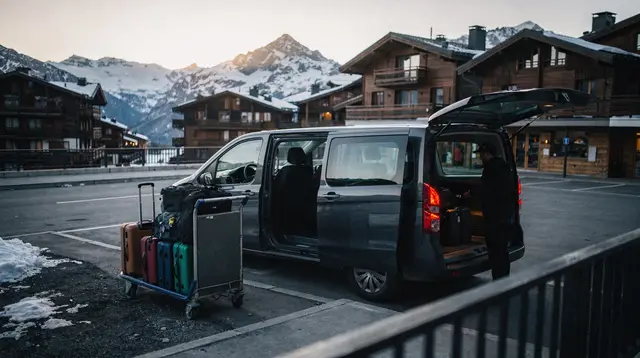
A private transfer picks you up and takes you directly to your Morzine accommodation, with no intermediate stops. It costs more than a shared shuttle but removes the uncertainty of shared scheduling and is generally faster point-to-point, particularly useful with a lot of luggage or ski equipment, or when arriving late at night.
Private transfers are typically booked ahead of arrival, with the vehicle waiting at the airport. As with the shared shuttle, journey time still depends on road and weather conditions on the day.
Option 3: Car rental at Geneva Airport
Geneva Airport has car rental desks for travelers who want flexibility once in the mountains — useful for exploring the wider Portes du Soleil area, driving to neighboring valleys, or simply not being tied to a shuttle schedule.
A few things to plan for:
- Winter tires or chains are often required by French law on alpine roads in winter and are worth confirming with the rental company before departure.
- Mountain driving into Morzine involves winding roads with elevation gain; drivers unfamiliar with alpine conditions should factor in extra time and caution, especially after dark or in fresh snow.
- Parking in Morzine during peak ski season can be limited near central accommodation; check what is included with your booking before arrival.
Booking your transfer in advance
Because road transport is the only realistic option for this route, booking ahead is worth doing rather than arranging something on arrival. A pre-booked option such as the one-way transfer from Geneva Airport to Morzine removes the need to compare shuttle timetables or hunt for a taxi once you land, and it fixes the pickup point at arrivals rather than leaving you to negotiate on the spot. This matters most during peak weeks, when demand for road transport into the Portes du Soleil outstrips what walk-up options can cover.
Whichever option you choose, confirm the pickup location at Geneva Airport before departure — arrivals halls can be busy, and knowing exactly where to look for a driver or shuttle desk saves time after a flight, particularly if the trip has already run long because of a delayed landing.
Since the road is the only realistic way up to the Portes du Soleil, the booking page deserves a careful read before you pay. Check that the drop-off is your actual address in Morzine rather than a general stop, that the total is the final amount, and that the cancellation terms still work if your flight changes. You can browse one-way transfers from Geneva Airport to Morzine on Kiwitaxi to compare the options.
Flight arrival and pickup logistics
Most transfer operators, whether shared shuttle or private car, ask for your flight number when booking so pickup can be adjusted if the flight is delayed. This is worth doing even for a short delay: Geneva Airport’s arrivals process, plus baggage claim for a group carrying ski bags, can easily add thirty minutes beyond the scheduled landing time, and a driver tracking the flight will wait rather than leave.
For late-evening arrivals, particularly outside the main ski season’s peak departure days, confirm in advance that your chosen operator runs at that hour — some shared shuttle schedules are built around a handful of fixed daily departures rather than covering every incoming flight. A private transfer generally offers more flexibility here, since it is arranged specifically around your flight rather than a shared timetable.
Traveling with skis and snowboards
Winter visitors to Morzine are frequently carrying ski or snowboard bags, boot bags, and helmets in addition to normal luggage, and this affects which transfer option makes sense. Shared shuttles typically have defined luggage allowances per passenger, worth checking before booking if traveling with a full set of winter sports equipment for several people. Private transfers and car rentals generally handle bulky equipment with fewer restrictions, since the vehicle is not shared with other passengers’ bags.
Renting equipment in Morzine rather than flying with it is common and can simplify the transfer itself, since it reduces the volume of luggage moving through the airport and into the vehicle. Anyone bringing their own equipment regardless should mention it when booking a shuttle or private transfer, so the operator can confirm the vehicle has room.
Morzine compared to Chamonix for a Geneva arrival
Travelers deciding between a Morzine trip and a Chamonix trip from Geneva Airport are choosing between two different mountain systems, not two versions of the same journey. Chamonix sits directly on the Mont Blanc massif and benefits from higher shuttle frequency and a rail connection further down its valley, details covered in the guide to getting to Chamonix from Geneva Airport. Morzine, in the Portes du Soleil, has neither of those, which is why road transfers carry more weight for this specific route.
Travelers combining both destinations in one trip, or comparing private transfer options for the Mont Blanc side, may also find the private transfer from Geneva Airport to Chamonix useful for that separate leg. The two transfers should be booked independently, since they run on different roads with different typical drive times.
When to visit: seasonal transfer considerations
Morzine functions as a winter sports destination first, and the majority of airport transfer demand follows the ski season, roughly from December into April depending on snow conditions. Outside that window, the Portes du Soleil shifts toward hiking, mountain biking, and quieter alpine scenery, and transfer demand — along with shuttle frequency — tends to drop accordingly.
Summer travelers generally face easier driving conditions, without the snow-related slowdowns described above, though French school-holiday traffic can still affect the roads during peak summer weeks. Whatever the season, checking current shuttle schedules before booking is worth it, since off-peak months sometimes run a reduced timetable compared to the height of ski season.
Why there’s no direct train
Morzine has no railway station, which rules out a genuine direct train option for this transfer. The nearest stations sit lower in the valley, and completing the journey from any of them still requires a connecting bus or taxi — in practice, no faster or simpler than booking a shuttle from the airport in the first place. Travelers who prefer rail for other parts of a Geneva-region trip, such as reaching Lausanne or Annecy via the Léman Express, should plan on road transport specifically for the Morzine leg.
The Franco-Swiss border crossing
Geneva Airport sits mostly in Switzerland, and the drive to Morzine crosses into France, specifically the Haute-Savoie department. Both countries are part of the Schengen Area, so there is typically no routine passport check at the border itself — shuttle vans and rental cars generally cross without stopping.
That said, carrying a valid passport or national ID card is still worth doing. Spot checks happen occasionally, and having identification on hand avoids any complication if one occurs, whether at the airport, at the border, or later in France. Schengen membership covers passport-free movement; it does not eliminate the possibility of an identity check.
Currency: francs to euros
Geneva and the rest of Switzerland use the Swiss franc (CHF). Once you cross into France, the currency is the euro. It is worth having some euros, or a card comfortable with euro transactions, ready before leaving the airport — currency desks and change machines on the Swiss side of Geneva Airport deal primarily in francs, and Morzine’s shops, restaurants, and ski facilities price everything in euros, not francs.
Comparison table: shuttle vs. private transfer vs. car rental
| Option | Typical cost | Flexibility | Best for |
|---|---|---|---|
| Shared shuttle | Lowest | Fixed schedule, possible stops | Budget travelers, solo or small groups |
| Private transfer | Mid to higher | Direct, on-demand pickup | Groups, heavy luggage, late arrivals |
| Car rental | Variable | Full flexibility | Multi-resort exploring, longer stays |
Morzine vs. Megève: not the same route
It’s worth being clear about one thing: Morzine and Megève are both reached from Geneva Airport in a similar overall drive time, but they are not the same trip. Megève sits on the approach toward the Mont Blanc massif, while Morzine belongs to the Portes du Soleil, a separate ski area with its own road network through the Chablais valleys. Booking a shuttle or comparing transfer times for one resort does not tell you much about the other — check the specific route when planning, rather than assuming interchangeability between Haute-Savoie’s alpine resorts.
Making the most of your first day in Morzine
Once you’ve arrived, a relaxed way to get oriented is a short guided walk with a local — see the express 60-minute walking orientation in Morzine, useful for finding your bearings after a travel day. Families traveling with young children may want to look into the beginner alpine skiing lesson for children aged 5 to 7 as an easy first outing on snow.
For those who arrived earlier in the day and have time before settling into Morzine, a stop for a regional wine, cheese, and charcuterie tasting is a good way to sample Haute-Savoie flavors. And if the wider Mont Blanc region is also on the itinerary during the same trip, the private day trip to Chamonix and Mont Blanc is worth considering as a separate excursion, since it covers a different massif from Morzine’s Portes du Soleil.
Planning ahead
Because Morzine’s transfer options all run on the road rather than the rails, booking ahead matters more here than for some other Geneva-region destinations. Shared shuttles and private transfers both fill up during peak ski weeks, and car rentals can sell out around French school-holiday changeovers. Reserving your transfer, along with winter tires or chains if you’re self-driving, before you land removes one of the few genuinely unpredictable parts of the trip — the weather on the day itself.
For more on how transport works more broadly around the Geneva region, see the Geneva transport guide, and for the different route toward the Mont Blanc side, the Chamonix transport guide covers that corridor in detail. Broader trip planning around Geneva itself is covered in the Geneva planning guide, and once you’re settled in Morzine, the Morzine adventure sports guide is a useful next stop for what to do beyond the transfer itself.
Getting Around Geneva
Verified deep-linked GetYourGuide tours. Book through these links and we earn a small commission at no cost to you.
GetYourGuide does not provide a product photo for this activity — the image shows the meeting point, photographed by us.