Aiguille du Midi: Visiting Chamonix's 3,842m Cable Car Summit
What is the Aiguille du Midi and how do you visit it?
The Aiguille du Midi is a 3,842m peak above Chamonix, France, reached by a two-stage cable car from the valley floor with no hiking or glacier walking involved. Tickets are sold for a specific time slot and sell out in high season, and the summit view over the Mont Blanc massif depends entirely on the day's weather.
What the Aiguille du Midi actually is
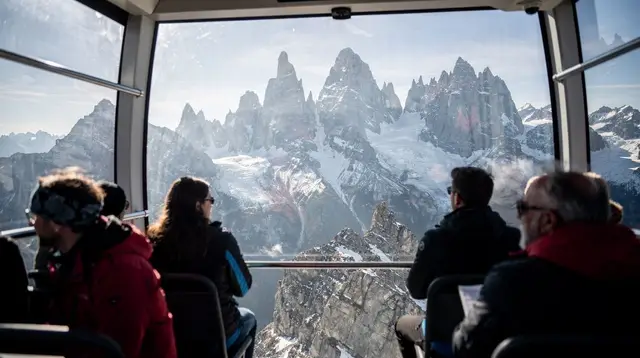
The Aiguille du Midi is a rock summit above Chamonix, in France, reached entirely by cable car — no hiking boots, glacier crossing or staircase into an ice cave involved. The two-stage lift climbs from the valley floor at roughly 1,035m, via a mid-station at Plan de l’Aiguille (2,317m), to a summit station at 3,842m. That is one of the highest points in Europe reachable without setting foot on a trail, and the ascent itself — nearly 2,800m of vertical gain in well under half an hour — is part of what makes the visit feel dramatic rather than routine.
It sits within day-trip range of Geneva, and is one of the most-booked excursions covered in our Chamonix day trips and Mont Blanc excursions guides. This page focuses specifically on what the Aiguille du Midi visit involves, what it costs in time and comfort at altitude, and where it genuinely differs from the Mer de Glace, the other major Chamonix-area excursion it’s frequently confused with.
Getting there from Geneva
The Aiguille du Midi departs from its own cable car station in central Chamonix, roughly an hour to 90 minutes by road from Geneva depending on traffic and border conditions, since the route crosses from Switzerland into France. Travellers based in Geneva typically arrive either by organised tour with transport included, by train and local bus, or by self-drive, then queue at the Chamonix station for the first cable car stage.
For a guided option that handles transport and logistics from the Geneva side, the Geneva: Chamonix Aiguille Du Midi Mer de Glace Tour combines both excursions in a single day, useful for visitors who want to see both sites without arranging transport twice. A lighter option covering just the transfer is the Transport to Chamonix Aiguille Du Midi Mer de Glace, for travellers who prefer to book cable car tickets separately or already hold them.
For those staying in or routing through Chamonix itself, the Mythical Aiguille Du Midi Half Day is built specifically around the ascent, without bundling in a full-day itinerary.
Booking: why the time slot matters
Aiguille du Midi tickets are sold for a specific departure time, not as an open-ended day pass. In July, August, and French and Swiss school holiday weeks, slots for popular departure windows — especially mid-morning — can sell out days in advance. Arriving without a booking in high season risks either a long stand-by queue or no availability at all that day.
Booking ahead also fixes your ascent time, which matters for planning around weather: checking the mountain forecast the evening before or morning of your visit, then choosing (where flexibility exists) a slot timed to the clearest forecast window, improves the odds of a clear summit view more than choosing a slot at random.
| Visit style | What’s included | Best for |
|---|---|---|
| Aiguille du Midi half-day | Cable car ascent and summit time only | Visitors already in Chamonix, shorter itineraries |
| Aiguille du Midi and Mer de Glace combined | Both major Chamonix excursions in one day | Visitors wanting to compare the cable car summit and the glacier in one trip |
| Guided tour to the Aiguille du Midi and Montenvers | Guided commentary across both sites | First-time visitors who want context, not just transport |
| Private guide at the Aiguille du Midi | One-to-one guiding, flexible pacing | Travellers wanting a slower pace at altitude, or specific questions answered |
What altitude actually feels like at 3,842m
This is worth taking seriously rather than treating as a footnote. The cable car covers almost 2,800m of ascent in around 20 minutes across its two stages — far faster than the body typically adjusts to reduced oxygen at altitude. Common, usually mild effects reported by visitors include:
- Breathlessness on exertion — climbing the internal stairs to the highest viewing platforms can leave people out of breath who wouldn’t normally notice stairs at sea level.
- Light-headedness or a mild headache, particularly if dehydrated or arriving straight from a hot day in the valley.
- A faster resting heart rate, which most people don’t consciously notice but which is a normal physiological response to the altitude.
For the large majority of visitors these effects are mild and pass with rest. Moving slowly, drinking water, and sitting down if you feel unwell are the practical responses; visitors with known heart or respiratory conditions should check with a doctor before planning a rapid ascent like this one.
Cold compounds the altitude effect. Summit temperatures are routinely well below those in the Chamonix valley even in summer, and wind adds a further chill on the exposed platforms. A warm layer, hat and gloves are worth carrying year-round — a warm, sunny morning in Chamonix says nothing about conditions 2,800m higher.
The view is not guaranteed
The single most important expectation to set correctly: a clear view of the Mont Blanc massif is not guaranteed on any given visit. The summit can be:
- Above the clouds, in which case the massif is visible but the valley below is hidden under a cloud layer.
- Inside cloud, in which case visibility can drop to a few metres and the massif is not visible at all.
- Affected by high wind, which can also affect cable car operating schedules independent of ticket bookings.
Because tickets are sold for a fixed time slot rather than sold conditionally on weather, a booking does not include any guarantee of what you’ll actually see once you arrive. Checking the mountain webcam or forecast shortly before your visit — and adjusting expectations, not necessarily plans, accordingly — is the realistic approach. Many visitors still find the ascent, the exposed platforms and the sense of scale worthwhile even on a partly clouded day; a completely closed-in day is less common but does happen.
What’s actually at the summit
Once at the top, the site includes several distinct viewing structures connected by walkways and lifts within the mountain itself:
- Multiple viewing platforms and terraces at different levels, looking toward the Mont Blanc massif and, on clear days, across to Switzerland and Italy.
- The Step into the Void, a glass-floored box cantilevered out from the rock — a separate, optional attraction within the summit complex rather than the main viewing platform.
- A short tunnel and walkway connecting the main summit building to the Vallée Blanche departure point (relevant mainly to skiers, covered below).
- A café and facilities at the summit, though queues for both lifts and facilities build quickly at peak times.
Visitors spend anywhere from 45 minutes to over an hour on the summit itself once they’ve queued through both cable car stages, and most day visits — including travel time from Chamonix — run two to four hours in total.
Aiguille du Midi vs. Mer de Glace: what’s actually different
These two Chamonix-area excursions are often mentioned in the same breath, and combined tours (like the ones listed above) make that pairing easy — but the two visits work quite differently:
| Aiguille du Midi | Mer de Glace | |
|---|---|---|
| How you get there | Two-stage cable car | Rack railway (Montenvers) |
| Summit/arrival altitude | 3,842m | Around 1,913m at Montenvers station |
| Walking involved | Minimal — platforms and internal stairs | A staircase of several hundred steps down to the glacier |
| What you see | High-altitude rock summit, panoramic views | A retreating glacier and an ice cave dug freshly each year |
| Altitude effects | Noticeable for many visitors | Generally minimal |
In short: the Aiguille du Midi is about altitude and panorama from a suspended platform; the Mer de Glace is about a glacier walk and a literal, physical demonstration of ice loss, reached at a much lower elevation. Visitors with limited time sometimes have to choose one; those with a full day often combine both, as several of the tours above do. Our dedicated Mer de Glace guide covers that excursion in detail.
The Vallée Blanche: not for casual visitors
The Aiguille du Midi summit is also the starting point for the Vallée Blanche, one of the most famous off-piste ski descents in the Alps, dropping through glaciated terrain back toward Chamonix. It’s worth naming clearly here because visitors sometimes assume it’s a marked or beginner-accessible route because of where it starts.
It is not. The Vallée Blanche is unmarked, unpatrolled and crosses genuine crevasse terrain. It requires:
- A qualified high-mountain guide (not a ski instructor) — going without one is a real safety risk, not a formality.
- Off-piste skiing or snowboarding experience, since the terrain is ungroomed and variable.
- Proper glacier and avalanche safety equipment, arranged through the guide.
For the vast majority of Aiguille du Midi visitors — anyone not specifically booking a guided Vallée Blanche descent — this is simply a fact about the summit rather than something to plan around. It does not affect the standard sightseeing visit in any way.
Practical tips for the visit
- Book your time slot ahead, especially for July, August, and Swiss and French school holiday periods — availability at popular hours can disappear days before your date.
- Check the mountain forecast, not just the Chamonix valley forecast, since conditions at 3,842m are frequently very different from conditions at 1,035m.
- Dress in layers regardless of season — a warm valley morning tells you nothing about summit temperature or wind chill.
- Move slowly on arrival at altitude, particularly on stairs, and sit down if you feel dizzy or unwell rather than pushing through it.
- Carry water and sun protection — UV exposure is stronger at altitude, and dehydration worsens altitude effects.
- Build in queue time at both cable car stages, particularly at the Chamonix base station in peak season, even with a booked slot.
- Consider combining with the Mer de Glace on the same day if time allows, since both depart from Chamonix and several tours already bundle the pair, such as the combined highlight tour.
For broader planning around the wider Chamonix and Mont Blanc area, see our Chamonix day trips and Mont Blanc excursions guides, or the Chamonix hiking and Chamonix winter sports guides for activities beyond the cable car itself. Travellers weighing Chamonix against other high-altitude excursions from the Geneva region may also find our Zermatt and Glacier 3000 coverage useful for comparison, and those interested in the geology and retreat of Alpine glaciers should also read our separate Mer de Glace guide, which covers that excursion’s ice cave and staircase in detail.
Aiguille du Midi at a glance
Frequently asked practicalities about visiting the Aiguille du Midi are answered below; for the fuller picture on altitude, weather and how this excursion compares with the Mer de Glace, see the sections above.
How high is the Aiguille du Midi and how do you get there?
The summit sits at 3,842m, reached entirely by cable car from Chamonix (about 1,035m) in two stages, with a mid-station stop at Plan de l’Aiguille (2,317m). No walking, climbing or glacier crossing is required to reach the viewing platforms.
Do I need to book in advance?
Yes. Tickets are sold for a specific departure time slot, and in July, August and school holiday weeks these slots sell out, sometimes days ahead. Booking online before your trip is strongly recommended rather than assumed as a walk-up option.
Is the view of Mont Blanc guaranteed?
No. The summit is often above cloud, in cloud, or affected by high wind, any of which can reduce or completely block visibility of the Mont Blanc massif. Cable cars can also run reduced schedules or close temporarily in poor weather, independent of ticket bookings.
Is it very cold at the top?
Yes, even in summer. Temperatures at 3,842m are routinely far below those in the Chamonix valley, and wind chill adds to the effect on the exposed platforms. A warm layer, hat and gloves are worth carrying regardless of the season or the weather down in town.
Will I feel the altitude?
Many visitors notice some effect from the rapid ascent to 3,842m, ranging from mild breathlessness or light-headedness to a faster heart rate on exertion, since the cable car climbs almost 2,800m with no time to acclimatise. Moving slowly on the platforms and stairs, and sitting down if you feel unwell, resolves it for most people.
What is the difference between the Aiguille du Midi and the Mer de Glace?
The Aiguille du Midi is a cable car ascent to a high-altitude rock summit with viewing platforms and no glacier walking. The Mer de Glace is a separate excursion by rack railway to a lower-altitude glacier, involving a staircase down to an ice cave dug fresh into the glacier each year. They depart from different stations in Chamonix and are commonly treated as two distinct visits.
Can beginners access the Vallée Blanche ski route from here?
No. The Vallée Blanche off-piste descent starts from the Aiguille du Midi summit but is an unmarked, unpatrolled glacier route that requires a qualified mountain guide, proper glacier equipment and prior off-piste experience. It is not a route for beginners or unguided skiers.
How long should I plan for a visit?
Most visitors spend two to four hours between queuing, the two cable car stages, and time on the summit platforms, longer if combining it with lunch or the Mer de Glace on the same day. Building in extra time around your booked slot avoids rushing the ascent or descent.
Winter in Geneva
Verified deep-linked GetYourGuide tours. Book through these links and we earn a small commission at no cost to you.
GetYourGuide does not provide a product photo for this activity — the image shows the meeting point, photographed by us.