Yvoire Walking Tour: Geneva's Flower Village Across the Lake
Is Yvoire worth a walking day trip from Geneva?
Yes: Yvoire is a fortified 14th-century French village on Lake Geneva's south shore, roughly 25-45 minutes from Geneva by boat, with a pedestrian historic core known for geranium-covered walls, cobbled lanes, and lake views. The private château is not open to visitors, so the appeal is the walk itself and the crossing, not an interior visit.
Most of the villages in this guide sit on Swiss soil. Yvoire does not — it is French, tucked onto the southern shore of Lake Geneva, and reaching it usually means crossing open water rather than stepping off a Swiss train. That crossing, and the flowers waiting on the other side, are what set this walk apart from anything else within day-trip range of Geneva.
Where Yvoire actually sits
Yvoire is a small fortified village in the Haute-Savoie department of France, on the south shore of Lake Geneva, roughly opposite Nyon and not far from Coppet as the crow flies across the water. There is no bridge across this part of the lake, so the village is reached either by a seasonal lake crossing from the Swiss shore or by a road that loops around the lake’s eastern end through Thonon-les-Bains.
Because Yvoire and Geneva both sit within the Schengen Area, there is no routine passport check when moving between them. That does not mean identification is optional: spot checks happen on boats, at parking areas near the border, and occasionally on the roads themselves, so carrying a valid passport or national ID card is the sensible default for this leg of a Geneva day trip, even though nobody may ask to see it.
The practical result is a village that feels like a genuine change of country, not a themed extension of Geneva. Prices are in euros, shop signs are unmistakably French, and the rhythm of the place — long lunches, shuttered shops in the early afternoon in the off-season — follows French provincial habits rather than Swiss ones.
Getting there: boat or road
The most enjoyable way to reach Yvoire from Geneva is the lake itself. A seasonal boat service connects the Geneva lakefront to Yvoire, generally running from spring through autumn, with the crossing taking somewhere between 25 and 45 minutes depending on the vessel and whether it calls at intermediate ports. Schedules thin out or stop entirely in winter, so anyone planning a visit outside the summer season should check current timetables before building a day around the boat.
a sailboat outing from Yvoire that tucks in a stop at a secluded lakeside beach turns the crossing itself into part of the day rather than a means to an end, and it is a good option for anyone who wants time on the water beyond a straight point-to-point ferry.
Driving is the fallback, particularly outside the boat season. There is no direct road along the water between the Swiss and French shores at this point, so the drive runs around the eastern end of the lake through Thonon-les-Bains, typically taking 40 minutes to an hour from central Geneva depending on the border crossing used and traffic. Parking is available just outside Yvoire’s walls, since the historic centre itself is pedestrian.
For a fuller sense of how Yvoire fits alongside other lakeside stops, the dedicated Yvoire day trip guide lays out combinations with Thonon and Évian, and the lake cruises guide covers the boat options in more depth.
Entering the walled village
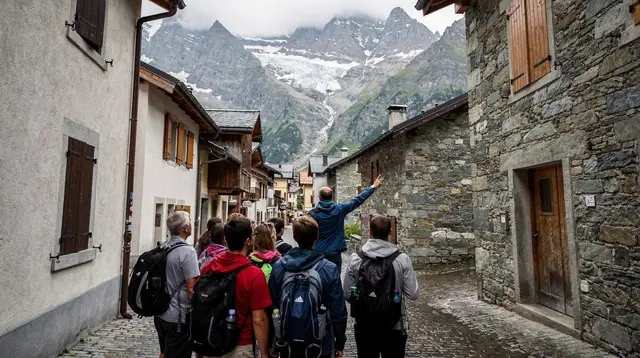
Yvoire’s historic core is a genuinely fortified village, built up through the 14th century as a defensive outpost on the lake, and its layout still reads that way. Two surviving gates lead into the old town, and once inside, the lanes are narrow, cobbled, and closed to cars — a large part of what makes the place pleasant to explore slowly rather than rushed through.
Visitors arriving by boat step off directly near the old harbour, a natural starting point for a loop through the village. Those arriving by car park outside the ramparts and walk in through one of the historic gates, which frames the first proper view of the flower-covered stone that Yvoire is known for.
There is no fixed route required to see Yvoire; the village is compact enough that most visitors simply wander. A natural loop takes in the harbour, the two main gates, the church tower, and a slow pass along the lakeside promenade before looping back through the interior lanes — comfortably done in two to three hours at an unhurried pace, longer with stops for food or drinks.
The château that stays closed
The Château d’Yvoire sits at the heart of the old town and is unmistakably the village’s dominant building, its towers visible from the lakeside and from several of the interior lanes. It is privately owned, and unlike many of the castles covered elsewhere in this guide — Château de Chillon, for instance — there is no interior visit on offer here. It is not a matter of buying a ticket in advance; the château simply does not open its doors to the public.
This is worth setting expectations around before arriving, since visitors used to castle-heavy itineraries elsewhere on the lake sometimes assume Yvoire’s château works the same way. What is available is the exterior view from the ramparts, the lanes around it, and the adjacent gardens, which is enough to appreciate the building’s presence in the village without an interior tour.
The flowers Yvoire is known for
Yvoire has built a long-standing reputation around its geraniums, and it shows the moment visitors pass through the gates. Cascades of red and pink flowers spill from window boxes, climb along stone walls, and frame the archways throughout the historic centre, an effect that is most vivid from late spring through summer when the plantings are at their peak.
The horticultural theme extends beyond street decoration. A walled garden inside the village, laid out along medieval design principles, groups plants by traditional use — medicinal, culinary, ornamental — and gives the flower displays some context beyond simple prettiness. It is a quieter stop than the main lanes and a good place to slow down partway through the walk.
Photographers tend to find the best light in the early morning or later afternoon, when the sun angles along the narrow lanes rather than flattening them from directly overhead, and when the village is at its quietest before or after the midday crowds that build up in peak summer.
The lakeside and the harbour
Yvoire’s small harbour, tucked just inside the old walls, is where boats from Geneva and Nyon dock, and it doubles as one of the best vantage points in the village for looking back across the water toward the Swiss shore. On a clear day, the Alps rise behind the lake in the distance, a reminder of how much scenery sits within range of a single afternoon out of Geneva.
A lakeside promenade runs along part of the village’s edge outside the main walls, offering a quieter alternative to the busier interior lanes in high season. It is a reasonable place to pause with a drink or an ice cream and watch the boat traffic, particularly for anyone visiting on a warm summer afternoon when the old town’s narrow lanes can fill up.
For a different way to see the lake from Yvoire, a sunset sail with drinks on board departing this stretch of shoreline extends the day into the evening, when the light over the water and the Alps tends to be at its most dramatic.
Combining Yvoire with other stops
Yvoire rarely fills an entire day on its own for visitors who prefer a fuller itinerary, and it pairs naturally with other towns on the French shore of the lake. Thonon-les-Bains and Évian-les-Bains are both within easy reach along the same shoreline, and each has its own character — Thonon larger and more workaday, Évian built around its thermal spa heritage.
a private day tour from Geneva that combines Yvoire with Évian-les-Bains is a way to cover both towns without coordinating separate transport, useful for visitors short on time or travelling with a small group.
a private van itinerary linking Évian, Yvoire, and a goat farm visit, departing from Montreux is a further option for anyone based on the Swiss Riviera side of the lake rather than in Geneva itself, folding Yvoire into a longer loop with a rural stop added in.
Those wanting to stay on the water into the evening can look at a nighttime sailing tour departing from Yvoire, a different way to experience the lake than the daytime crossing most visitors make.
Where to eat and drink in the old town
Yvoire’s lanes are lined with small restaurants and cafés, many of them tucked into stone buildings that predate the village’s tourist era by centuries. Lake fish — féra and perch are the local specialties around Lake Geneva — shows up on menus close to the harbour, alongside the usual range of French bistro standards: salads, tartines, crêpes, and ice cream stands that do brisk business on warm afternoons.
Prices sit closer to what visitors would expect in a well-known French lakeside village than in a quiet rural one, since Yvoire’s flower reputation draws a steady stream of day-trippers through the summer months. A coffee or ice cream on a terrace with a harbour view costs more than the same order a few streets back from the water, which is worth knowing for anyone planning a longer stop rather than a quick pass-through. Payment in euros is standard, and while cards are widely accepted, small family-run stalls and some ice cream counters are easier with cash in hand.
Anyone timing a visit around a meal should note that many restaurants follow French provincial hours rather than staying open continuously through the afternoon, closing between lunch and dinner service outside the busiest summer weeks. Arriving with a rough sense of Yvoire’s rhythm — busy midday, quieter mid-afternoon, busy again toward evening — makes it easier to find a table without a wait.
When to visit: seasons and crowds
Yvoire is at its most photogenic exactly when it is also at its busiest: late spring through summer, when the geraniums are in full bloom and the boat service from Geneva runs its fullest schedule. Midday in July and August brings the heaviest crowds through the two main gates, and the narrow lanes can feel genuinely packed for a few hours around lunch. Arriving on the first boat of the day, or timing a visit for early morning or early evening, is the simplest way to see the village with room to breathe.
Outside the boat season, Yvoire empties out considerably. The flowers fade, many shops and restaurants reduce their hours or close for stretches, and the crossing from Geneva depends on driving around the lake’s eastern shore rather than a direct sail. This trade-off is worth weighing deliberately: a winter or early-spring visit trades the village’s signature look for a quieter, more contemplative walk through the same fortified lanes, useful for anyone who has already seen Yvoire in bloom and wants a different atmosphere, or who is simply visiting Geneva outside the warmer months and does not want to force the boat crossing into an itinerary where it does not naturally fit. The Geneva in winter guide covers what stays open around the wider region during the colder months, which is useful context for planning a Yvoire visit outside peak season.
For visitors who want the walled village paired with more time on the water, a cruise from Geneva that takes in Yvoire’s castle and the surrounding lake is a straightforward way to combine the crossing with a longer look at the shoreline beyond the village itself, rather than treating the boat purely as transport.
A longer day: Yvoire, Chamonix, and beyond
For visitors basing a trip more around the mountains than the lake, a day tour that pairs Chamonix with Yvoire’s medieval village links two very different sides of the region in a single outing — glacier scenery in the morning, flower-covered lanes and lake views in the afternoon, or the reverse depending on the route. It is a long day by the standards of this guide, but a useful option for anyone with limited time in the region who wants a genuine sense of contrast between the Alps and the lake in one trip.
A gentler version of the same idea covers the length of the lake’s French shore in one outing: a tour covering Annecy, Yvoire, and Évian along what is sometimes called the French Riviera of Lake Geneva strings together the walled village with the canal town of Annecy and the spa heritage of Évian, useful for visitors who want a single organized day rather than piecing together separate crossings and drives. For those planning independently, the three days lake and mountains itinerary sketches a similar route across several days rather than one long outing.
Practical notes for the walk
| Detail | What to expect |
|---|---|
| Country | France (Haute-Savoie), not Switzerland |
| Currency | Euro, not Swiss franc |
| ID | No routine border check, but carry a passport or ID card |
| Historic core | Pedestrian; cars park outside the ramparts |
| Château | Privately owned; exterior only, no interior visits |
| Boat season | Roughly spring through autumn; check current timetables |
| Time needed | 2-3 hours for an unhurried walk of the old town |
| Best light for photos | Early morning or late afternoon |
A few points are easy to get wrong when planning this trip. Assuming Yvoire is Swiss because it sits on the same lake as Geneva is the most common one — it leads to budgeting in the wrong currency and, occasionally, to skipping identification that turns out to matter if a spot check happens. Assuming the château can be toured, the way Château de Chillon or the sites around Gruyères can, is the second — it is worth knowing in advance so the château reads as a backdrop to the walk rather than a missed ticket.
Beyond Yvoire on the French shore
Yvoire is one entry point into a broader stretch of France that borders the lake and the mountains beyond it. Annecy and Lake Annecy sit further south, an entirely separate lake with its own canals and old town, while Thonon-les-Bains and Évian-les-Bains fill out the same shoreline as Yvoire itself. Further inland, the road toward Chamonix and Mont Blanc climbs into an entirely different landscape, glacier country rather than lakeside villages.
For visitors weighing where a day around Lake Geneva’s shores is best spent, the Nyon walking tours guide and the Yvoire day trips guide offer useful points of comparison — one Swiss, one French, both built around walking rather than driving between sights. The one-day trip to Annecy from Geneva itinerary is a reasonable next stop for anyone drawn to this side of the border and wanting to see more of it.
Yvoire’s appeal is a narrow one by design: a small, flower-filled, car-free village built for walking rather than a checklist of paid attractions. That is precisely why it works well as a half-day addition to a longer Geneva stay — a change of pace, a change of country, and a change of pace of walking, all within a short boat ride of the city.
Old Town Walking Tours
Verified deep-linked GetYourGuide tours. Book through these links and we earn a small commission at no cost to you.
GetYourGuide does not provide a product photo for this activity — the image shows the meeting point, photographed by us.