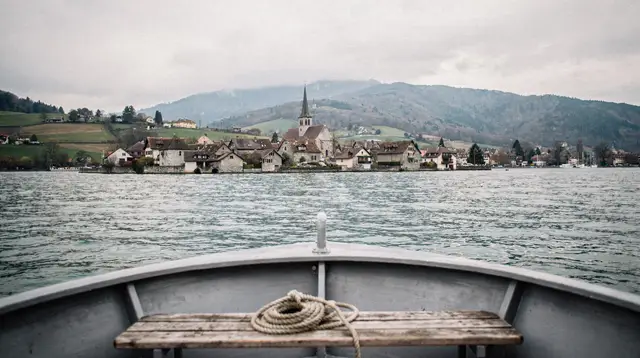
Lake Cruises to Thonon-les-Bains: Geneva's French Neighbour by Boat
What's special about a Thonon-les-Bains cruise from Geneva?
Thonon is a French lakeside town whose historic centre sits on a bluff well above its port; a funicular connects the two. It has a well-known market and the wooded Château de Ripaille estate nearby, giving it a lived-in, working-town feel rather than the spa polish of Évian or the postcard medievalism of Yvoire.
Most day-trippers crossing Lake Geneva by boat head for Yvoire’s postcard lanes or Évian’s spa-town polish. Thonon-les-Bains gets skipped more often than it deserves, and that’s partly the point: it’s a real French town with a working relationship to its own port, not a stage set for visitors.
Where Thonon-les-Bains sits on the lake
Thonon-les-Bains sits on the French, or “Savoie”, shore of Lake Geneva, across the water from the Swiss side where Geneva, Lausanne and Montreux sit. Roughly 40% of the lake’s surface lies in France, in the region historically known as Savoie, and Thonon is one of its principal towns — larger and more administratively significant than either Yvoire or Évian-les-Bains, its more famous neighbours a short distance along the same shoreline.
The town was, for centuries, the capital of the Duchy of Savoy before the dukes shifted their seat elsewhere and, eventually, Savoie itself was annexed to France in 1860. That history still shows: Thonon has the bones of a regional capital — administrative buildings, a functioning town centre, a market that serves locals as much as visitors — rather than the single-note charm of a village built for tourism.
Because Thonon is in France and Geneva is in Switzerland, this is an international crossing even though nothing about the lake itself marks the border. Bring a valid passport or national ID card for the trip; Switzerland is inside the Schengen Area but not the European Union, and while passport checks along the lake are typically light, they are not guaranteed to be absent, and carrying identification is the sensible baseline for any crossing into France.
The funicular: Thonon’s defining feature
What sets Thonon apart from its neighbours on the French shore is its relief. Unlike the flat lakefront of Yvoire or the gently sloping esplanade of Évian, Thonon’s historic centre sits on a bluff well above the lake, with its port — the port of Rives — down at water level. The two are connected by a funicular, a short rail link that carries passengers up the slope between the harbour and the upper town.
It’s a genuinely practical piece of transport, not a novelty ride: arriving by boat, the funicular is the natural way to reach the old town without a steep climb on foot. That said, don’t assume it runs on a fixed, year-round continuous schedule — like much lake-facing infrastructure in this region, operating hours shift with the season, and it’s worth checking current times locally or with your cruise operator before counting on it for a tight connection.
The port of Rives itself is worth a slow look before heading up: fishing boats share the harbour with pleasure craft, and a handful of lakeside restaurants and cafés make it a reasonable spot to start or end a visit, whether or not you climb straight up to the old town.
The old town and the market
Up on the bluff, Thonon’s old town has the layout of a working provincial centre: a core of period buildings, administrative offices reflecting its role as a sub-prefecture, and streets that carry on with daily business well outside the summer tourist window. That’s a meaningful contrast with Yvoire, whose entire compact centre is essentially a single, tightly preserved medieval set piece, or with Évian, whose identity is built around its thermal spa heritage and mineral water fame.
Thonon’s market is one of its best-known features, drawing shoppers from both the French and Swiss sides of the lake for local produce, cheese, and Savoie specialities. It’s a genuinely local affair rather than a tourist-oriented craft market, and timing a visit to coincide with market day (check current days locally, as they can shift) gives a much better sense of the town than a quiet afternoon might.
The lakefront promenade below the old town, and the views back across the water toward the Swiss shore and, on a clear day, the mountains beyond, round out a walk that mixes genuine town life with lake scenery in a way the smaller villages nearby can’t quite match.
Château de Ripaille, just outside town
A short distance from the centre of Thonon lies the Château de Ripaille, set within a large wooded estate that once served as a hunting ground for the Dukes of Savoy. The château and its grounds make for a worthwhile half-day addition if you have more than a few hours in town, though it’s a separate excursion from the port-and-old-town core rather than something reached directly from the boat.
The Ripaille estate today combines the historic building with vineyards and woodland trails, giving Thonon a second, quieter register beyond its town centre — useful for visitors who want to slow down after the market and the climb up from the port.
How Thonon compares to Évian and Yvoire
All three towns sit on the same French shore within a short distance of each other, and all three are realistic boat-trip or day-trip targets from Geneva, but they read very differently on arrival.
| Town | Character | Signature feature | Pace |
|---|---|---|---|
| Thonon-les-Bains | Working sub-prefecture, former Savoy capital | Port-to-town funicular; market | Lived-in, everyday |
| Évian-les-Bains | Thermal spa resort | Belle Époque spa architecture, mineral water | Polished, leisurely |
| Yvoire | Preserved medieval village | Flower-decked stone lanes | Compact, tourist-focused |
If your image of the French shore is Yvoire’s flower boxes or Évian’s grand hotels, Thonon is a useful corrective: it shows what an actual French lakeside town looks like when it isn’t primarily built around visitors.
Thonon’s own thermal tradition
The “les-Bains” in Thonon-les-Bains is not a marketing flourish borrowed from its more famous neighbour — Thonon has its own history as a spa town, built around thermal springs that were developed alongside the port and the old town rather than replacing them. It never became the single-industry resort that Évian did; the baths sit as one layer among several, alongside the administrative role, the market, and the working harbour. Travellers curious about that side of the town, rather than only the boat-and-funicular loop covered above, can read more in the dedicated guide to Thonon’s spa and thermal offerings, or compare it directly with Évian’s own thermal heritage to see how the two towns diverged from a similar starting point.
That layered identity is really the throughline of Thonon: it is simultaneously a former ducal capital, a working sub-prefecture, a market town, a minor spa destination, and a lake port — and no single one of those roles dominates the way “medieval village” dominates Yvoire or “spa resort” dominates Évian.
Combining Thonon with the rest of the French shore
Few visitors treat Thonon as a destination entirely on its own; it usually gets folded into a wider look at the Savoie shore. Travellers who enjoy Thonon’s market and funicular often go on to spend time in Yvoire, whose compact centre rewards an unhurried walking tour, or push further to Évian-les-Bains for its Belle Époque lakefront. Those building a longer trip around the French shore and the Alps beyond it can look at the four-day Geneva and Savoie itinerary, which strings several of these towns together, or the more compact three-day lake-and-mountains route for a shorter version of the same idea. Those with a full week to work with might fold Thonon into the broader seven-day Geneva, Alps and Valais itinerary, using it as a lower-key day between more strenuous mountain stops.
Back on the Swiss side, the same lake supports a very different rhythm of towns — Lausanne’s own lake cruises, the vineyard-terrace views around Nyon, and the castle-and-mountain backdrop of Montreux’s cruises — and seeing both shores in the same trip is one of the more effective ways to understand why the lake reads so differently depending on which side you’re standing on.
Crossing the border and paying in euros
Because this is a genuine international crossing, it’s worth reading up on the practicalities before setting out rather than working them out on the dock. The short version — a valid passport or ID card, no expectation that Swiss francs will be accepted, prices in euros rather than francs — is covered above, but two dedicated guides go into more depth for travellers who want it: crossing into France from Geneva covers the border mechanics in more detail, while paying in francs, not euros explains the currency split between the two shores and why carrying both currencies (or a card that handles both cleanly) makes the day simpler. For getting between the Geneva side and the French shore more generally, trains versus buses around Lake Geneva lays out the practical transport options beyond the boat itself.
When to go
Thonon works at a different pace than Yvoire or Évian across the year: because it’s a genuine working town rather than a seasonal set piece, it doesn’t shut down in the same way outside summer, though boat access and funicular hours both still follow the lake’s broader seasonal rhythm. For a general sense of when the lake basin is at its best for a cruise-based day, Geneva in summer and the lake season and the wider best time to visit Geneva guide both apply reasonably well to Thonon, since the two sides of the lake share the same boating season even if the towns themselves feel different once you arrive.
Getting there and planning a visit
Scheduled lake boats and a range of guided or private cruise itineraries connect the Geneva area to towns along the French shore in season, and several tours based in Yvoire or Évian include stretches of open water that pass close to Thonon’s stretch of coastline. Exact routings, seasons and timetables vary from year to year, so check current schedules directly with the operator before building a day around a specific crossing.
For visitors who’d rather charter their own time on the water than follow a fixed timetable, a private sailboat outing is a flexible way to take in this part of the lake. An evening sail with drinks on board is one option for seeing the French shore’s changing light without committing to a full scheduled itinerary, while a sailboat trip to a quieter stretch of shoreline near Yvoire suits travellers who want swimming or a slower pace alongside the sightseeing.
Those wanting the lake after dark can look at a night sail under the stars, and for a single day that strings together several French-shore towns, a private guided day covering Yvoire and Évian gives a structured alternative to independent travel, even where Thonon itself isn’t the headline stop.
Whichever way you arrive, allow enough time to do both halves of Thonon justice: the port and its funicular ride, and the old town and market above. Rushing the climb, or skipping the port entirely in favour of a bus straight to the centre, misses the contrast that makes this town distinctive in the first place.
Practical notes for the crossing
A few points are worth keeping in mind before setting out:
- Identification: carry a passport or national ID card, since Thonon is in France and Switzerland sits outside the EU despite being in Schengen.
- Currency: Thonon prices are in euros, unlike Geneva’s Swiss francs — budget accordingly and don’t expect Swiss francs to be readily accepted.
- Funicular hours: don’t assume year-round continuous service; confirm current operating times before relying on it for a tight schedule.
- Market days: worth checking locally, since the market is one of the best reasons to time a visit deliberately rather than arrive at random.
- Ripaille as an add-on: treat the château and its estate as a separate stop from the port-and-old-town walk, not something combined in the same short visit.
Compared with a quick photo stop in Yvoire or an afternoon at Évian’s lakefront, Thonon rewards a bit more time and a willingness to climb — literally, via the funicular — from the working port up to a town that has been getting on with its own business since long before lake cruises existed.
Lake Geneva Cruises
Verified deep-linked GetYourGuide tours. Book through these links and we earn a small commission at no cost to you.
GetYourGuide does not provide a product photo for this activity — the image shows the meeting point, photographed by us.