Fribourg's Old Town: Cathedral, Bridges and the Bourg Quarter
What is Fribourg known for, and how far is it from Geneva?
Fribourg is a bilingual French-German Swiss city built on a steep, forested gorge of the Sarine river, known for its Gothic St-Nicholas Cathedral, suspension bridges, and the half-timbered Bourg quarter. It's roughly an hour and a half from Geneva by train, and its old town involves genuinely steep walking between river and hilltop levels.
Most visitors reach the Geneva region’s lakeside towns and Alpine valleys without ever crossing the linguistic border that runs quietly through Switzerland itself. Fribourg sits almost exactly on that line, and it shows: a Gothic cathedral tower, a medieval old town carved into a river gorge, and a city that genuinely operates in two languages at once. It’s a different kind of Swiss town from anything else within reach of Geneva, and it rewards a full day rather than a fast pass-through.
Where Fribourg fits in the Geneva region
Fribourg belongs to the same broad Gruyères-Fribourg area covered elsewhere on this site, but it stands apart from its more famous neighbor. Gruyères is a small hilltop village built around a single castle and a cheese dairy — compact, picturesque, and easy to see in a couple of hours. Fribourg is a real city, with a university, a working cathedral, and an old town that spreads across multiple levels of a steep gorge. The two are sometimes combined on the same itinerary, and several bookable day trips do exactly that (see below), but Fribourg is worth treating as a destination in its own right, not a stop bolted onto a Gruyères visit.
It’s also worth distinguishing Fribourg from Neuchâtel, the other French-speaking Swiss city commonly mentioned in the same breath. Neuchâtel’s character comes from its lake — a long, gentle waterfront town with sandstone architecture facing open water. Fribourg has no lake at all. Its defining feature is topography: the Sarine river has carved a deep, forested gorge through the city, and the old town clings to its steep banks. Where Neuchâtel is horizontal, Fribourg is vertical, and that difference shapes almost everything about visiting it.
The bridges over the Sarine
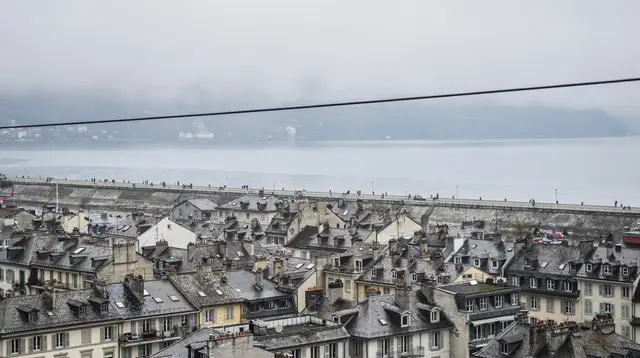
The Sarine (Saane in German) cuts through Fribourg in a series of dramatic loops, and the city’s history is largely a story of finding ways across it. Several pedestrian and road bridges connect the old town’s banks at different heights, including historic suspension bridges that were significant engineering achievements in their day. Walking across one of these bridges, with the river running far below and the old town’s rooftops climbing steeply on either side, is one of the clearest ways to understand why Fribourg looks the way it does — a city built not around a lake or a plain, but into a gorge.
The riverside itself, down at the Sarine’s level, has a different atmosphere from the hilltop streets above: quieter, greener, and a useful contrast after the density of the old town. Getting down to the river and back up again, though, is unavoidably a matter of stairs and sloped lanes — there’s no way to see both the heights and the water’s edge without the climb in between.
St-Nicholas Cathedral and its Gothic tower
The Cathedral of St-Nicholas is Fribourg’s principal landmark, a Gothic structure whose tower rises above the old town’s rooftops and is visible from much of the city below. The tower can be climbed separately from a visit to the nave, and the reward at the top is a genuine panorama: the old town’s roofs, the Sarine gorge, and on clear days the surrounding hills. Like comparable towers elsewhere in the region, the climb means a long, narrow spiral staircase — worth knowing in advance if that’s not for you, and worth checking current opening hours for the tower specifically, since they can run separately from the cathedral’s own schedule.
The cathedral anchors what’s generally considered the historic heart of the city, and its scale — a genuine Gothic cathedral rather than a parish church — reflects Fribourg’s historical importance as a religious and political center in this part of Switzerland, distinct from Geneva’s own, very different Reformation-era religious history.
The Bourg quarter
Just below and around the cathedral, the Bourg quarter is Fribourg’s best-preserved medieval district: narrow streets, tightly packed façades, and a number of half-timbered houses that have survived from the city’s earlier centuries. It’s a compact area, easy to explore on foot once you’re there, but reaching it and moving between its levels and the lower town is where the old town’s slope becomes unavoidable again. This isn’t a district to see on a quick, flat stroll — allow time to walk it properly, both for the architecture itself and for the effort the terrain requires.
Taken together, the cathedral, the bridges and the Bourg quarter make a natural walking route through Fribourg’s old town, moving between the heights and the river and back again. A self-guided food tour of the old town is one practical way to structure that walk, with stops along the route rather than a straight sightseeing march.
a self-guided food tour through Fribourg’s old town, pairing local specialties with stops past the cathedral and the Bourg quarterFribourg’s bilingual character
Fribourg sits almost exactly on Switzerland’s language border, informally known as the Röstigraben, and the city is officially bilingual as a result. Street signs, restaurant menus and public information commonly appear in both French and German, and the population is genuinely split between French and German speakers — French tends to dominate in the old town and city center, German more in parts of the wider canton. This is a distinctly local feature, and it’s worth being clear about what it is not: it has nothing to do with Geneva, which is solidly and almost exclusively French-speaking with no comparable German presence in daily life. Visitors coming from Geneva sometimes assume all of French-speaking Switzerland works the same way — Fribourg is the clearest counterexample within easy reach.
This bilingualism isn’t a tourist curiosity so much as an everyday fact of how the city functions, and it’s one of the more interesting cultural contrasts available on a single day trip from Geneva, alongside the architectural and topographical differences already covered above.
Getting from Geneva to Fribourg
Fribourg is reachable from Geneva by train on the Swiss rail network, with a change along the way — there is no single direct service. In practice, the journey runs to roughly an hour and a half in total, though the exact routing (commonly via Lausanne or Bern) and timing can vary, so checking a current timetable before travelling is worth doing rather than assuming a fixed connection. This is one of the less straightforward rail trips covered in this guide’s region, and it’s a reasonable one to combine with a full day in Fribourg rather than a half-day stop, given the time invested in getting there and back.
For visitors who’d rather not manage the connection themselves, or who want to pair Fribourg with Gruyères and Lausanne in a single outing, a guided day trip can cover the ground with a driver and a planned route rather than independent train travel.
a private day trip from Geneva covering Lausanne and the Gruyères region, useful for travelers combining Fribourg-area stops without managing train connections themselvesTravelers weighing train against a guided option might also find it useful to read this site’s broader comparison of trains versus buses around Lake Geneva, which covers how routing and connections generally work in this part of Switzerland, and the Geneva transport card guide, for anyone wondering whether a local transport pass has any bearing on a longer regional trip like this one — in short, Fribourg lies outside Geneva’s own transport network, so this is a separate rail fare rather than something a city pass would cover.
Fribourg and Gruyères together
Because the two sit in the same general area, it’s common to see them paired on itineraries, and a handful of tours build a day around both. If Gruyères’ castle and cheese-making heritage are on your list alongside Fribourg’s cathedral and old town, a combined excursion can make sense logistically — though each place has enough on its own to justify a dedicated visit, and treating Fribourg as a brief stopover before or after Gruyères risks shortchanging both.
a visit to Gruyère village, the hilltop counterpart to Fribourg often paired with it on regional day tripsFor a livelier, more active way to see Fribourg’s own streets rather than a standard walking route, an urban golf format turns the old town’s slopes and squares into a course of sorts — a different way of covering the same ground described above.
an urban golf experience through Fribourg’s old town, weaving past the cathedral and down toward the SarineFribourg compared with the region’s other stops
Fribourg is one of several French-speaking Swiss cities within reach of Geneva that visitors sometimes lump together without quite distinguishing. Alongside the contrasts already drawn with Gruyères and Neuchâtel, it’s worth placing Fribourg against Lausanne too: Lausanne is a lakeside city built on its own set of hills above Lake Geneva, with a cathedral of its own and a very different relationship to water than Fribourg’s landlocked gorge setting. Anyone assembling a longer route through this part of Switzerland — perhaps using the Lausanne museums and landmarks guide alongside this one — will find that each city’s defining feature is different enough to justify separate, unhurried visits rather than treating them as interchangeable stops on the same checklist.
For a wider view of how Fribourg fits into a multi-day route through this side of Switzerland, this site’s three days between the lake and the mountains itinerary and the two-day cheese and chocolate route both touch on the general Gruyères-Fribourg corridor, giving a sense of how a Fribourg day fits alongside other regional highlights rather than standing entirely alone.
Practical essentials for the day
A few practical points apply to Fribourg as they do to most day trips from Geneva into the wider Swiss interior. Switzerland’s currency is the Swiss franc, not the euro, even this close to the French border — worth knowing in advance, and covered in more detail in this site’s guide to paying in francs, not euros. Tipping conventions in Switzerland also differ from those across the border in France: service is already included in menu and bill prices, so a tip isn’t expected — the tipping in Switzerland guide covers the small rounding-up habit that applies equally in Fribourg’s old town.
It’s also worth remembering, as with any trip inside Switzerland from Geneva, that no border crossing is involved — unlike outings into neighboring Annecy or Chamonix, which cross into France. Fribourg stays entirely within Swiss rail and administrative territory, which simplifies planning even if the train itself requires a change en route.
Planning your visit: distances and what to expect
The table below sets rough expectations for planning, based on the practical realities described above rather than round, invented figures.
| Aspect | What to expect |
|---|---|
| Train from Geneva | Around 1.5 hours, with a change en route (no single direct train) |
| Old town terrain | Steep, multi-level; stairs and sloped lanes between the gorge and the heights |
| Cathedral tower | Separate ticket/access from the nave; narrow spiral staircase |
| Bourg quarter | Best explored on foot at a slow pace, not a quick pass-through |
| Suggested duration | A full day, especially if combining the tower climb, the Bourg quarter and the riverside |
| Combining with Gruyères | Possible on a single guided day trip, but each destination merits its own time |
Common mistakes to avoid
A few assumptions trip up first-time visitors to Fribourg specifically:
- Don’t expect a quick, flat stroll. Fribourg’s old town is built across a genuinely steep gorge, and seeing the cathedral, the bridges and the Bourg quarter together means real uphill and downhill walking, not a level sightseeing loop.
- Don’t expect a direct train from Geneva. The journey involves a change en route and runs to roughly an hour and a half in total — worth checking a current timetable rather than assuming a fixed, non-stop connection.
- Don’t confuse Fribourg’s bilingualism with Geneva’s French character. Geneva is solidly French-speaking; Fribourg sits on Switzerland’s language border and genuinely functions in both French and German, a distinctly local feature not shared by Geneva.
- Don’t treat Fribourg as identical to Gruyères. They’re often paired on itineraries, but Fribourg is a bilingual river city with a cathedral and bridges, while Gruyères is a small hilltop village centered on a castle — different places, each worth its own visit.
Where to go next
Fribourg pairs naturally with other stops in the same corridor between Geneva and the Alps. For the hilltop village most often mentioned alongside it, see the Gruyères castle and cheese circuit. For the lakeside city most often confused with it, the Neuchâtel landmarks guide makes the contrast clear. And for a structured route through the wider region, the day trips from Geneva guide sets Fribourg alongside the area’s other classic excursions.
Museums and Landmarks
Verified deep-linked GetYourGuide tours. Book through these links and we earn a small commission at no cost to you.
GetYourGuide does not provide a product photo for this activity — the image shows the meeting point, photographed by us.