Glacier 3000: Peak Views, Suspension Bridge and Glacier Skiing
What is Glacier 3000 and is it worth the trip from Geneva?
Glacier 3000 is a high-altitude cable car and viewpoint complex above the Col du Pillon, near Gstaad, reaching roughly 3,000 metres with a glacier ski area and the Peak Walk suspension bridge. It is worth visiting for the scenery and the bridge, but it is a long day from Geneva — several hours by car or train with a change — and both the view and the lift operation depend heavily on weather and season.
What makes Glacier 3000 different from a ski resort
Most winter-sports pages in this guide describe a ski area organised around a village — lifts fanning out from a base town, with slopes, lessons and après-ski woven into daily life there. Glacier 3000 is a different kind of place. It is a single high-altitude site: a cable car climbing from the Col du Pillon to just under 3,000 metres, built as much around a viewpoint and a suspension bridge as around skiing. There is no village at the top, no accommodation, and no wandering between restaurants and shops between runs. Visitors go up, spend a few hours on the summit plateau, on the glacier, or in the mountain restaurant, and come back down.
That distinction matters when planning a trip. A resort like Gstaad or Verbier rewards a multi-day stay, because the appeal is the range of pistes and the rhythm of resort life. Glacier 3000 rewards a well-timed single visit: get the cable car ride, the summit views if the weather allows them, the Peak Walk bridge, and the glacier skiing or sledging, then head back down. It sits geographically close to Gstaad — the base station at Col du Pillon is a short drive from the town — but it is administered and experienced as its own attraction rather than as an extension of the Gstaad ski area.
If the goal is a full ski week with varied terrain and village infrastructure, Gstaad itself, covered separately in this guide’s Gstaad winter sports page, is the more complete answer. If the goal is the specific combination of a glacier, a dramatic bridge and one of the highest viewpoints reachable by cable car in this part of Switzerland, Glacier 3000 is the site to plan around.
Getting there from Geneva: a long day, not a quick trip
Glacier 3000 is not a convenient add-on to a Geneva stay. There is no direct train, and the journey — whichever way it is made — takes real time out of the day.
By car, the route runs along the lake via Lausanne and Vevey toward Montreux, then up through Aigle and over the Col du Pillon. In good conditions this is roughly two and a half to three hours of driving each way; in winter, mountain roads near the pass can be slower, and snow chains or winter tyres are a real consideration, not a formality.
By train, there is no single line all the way to the base station. The practical route is a mainline train from Geneva to Montreux or Aigle, then a change onto a regional line toward Le Sépey or Les Diablerets, followed by a bus or connecting transfer to the Col du Pillon cable car. Door to door, this commonly takes three to four hours each way once transfers and waiting time are counted, which makes a same-day round trip from Geneva a long day rather than a relaxed outing.
Because of this distance, Glacier 3000 works better as part of a trip that already includes an overnight in the Montreux, Gstaad or Aigle area, or as a deliberate full-day excursion planned around it, rather than as a spontaneous half-day trip squeezed between other Geneva sightseeing. Several operators run guided day trips that handle the transfers directly from the lake shore, which removes the connection planning at the cost of a fixed schedule.
A guided option such as the day trip to Glacier 3000 departing from Montreux shortens the logistics considerably compared with self-organised train connections, and the Glacier 3000 and Diablerets excursion from Lausanne covers a similar route starting further along the lake. For visitors basing themselves in Gstaad rather than on the lake, the private day trip linking Gstaad, Glacier 3000, Montreux and Vevey combines the summit visit with lakeside towns in one arranged itinerary.
The cable car and the Peak Walk suspension bridge
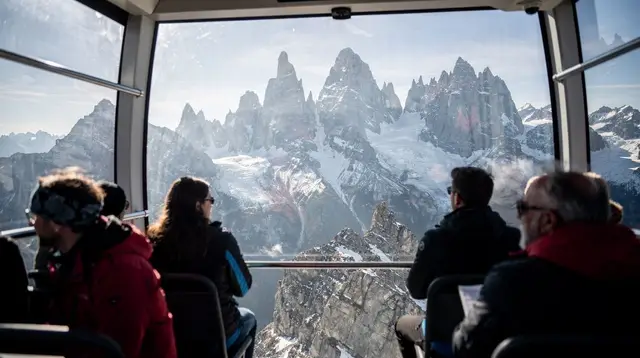
The ascent from the Col du Pillon base station to the top runs in stages, climbing to a summit area close to 3,000 metres — hence the name. The ride itself is one of the draws: cabins move up through forested lower slopes into increasingly bare, rocky and then glaciated terrain, with the change in landscape happening over a relatively short vertical distance.
At the top, the main non-skiing attraction is the Peak Walk, a pedestrian suspension bridge connecting two rocky summits. It is built to be crossed in a few minutes on foot, with open views down both sides toward the glacier on one side and the valley on the other. It is included in the standard cable car ticket rather than being a separate paid extra, which makes it accessible to visitors who have no interest in skiing. Alongside the bridge, the summit area has viewing terraces, a mountain restaurant, and — depending on conditions — sledging or snow-tubing areas for visitors who want snow time without skis.
On a genuinely clear day, the panorama from the top is wide: Mont Blanc is visible to the southwest, and the Bernese Alps spread out to the north and east. That clarity is not something a visit can be planned around with certainty, which is the next point worth being direct about.
Weather and visibility: what a visit can and cannot promise
The summit sits close to 3,000 metres, in open alpine terrain exposed to fast-moving weather. Cloud can form or clear within an hour, and cloud inversions — common around Lake Geneva and the nearby valleys, particularly in winter — can leave the summit in bright sun above a solid layer of cloud filling the valleys below, or conversely leave the top socked in while the valley floor is clear. Neither pattern is predictable more than a day or two in advance, and neither should be assumed as the default outcome of a visit.
This has practical consequences beyond the view. In genuinely poor conditions — strong wind, heavy snowfall, or very low visibility — individual sections of the cable car can be suspended, or the top station can close temporarily, sometimes with little advance warning given how quickly conditions change at that altitude. This guide does not promise a clear summit or guaranteed lift operation on any given day; checking the operator’s live status shortly before travelling, and having a fallback plan (a lower-altitude activity near Montreux or Aigle, for instance) is the sensible approach rather than building a whole day’s plan around an assumption of clear skies.
Clothing matters here too. Temperatures at the summit are consistently and often sharply colder than in the valley, and wind adds a further chill factor. Warm, windproof layers and sturdy footwear are worth bringing regardless of the specific activity planned, even on a day that looks mild from the valley floor.
Glacier skiing, and a retreating glacier
The ski area at Glacier 3000 spans terrain from the glacier itself down toward Les Diablerets, offering high-altitude skiing that in past decades ran reliably through much of the year, including into summer. That reliability has eroded. Like other glaciers across the Alps, the glacier at Glacier 3000 has been retreating and thinning over recent decades, and skiable snow cover on the glacier now depends more heavily on the season, on snowfall in a given winter, and on artificial snowmaking and grooming, rather than being a fixed, weather-independent feature of the site.
Summer skiing in particular has become far less dependable than it once was. This guide does not describe the glacier as offering permanent, guaranteed snow cover, and visitors planning a trip specifically for glacier skiing outside the core winter season should check current conditions before travelling rather than assuming past patterns hold.
Within the winter season itself, conditions are generally more dependable, with a mix of glacier terrain and lower runs toward Les Diablerets suited to different levels. For visitors who want structured instruction rather than skiing independently, options built around this area include the private ski lessons for all levels, which can be arranged to suit a specific ability and schedule rather than a fixed group class time.
Sledging, snow-tubing and the summit for non-skiers
Not everyone travelling all that way wants to ski, and Glacier 3000 is built with that in mind. The Peak Walk bridge, the viewing terraces and the mountain restaurant are all reachable on the standard cable car ticket, with no skiing required and no separate equipment to rent. Depending on snow conditions and the season, the summit area also typically offers sledging or snow-tubing runs — a way to spend an hour or two in the snow without lessons, lift passes or ski gear, and a reasonable option for a family group where not everyone skis. For a party genuinely split between skiers and non-skiers, this matters: the non-skiing half of the group is not left waiting in the mountain restaurant while the rest of the group is on the slopes, because the bridge, terraces and snow-tubing areas give them something to do on the same summit plateau.
For visitors who want the full summit experience — cable car, Peak Walk, and whatever sledging or snow area is running that day — bundling everything into one ticket rather than assembling separate passes is usually simpler. A straightforward Glacier 3000 cable car roundtrip ticket covers the ascent itself, while a fuller package such as the private day trip from Geneva combining Glacier 3000 and the fun park is built specifically around this mix of viewpoint and snow-play activities, which suits a group that isn’t purely there to ski.
Dining and facilities at the top
The mountain restaurant at the summit is the practical hub of a Glacier 3000 visit: it is where most visitors end up between the cable car ride, the Peak Walk crossing and any time on skis or a sledge, and it is the obvious place to warm up given how much colder and windier the summit is than the valley floor. Facilities at this altitude are inherently more limited than at a village-based resort — there is no strip of restaurants and shops to wander between, and no accommodation on site — so a visit here is built around a single dining stop rather than the kind of choice a base town like Gstaad or Montreux offers. That is consistent with the character of the whole site: Glacier 3000 is a destination to visit for a few hours, not a place to spend an evening.
Best time of day and season to visit
Because the summit’s weather and visibility can change quickly, timing a visit well makes a real difference to what it delivers. Mornings tend to offer the best odds of clear conditions before cloud has a chance to build through the day, which is one more reason to set out from Geneva or the lake shore early rather than mid-morning. Within the winter season, conditions on the glacier itself are generally more consistent than in the shoulder months around it, when snow cover can be thinner and more dependent on recent snowfall and grooming.
A visitor choosing between a midwinter date and an early or late-season one should weigh that trade-off: midwinter gives more reliable snow on the ski terrain, while shoulder-season dates can occasionally offer clearer, calmer weather but with less certainty about how much of the glacier terrain is actually skiable. Either way, checking conditions the morning of the visit rather than trusting a forecast checked days in advance remains the more reliable approach.
A comparison: Glacier 3000 versus Gstaad’s main ski area
| Glacier 3000 | Gstaad ski area | |
|---|---|---|
| Base | Col du Pillon, opposite side of the valley from Gstaad village | Gstaad village and surrounding sectors |
| Character | High-altitude viewpoint and glacier site, cable car access | Village-based network of pistes across several sectors |
| Main draws | Peak Walk suspension bridge, summit panorama, glacier skiing | Range of marked pistes, resort infrastructure, village life |
| Typical visit | A single well-planned day, on-site hours only | Multi-day stay suited to a full ski week |
| Accommodation on site | None | Hotels and chalets in and around the village |
| Weather sensitivity | High — summit exposed, lifts can suspend in poor conditions | Lower at village level, higher on upper sectors |
Planning a realistic visit
Given the travel time from Geneva, a visit to Glacier 3000 works best under one of a few plans: an overnight stay somewhere along the lake or in the Gstaad area with the cable car as a dedicated day; a guided excursion that handles transport directly, such as the operator-run day trips already mentioned; or a stop built into a longer loop through Montreux, the Château de Chillon and Aigle, where the extra distance to Col du Pillon is a smaller marginal addition to a day already spent in that direction.
Arriving reasonably early in the day helps on two fronts: it gives the best chance of catching clearer morning conditions before afternoon cloud tends to build, and it leaves margin for the long return journey without rushing the descent. Checking current lift status and weather forecasts the morning of the visit, rather than relying on a forecast checked days earlier, is worth the extra few minutes given how quickly conditions at this altitude can shift.
For travellers weighing whether this detour fits a Geneva-based itinerary at all, it helps to see it alongside the region’s other higher-altitude options — Zermatt, Verbier and Crans-Montana all involve comparable or longer travel times from Geneva, and each has its own character worth weighing against what Glacier 3000 specifically offers: the bridge, the glacier setting, and the particular combination of viewpoint and ski terrain above the Col du Pillon. This guide’s Crans-Montana winter sports, Verbier winter sports and Zermatt winter sports pages cover those alternatives in the same detail as this page covers Glacier 3000, for anyone still deciding which high-altitude excursion best fits the rest of a trip.
Travellers building a full winter itinerary around Geneva rather than a single day trip may find it easier to plan the whole loop at once. This guide’s winter weekend from Geneva itinerary sketches out a short trip that can be adapted to include Glacier 3000 alongside Montreux and the lake shore, and the four-day hiking and Mont Blanc and Valais itinerary shows how a longer, mountain-focused trip out of Geneva is typically structured, for comparison. For visitors who would rather have the whole outing organised end to end, a multi-day package such as the four-day tour from Geneva covering Glacier 3000 and Chamonix Mont Blanc pairs this excursion with another of the region’s major viewpoints in a single arranged trip, which removes the need to plan separate transport for each.
Winter in Geneva
Verified deep-linked GetYourGuide tours. Book through these links and we earn a small commission at no cost to you.
GetYourGuide does not provide a product photo for this activity — the image shows the meeting point, photographed by us.