Scenic Flights Over the Matterhorn from Zermatt
What do scenic flights from Zermatt actually show you?
Short helicopter flights circle the Matterhorn at close range and above the surrounding glaciers, terrain that otherwise takes a full day of hiking or climbing to approach. Longer circuits add neighbouring 4,000m peaks and glacier fields. Fares are considerably higher than a typical scenic flight elsewhere in the Alps, reflecting the altitude and the short, weather-dependent flying season.
Why fly near the Matterhorn at all
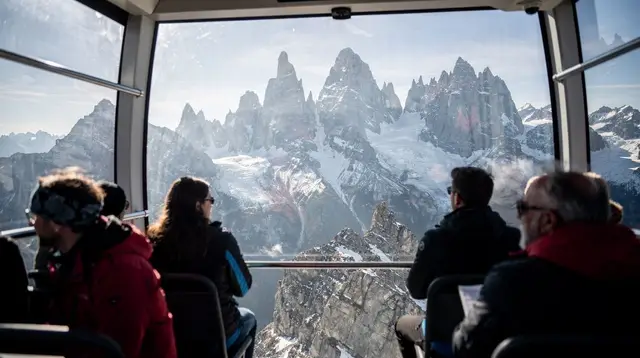
The Matterhorn is one of the few mountains in the world recognisable from a single silhouette, and most people who travel to see it never get closer than the streets of Zermatt or a viewpoint a short walk above the village. That is not a small consolation prize — the ground-level view is genuinely one of the great sights in the Alps — but it is also a fixed, distant view. A scenic flight is the only way for most visitors to close that distance: to circle at close range around the pyramid-shaped summit, look down onto glaciers that only mountaineers otherwise reach, and see the mountain’s other faces, the ones that never appear in the postcards taken from the valley.
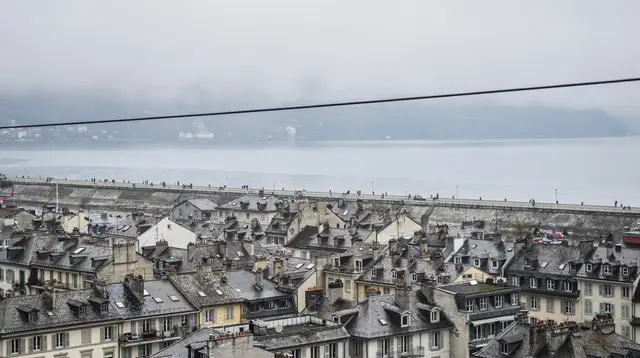
This is worth separating clearly from what a scenic flight over Geneva or the lake offers. A flight from Geneva shows a city, a lake and a distant mountain skyline from altitude — pleasant, low-key, and reasonably priced. A flight from the Zermatt area is a different kind of product: high-altitude terrain, glacier ice, and a single famous peak approached from angles that hiking trails simply do not reach in a day. The tradeoff is price and logistics, both of which are considerably steeper here than around Geneva.
Because the Matterhorn flight starts from the Zermatt area, your own journey to Switzerland is the part you can plan most freely. Fix your arrival into Geneva first, and leave a generous gap between landing and the trip up to the mountains, since the logistics are steeper than anything around the lake. To match an arrival day to the day you want in Zermatt, you can look up Geneva fares on Aviasales.
Getting there from Geneva
Zermatt sits roughly four hours from Geneva by road or by train, and the trip is worth planning as its own day or overnight rather than an add-on. The Swiss rail network runs comfortably into the Valais, changing at Visp for the final leg up to Täsch, the last stop reachable by car. From there, Zermatt itself is car-free: everyone, residents and visitors alike, continues into the village by a short shuttle train, and no private car — rented or otherwise — is allowed to drive in. That single fact shapes almost everything about visiting for the day: there is no “park near the helipad” option, and flight operators based in or near Zermatt are reached the same way everyone else arrives, on foot from the station or by local electric taxi.
A day trip from Geneva that includes a scenic flight is an ambitious but realistic plan if the timing lines up, and pairing the rail journey with a guided day trip to Zermatt from Geneva removes some of the routing decisions. For anyone who would rather not compress a four-hour journey, a flight, and a return trip into one day, an overnight in the Valais turns the same itinerary into a considerably more relaxed two days, with time in the village itself rather than just the train platform and the flight pad. For the bigger picture on how far this actually is, see how far the Matterhorn really is from Geneva before building a same-day plan around it.
What a Matterhorn scenic flight actually is
Helicopter is the standard aircraft for these flights, and for good reason: helicopters can climb, hover and turn tightly in a way fixed-wing planes cannot, which matters enormously when the whole point of the flight is to circle close around a single summit rather than cruise past it in a straight line. Most operators fly out of small heliports and landing strips scattered through the valley around Zermatt and neighbouring towns, not from Zermatt’s own car-free centre.
The shortest and most affordable option is typically a loop that climbs toward the Matterhorn, circles it at a respectful but genuinely close distance, and returns — often twenty to thirty minutes in the air. Longer circuits extend the route to take in neighbouring four-thousand-metre peaks and additional glacier fields beyond the Matterhorn itself, stretching the flight time and the price accordingly. A small number of operators also offer glacier landings as a separate, longer, and considerably pricier add-on, setting down briefly on snow at altitude before returning — this depends heavily on conditions and is usually arranged as a distinct booking rather than a default part of a sightseeing flight.
What none of these flights are is a way to see the whole Valais or a lake-and-city view of the kind a Geneva flight offers. The focus here is narrow and vertical: rock, ice and a famous summit shape, seen from angles the trails around Zermatt cannot provide in a single day.
| Flight type | Typical duration | What it covers | Approximate price range (CHF, per person) |
|---|---|---|---|
| Short Matterhorn loop | 20-30 minutes | Close circuit around the Matterhorn summit | Several hundred francs |
| Extended glacier circuit | 40-60 minutes | Matterhorn plus neighbouring 4,000m peaks and glacier fields | Noticeably higher than the short loop |
| Glacier landing add-on | Varies, booked separately | Brief landing on snow/glacier terrain, conditions permitting | Highest tier, weather-dependent |
Exact prices shift by operator, season, and group size, and should always be checked directly with the flight company rather than assumed from general figures — but as a rule of thumb, expect these fares to sit well above the cost of a typical light-aircraft scenic flight elsewhere in the region, simply because high-altitude mountain flying, short seasonal windows and small aircraft capacity all push the price up.
Why it costs what it does
It is worth being upfront about the price gap, because it is the single most common surprise for visitors comparing this to a flight over Geneva or the lake. Three factors combine to push Matterhorn-area flights well above typical scenic-flight pricing:
- Altitude and terrain. Flying safely close to a 4,478m summit and its surrounding glaciers demands more capable aircraft, more experienced pilots, and tighter operating margins than a low-altitude circuit over a lake.
- Short flyable windows. Wind, cloud and visibility near the summit are far less forgiving at altitude than over open water, and flights are grounded or postponed more often — a cost operators build into every flight that does go ahead.
- Small, exclusive groups. Helicopters here typically carry a handful of passengers rather than a planeload, so the fixed costs of each flight are spread across fewer seats.
None of this makes the flight a poor value for someone who specifically wants a close-range, high-altitude encounter with the Matterhorn — it simply means comparing the fare to a Geneva lake flight, or to a generic light-aircraft tour, is comparing two different products.
Choosing between a short loop and a longer circuit
For most visitors, the short Matterhorn loop is the right choice, and it is worth being honest about why: the summit itself is the draw, and a twenty-to-thirty-minute flight delivers a close pass around it without the extra cost of an extended circuit. The longer glacier circuits earn their price when the goal is genuinely different — seeing several 4,000m peaks in sequence, or taking in glacier fields well beyond what a short loop has time to reach. Anyone who has already spent a day or two hiking around Zermatt and wants the flight purely to see the Matterhorn from angles the trails do not reach is usually well served by the shorter option; anyone treating the flight as the single alpine highlight of a Valais trip, with no other high-altitude excursion planned, gets more out of paying for the longer route.
Group size and timing also shape which option makes sense. A short loop is easier to fit into a single day trip from Geneva alongside the train journey, while an extended circuit — and certainly a glacier landing — is realistically an activity for a trip that already includes an overnight in the Zermatt area, since weather delays are more likely to disrupt a longer, pricier booking that cannot simply be rescheduled for later the same afternoon. Travellers who want the flight bundled with guided transport rather than arranged independently can look at a private tour to Zermatt with a Glacier Paradise option, which pairs the journey from Geneva with time in the high-altitude terrain around the village.
What to expect on the day
Flight operators near Zermatt typically ask passengers to check in some time before departure, and — as with any weather-dependent mountain flight — building slack into the schedule either side of the booked slot matters more than it would for an indoor activity. Because the departure points sit outside Zermatt’s car-free centre, confirm in advance exactly how to reach the heliport from the train station or from Täsch; this is not a detail to work out on arrival with a flight window ticking down. Dress for the temperature at altitude rather than the temperature in the valley: even on a warm summer day in Zermatt, the air a helicopter circles through near the Matterhorn’s summit is markedly colder, and standing around outdoors before and after a flight in cold, exposed conditions is part of the experience whatever the season.
Photography is one of the main reasons people book these flights in the first place, and cabin space is limited, so anyone bringing a camera beyond a phone is better off checking with the operator ahead of time about window access and seating rather than assuming a particular seat or angle. Flights that include a glacier landing add a further layer of practical preparation, since stepping out briefly onto snow at altitude calls for sturdier footwear and warmer clothing than a flight-only booking. None of this is complicated, but it rewards confirming with the specific operator rather than assuming the same routine applies everywhere in the valley.
Building the flight into a longer Valais trip
A Matterhorn scenic flight sits naturally inside a longer stay in French-speaking Switzerland’s mountain country rather than as an isolated add-on to a Geneva city break. Travellers already spending a few days around Crans-Montana, Verbier or Sion can treat a day trip into Zermatt and a scenic flight as one leg of that itinerary rather than a separate journey from Geneva, since the towns share the same rail corridor through the Valais. For visitors who prefer to slow the pace down after a flight, a nature reset and mindfulness session in Crans-Montana is a low-key contrast to a morning spent watching glacier terrain from a helicopter window, and a stop for a guided tour and wine tasting in Sion works well on the rail journey back toward Geneva or onward into the rest of the Valais.
Skiers and snowboarders building a winter trip around Zermatt or nearby Verbier can combine a clear-morning flight with time on the slopes the same week; see Zermatt winter sports for the on-snow side of that plan, alongside the Swiss Alps skiing and snowboarding adventure already mentioned above. Whatever the season, treating the flight as one stop within a multi-day Valais itinerary — rather than the entire reason for the trip — tends to produce a calmer schedule, with room for a cancelled or rescheduled slot that a single rushed day from Geneva simply does not allow.
Setting the record straight
A few claims travel around about the Matterhorn that are worth correcting before booking anything. The mountain is famous, but it is not the Alps’ highest peak — at 4,478m it stands well below Mont Blanc near Chamonix, which tops 4,800m. Its reputation rests on its shape and its dramatic isolation above Zermatt, not on holding any altitude record. Nor is it visible from Geneva at any distance or from any rooftop in the city — the two sit roughly 150km apart, with a genuinely different mountain range, the Bernese Alps and the Valais chain, in between. Anyone hoping to combine “a day in Geneva” with “a glimpse of the Matterhorn” in the same afternoon is planning around a view that simply does not exist from the lake.
Alternatives if a Matterhorn flight is not for everyone
A scenic flight is not the only way to get close to this terrain, and it is worth weighing against the alternatives before committing. Hiking trails around Zermatt reach genuinely spectacular viewpoints on foot, at a fraction of the price and without any weather-dependent booking risk — see the options covered in Zermatt hiking. Cable cars and trains climb to high-altitude viewpoints and glacier terrain without needing a pilot or a clear-weather slot at all; Zermatt glacier and snow experiences cover those ground-based routes to the ice.
In winter, the same high terrain opens up for skiing and snowboarding rather than sightseeing — see Zermatt winter sports for that angle, or book directly through a Swiss Alps skiing and snowboarding adventure based in nearby Verbier. None of these substitute fully for the close, all-sides view a helicopter offers, but they are worth knowing about for anyone whose budget, schedule or nerves don’t suit a flight.
For travellers weighing Zermatt against the other major Alpine base near Geneva, Chamonix offers its own high-altitude scenic flights around Mont Blanc, covered in scenic flights from Chamonix and scenic flights around Mont Blanc — a useful comparison since the two destinations solve a similar problem (close-up alpine terrain, hard to reach on foot in a day) in different mountain ranges, one French and one Swiss. The broader comparison between the two bases is covered in Chamonix vs Zermatt from Geneva.
Practical planning notes
Because Zermatt itself is car-free, flight logistics are worth confirming with the operator before travelling rather than assuming a taxi to a helipad will work the way it might elsewhere. Departure points are frequently outside the village itself, in the valley towns around Täsch or further down the line, reachable by local transport rather than a walk from the Zermatt train station. Building in a buffer — arriving the day before a booked flight, rather than stepping off a train from Geneva straight into a flight slot — reduces the risk that a delayed connection costs an expensive, non-refundable booking.
Weather cancellations are common enough at this altitude that it is worth treating any single booked slot as provisional rather than guaranteed, and checking an operator’s rebooking or refund policy before paying. Clear, calm mornings tend to offer the steadiest flying conditions in both summer and winter; a hazy or windy afternoon, common in the mountains as the day warms up, is often when flights get scrubbed. For visitors building a longer stay around the flight, Zermatt passes and tickets and getting to and from Zermatt cover the surrounding logistics, and how Zermatt compares to other Valais bases is useful if the flight is one stop within a longer Valais itinerary that might also take in Sion, Verbier or Crans-Montana.
A four-day itinerary that mixes hiking, glacier terrain and a possible scenic flight around this part of the Valais is laid out in four days hiking Mont Blanc and Valais, useful for anyone weighing whether a flight fits into a longer alpine trip rather than a single rushed day from Geneva. Whatever the exact plan, the flight itself is best treated as the centrepiece of the day it happens on — booked with flexibility around it, not squeezed between a train arrival and a train departure with no room for weather to intervene.
Scenic Alpine Flights
Verified deep-linked GetYourGuide tours. Book through these links and we earn a small commission at no cost to you.
GetYourGuide does not provide a product photo for this activity — the image shows the meeting point, photographed by us.