Scenic Flights Over the Chamonix Glaciers
What is a Chamonix scenic flight, and does it fly over the summit of Mont Blanc?
It's typically a helicopter flight from a base near Chamonix, France, circling over the glaciers of the Mont Blanc massif — most often the Mer de Glace and neighbouring ice fields. Standard scenic flights do not land on or fly directly over the summit of Mont Blanc; summit-focused flights are a separate, longer, pricier product.
What a Chamonix scenic flight actually is
From the valley floor of Chamonix, in France, small operators run scenic flights — almost always by helicopter, sometimes by light aircraft — that lift off from a base near the town and circle over the glaciers of the Mont Blanc massif. The classic route passes above or alongside the Mer de Glace, France’s largest glacier, and over neighbouring ice fields and rock spires that ring the valley. It is a fundamentally different product from a walk-up sightseeing stop: you are booking a specific aircraft, a specific weather-dependent window, and a route that the operator controls, not a fixed attraction you can simply turn up to.
It’s worth being precise about what these flights are, and are not, because the marketing language around “Mont Blanc flights” gets used loosely. A standard Chamonix scenic flight is built around the glaciers of the massif — dramatic, close-up, genuinely spectacular terrain — rather than the summit of Mont Blanc itself. If your goal is specifically to see or circle the summit, that’s a separate, usually pricier and longer product, and it deserves its own research rather than an assumption baked into a shorter glacier flight. This guide focuses on the glacier-flight category; for summit-focused options, see the dedicated guide to Mont Blanc scenic flights.
A Chamonix glacier flight depends on a weather-dependent window set by the operator, so your travel dates need some slack around it. Leave a spare day in the valley rather than planning to fly on your last morning, and favour tickets that can be changed if the operator has to move your slot. With the span of days you can stay in mind, you can compare fares to Geneva on Aviasales for those dates.
Where these flights depart from, and what France means here
Chamonix sits in the French department of Haute-Savoie, not in Switzerland — a distinction that trips up a fair number of first-time visitors from Geneva, since the two feel like a single alpine region day to day. See why Mont Blanc is in France, not Switzerland for the fuller picture. Practically, this means:
- Bring a passport or national ID card. Switzerland is inside the Schengen Area, so there’s no routine passport-stamping border post on the road from Geneva to Chamonix, but Switzerland is not an EU member, and identity checks can and do happen. Read more on Switzerland’s Schengen-not-EU status before you travel.
- Currency changes. Flight prices, deposits, and any add-ons in Chamonix are quoted in euros, not Swiss francs — worth knowing if you’re budgeting across a trip based in Geneva.
- Getting there is its own small logistics exercise. If you’re staying in Geneva, see crossing into France from Geneva and the dedicated guide on getting to Chamonix from Geneva Airport for transfer options and rough timings.
None of this makes a scenic flight complicated to book, but it does mean it’s not a same-city, same-currency, no-ID errand — treat it as a short international excursion, because that’s what it is.
Weather rules these flights, not the schedule
This is the single most important thing to understand before booking: a scenic flight over the Chamonix glaciers is only as reliable as the weather that day. Helicopters and light aircraft flying close to high alpine terrain need decent visibility, manageable wind, and no active storm cells anywhere near the route. Cloud sitting low on the massif — which happens often, at altitude, even on days that look clear from the valley floor — is enough to ground a flight entirely or force a shortened, lower-altitude route.
What that means in practice:
- No operator can promise a flight will happen on a fixed date, no matter what you pay. Be wary of any listing that implies otherwise.
- Morning slots are often the most reliable, since alpine weather frequently deteriorates — more cloud, more wind, sometimes afternoon storms — as the day warms up, though this is a pattern, not a guarantee.
- Cancellations and rescheduling are routine, not exceptional. Reputable operators build flexible rebooking or refund policies into their terms for exactly this reason; read the cancellation policy before you pay, and treat any operator that doesn’t offer one with caution.
- Build in slack. If a scenic flight is the highlight of your Chamonix day, don’t schedule it for your last possible slot before a train or flight — leave a spare day or at least a spare few hours if your itinerary allows it.
If you’re planning a full day around Mont Blanc scenery from Geneva and want the flight to be one part of a fuller itinerary rather than the whole day’s plan, the one-day Mont Blanc from Geneva itinerary is a reasonable way to structure the rest of the time productively, flight or no flight.
What you’ll actually see: the Mer de Glace and the glaciated massif
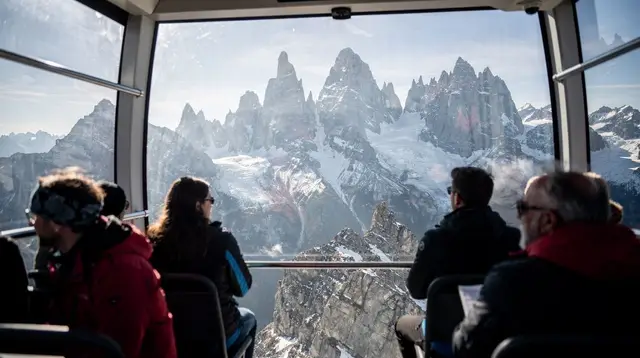
The centrepiece of most Chamonix glacier flights is the Mer de Glace, France’s largest glacier, a long, slow river of ice that flows down from the high slopes of the massif toward the Chamonix valley. From the air, its scale reads very differently than it does from any single ground viewpoint — crevasse fields, moraine lines, and the sheer length of the ice tongue are far easier to take in from a few hundred metres up than from a fixed platform.
It’s worth knowing, though, that the Mer de Glace has retreated substantially over recent decades, and this is visible even from the ground. Visitors who reach it via the Montenvers rack railway from Chamonix now descend a staircase of several hundred steps to reach the current ice surface — a staircase that has been extended repeatedly as the glacier has thinned and its surface has dropped relative to the fixed station above. Seeing that staircase, or reading about its growth, is one of the more concrete, human-scale ways to register how much ice has been lost; a flight gives you the aerial version of the same story, with the retreating tongue and exposed rock visible in a single sweep that the ground view can’t offer.
Beyond the Mer de Glace, typical routes also take in some combination of the massif’s granite spires and secondary glaciers, depending on the operator, the day’s conditions, and which route is flying that morning. Ask your operator in advance exactly which glaciers and peaks a given flight covers — routes are not standardised across companies, and a flight description on a booking page is a guide, not a guaranteed itinerary down to the minute.
For travellers interested in adventure options around Chamonix more broadly, not just scenic flights, the Chamonix adventure sports guide and the Chamonix paragliding flights guide cover other ways to get an aerial or high-altitude perspective on the valley.
Scenic flight vs. the Aiguille du Midi: two different experiences
It’s easy to conflate a scenic flight with a visit to the Aiguille du Midi, since both promise sweeping views of the same glaciated terrain — but they are genuinely different experiences, not interchangeable options for the same view.
| Scenic flight | Aiguille du Midi cable car | |
|---|---|---|
| How you move | By air, circling over glaciers | Static viewing platforms at altitude |
| Altitude reached | Varies by route, typically flying near/around peak level | Summit station at 3,842m |
| Booking | Weather-dependent slot, can be cancelled | Timed ticket, reserved in advance in high season |
| Duration | Often 15-25 minutes in the air | A half-day or more with transit and time at altitude |
| What you see | Sweeping, moving aerial views of ice fields | Fixed panoramic views, including toward the Mont Blanc summit itself |
| Weather sensitivity | High — flights cancel readily | High for visibility, but the cable car itself runs in more conditions than a flight will fly |
The Aiguille du Midi cable car climbs in two stages from Chamonix — via a stop at Plan de l’Aiguille — to 3,842 metres, one of the highest-altitude cable car stations in the world, and it requires a timed, booked ticket, especially in the busy summer and winter weeks. It’s a genuinely spectacular outing on its own terms, and it’s the more reliable of the two options if you want to guarantee some kind of high-altitude view on a fixed day, since a cable car runs in a wider range of conditions than a helicopter will fly.
But it is a ground-based, fixed-point experience — you don’t move over the glaciers the way a flight does. See the full Aiguille du Midi Mont Blanc excursions guide and the Mer de Glace excursions guide for what each actually involves. Many visitors treat the two as complementary rather than a choice between them: the cable car on a clear-weather day as the reliable option, a scenic flight added opportunistically if conditions and schedule line up.
Booking, timing, and what to check before you pay
A few practical points that make the difference between a smooth booking and a frustrating one:
- Book ahead, but keep flexibility. Slots are limited, particularly in July-August and the winter high season, and same-day availability is unpredictable. A day or two of lead time, with a backup day if your schedule allows, gives the best odds of actually flying.
- Check exactly what route is included. “Mont Blanc flight” is sometimes used loosely in marketing; confirm whether the product circles glaciers around the massif or specifically approaches the summit area, since these are priced and timed very differently.
- Ask about weight limits and passenger numbers. Helicopter flights typically have per-passenger weight limits and small group sizes; check this if you’re booking for a family or a larger party.
- Confirm meeting point and check-in time separately from flight time. Helipads and small airfields near Chamonix can be a short taxi ride from the town centre itself, and check-in is usually well before the scheduled flight slot.
- Read the weather-cancellation policy before paying, not after a flight is called off. A reasonable operator will rebook, credit, or refund; know which applies before you commit.
If you’re weighing a scenic flight against other high-altitude or aerial options in the wider region for comparison, the Geneva scenic flights guide, Annecy scenic flights guide, and Zermatt scenic flights guide cover the equivalent products elsewhere around the lake and the Alps, useful if your itinerary has you moving between bases.
a tandem paragliding flight over the Chamonix valley, with an optional video of the descent is a lower-cost, human-powered alternative to a helicopter tour if you want an aerial perspective on the valley without booking a full glacier flight — it launches from the valley slopes rather than circling the high glaciers, so it’s a different kind of view, but it shares the same weather sensitivity described above.
For visitors who want the glacier scenery bundled into a broader day out rather than booked as a standalone flight, a private day trip to Chamonix and the Mont Blanc area from Geneva covers transport, timing, and a guide who can help fit in the Aiguille du Midi or Mer de Glace alongside whatever else the day allows. Travellers based further into France can also reach the valley on a day excursion to Chamonix from Megève, useful if you’re staying in the Megève area rather than Geneva.
If Chamonix is one stop on a longer loop through the region, pairing it with a private guided tour of Megève or a snowshoeing outing with local cheese and wine tasting in winter rounds out a trip that isn’t entirely dependent on a single weather-sensitive flight going ahead.
Common mistakes to avoid
- Assuming any “Mont Blanc flight” from Chamonix reaches the summit. Most standard products circle the massif’s glaciers, not the peak itself — check the route description, not just the marketing name.
- Booking a flight for your last possible time slot. Weather cancellations are common enough that a flight scheduled with no backup day is a real risk to the plan, not a remote edge case.
- Forgetting ID for the France crossing. Chamonix is in France; Switzerland’s Schengen membership doesn’t remove the need to carry a passport or ID card.
- Confusing a scenic flight with the Aiguille du Midi cable car. They cover similar terrain but are fundamentally different experiences — one is airborne and moving, the other is a fixed, ground-based viewpoint reached by cable car.
- Expecting the Mer de Glace to look like older photos or postcards. The glacier has retreated significantly; the long staircase now needed to reach the ice from the Montenvers station is a direct, visible sign of that change.
- Treating the flight as the only item on the day’s plan. Given the weather dependency, it works better as one flexible element within a fuller Chamonix day — see the Chamonix planning guide, Chamonix transport guide, and Chamonix hiking guide for ways to fill the rest of the time productively regardless of whether the flight goes ahead.
Scenic Alpine Flights
Verified deep-linked GetYourGuide tours. Book through these links and we earn a small commission at no cost to you.
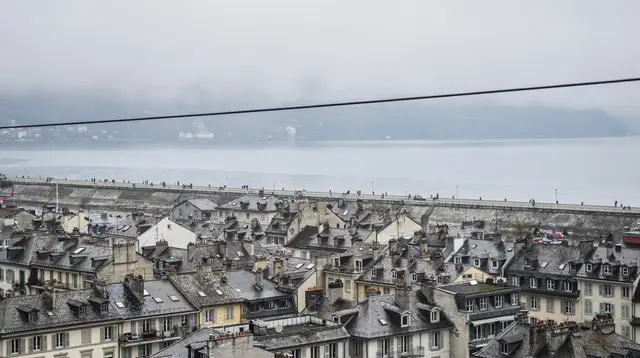
GetYourGuide does not provide a product photo for this activity — the image shows the meeting point, photographed by us.