Morzine Winter Sports: Skiing France's Portes du Soleil from Geneva
Is Morzine a good winter sports base for a trip from Geneva?
Yes — Morzine is a French Alpine village in the Portes du Soleil ski area, reachable from Geneva by road in a little over an hour, with a family-oriented, unpretentious feel. It requires crossing the Schengen border into France with a passport or ID card, and its own village-level snow is less reliably deep than higher, glacier-linked resorts.
Where Morzine fits on a Geneva winter itinerary
Morzine is a French Alpine village in Haute-Savoie, part of the wider Chamonix-Mont-Blanc region, and one of the anchor resorts of the Portes du Soleil, a linked ski domain that crosses the France-Switzerland border across twelve resorts. For visitors based in Geneva, it sits in a useful middle ground: closer and quicker to reach than most of the high-altitude Swiss resorts, but still requiring a genuine border crossing rather than a short hop within the canton.
By road, Morzine is roughly 70-75km from Geneva and takes a little over an hour to drive in normal winter traffic, longer on a snowy Saturday morning at the start of a school-holiday week. There is no direct train connection; most visitors either drive, book a shared or private transfer, or combine a regional train to a French town such as Thonon-les-Bains or Cluses with a onward bus or taxi. For a first visit, a direct transfer or self-drive is by far the simplest option — see the practical transfer options on the Morzine airport transfers guide.
This page focuses specifically on what Morzine offers for winter sports, how the crossing into France actually works, and how the resort compares with two other winter options frequently discussed alongside it from Geneva: Megève and Zermatt.
Crossing into France: what the border actually involves
Both Switzerland and France sit inside the Schengen Area, which means there is normally no routine passport check at the road crossing on the way to Morzine — no barrier, no queue, no stamp. That is genuinely convenient, and it is why day trips across this border are common practice for people staying in Geneva.
It is not, however, the same as there being no border at all. Schengen membership removes routine document checks; it does not erase the international frontier itself. France and Switzerland both retain the right to carry out spot checks, and Swiss customs in particular does check vehicles and goods at points along this border, including for items such as duty allowances and vehicle-related rules. Anyone crossing from Geneva to Morzine should carry a valid passport or national identity card at all times, not assume the trip is functionally identical to a drive within Switzerland. For a fuller explanation of how this plays out in practice around Geneva, see crossing into France from Geneva and why Switzerland is in Schengen but not the EU.
Currency is another switch to plan for: Switzerland uses the Swiss franc, while Morzine, like the rest of France, prices everything in euros. Lift passes, ski hire, lessons and restaurant bills in Morzine are all euro transactions, distinct from the franc-denominated budget of a Geneva base.
The Portes du Soleil: what makes Morzine’s ski area distinctive
Morzine’s core advantage among the ski options accessible from Geneva is the size and cross-border reach of its lift network. The Portes du Soleil links Morzine with resorts including Avoriaz, Les Gets, Châtel and Montriond on the French side, and Champéry, Les Crosets, Morgins and Champoussin on the Swiss side — around 650km of marked pistes across the whole area on a single lift pass. It is genuinely possible to click into skis in Morzine in the morning, ski across the ridge lines and lift network into Switzerland for lunch, and ski back into France in the afternoon, all without a car and without a passport check, because the crossing happens entirely on snow within the shared ski domain.
This cross-border skiing is a distinctive selling point among the winter options covered on this site. Megève’s own ski area, the Évasion Mont-Blanc domain, is entirely on the French side and does not offer the same day-of-skiing border crossing. For visitors who want the novelty and scale of skiing between two countries on one pass, Morzine and the Portes du Soleil are the natural answer, not Megève or Chamonix.
Morzine itself sits at a relatively low altitude for an Alpine resort — around 1,000m at village level — with skiing extending up to roughly 2,275m at the area’s higher points, mostly around Avoriaz and the ridge toward Switzerland. That altitude range is worth taking seriously when judging snow reliability (see below): it is what makes Morzine, in practice, a lower-altitude resort by Alpine standards, in contrast to the much higher glacier terrain around Zermatt or the Aiguille du Midi above Chamonix.
Snow reliability: the honest picture
Morzine’s low village altitude is the trade-off for its accessibility. In a good, cold winter, the resort and the wider Portes du Soleil ski beautifully, with reliable snow from the village upward for most of the season. In a mild or low-snow winter, however, Morzine’s own slopes can turn patchy or close early, particularly in December and again in late March and April, even while higher-altitude parts of the same lift network, or entirely different resorts, are still skiing well.
This is a genuine planning consideration, not a minor caveat. Anyone booking a Morzine trip for firm dates, rather than adjusting around conditions, should check snow reports in the days before travelling and build in flexibility — for example, planning to spend more time at Avoriaz’s higher slopes, or on a day trip into the higher Swiss side of the Portes du Soleil, if the village-level snow is thin. This is also where Morzine differs most clearly from Zermatt, discussed below: Zermatt’s much higher, glacier-fed terrain gives it a snow reliability that a village at Morzine’s altitude structurally cannot match, in exchange for a considerably longer journey from Geneva.
Morzine versus Megève: family resort against fashionable resort
Morzine and Megève are both popular French Alpine answers to “where should we ski from Geneva,” and they are often compared directly, but they suit different trips.
Megève built its reputation as a chic, historically aristocratic resort — cobbled streets, high-end boutiques, a polished restaurant scene, and a ski area, Évasion Mont-Blanc, that leans toward gentler, well-groomed cruising terrain with views toward Mont Blanc. It rewards visitors who want a refined village experience alongside their skiing, and pairs naturally with a private guided tour of the village for those who want to see the town properly, not just its slopes.
a guided walk through Megève’s historic streets gives a sense of that side of the resort, distinct from what a Morzine day is built around.
Morzine, by contrast, has built its identity around being practical and family-friendly rather than fashionable. Its ski schools are geared heavily toward young beginners, its village centre is functional rather than boutique-lined, and its evening scene is markedly lower-key than Megève’s. For a family with young children learning to ski for the first time, this matters in concrete ways — smaller class sizes are less the point than a village culture built around beginner terrain and family logistics rather than aprés-ski polish.
a group lesson for children aged five to seven is a practical example of that focus: Morzine’s ski-school infrastructure is set up specifically for this age group, in a way that is a smaller part of Megève’s offering.
Neither resort is “better” in the abstract. A family prioritising ease, cost and a relaxed pace tends to fit Morzine; a group wanting a more polished village experience, higher-end shopping and dining alongside gentler cruising terrain tends to fit Megève.
| Morzine | Megève | |
|---|---|---|
| Country | France | France |
| Distance from Geneva by road | ~70-75km, a little over 1hr | ~75km, roughly 1-1.5hrs |
| Character | Practical, family-oriented, low-key evenings | Polished, fashionable, higher-end dining and shops |
| Ski area | Portes du Soleil (cross-border, France-Switzerland) | Évasion Mont-Blanc (entirely French) |
| Village altitude | ~1,000m | ~1,113m |
| Best suited to | Families, first-time skiers, longer varied terrain | Refined village stays, gentler cruising, Mont Blanc views |
Morzine versus Zermatt: speed against altitude
The comparison with Zermatt runs in the opposite direction: Morzine wins decisively on travel time, Zermatt wins decisively on altitude and snow security.
Zermatt sits deep in the Swiss Valais, at around 1,620m, with skiing running up onto glacier terrain above 3,800m near the Matterhorn — a genuinely different scale of high-mountain skiing, with snow reliability that a village at Morzine’s altitude cannot offer. That altitude comes at the cost of access: Zermatt is car-free, reached by train via Täsch, and the journey from Geneva runs to roughly three to four hours door to door, factoring in the change onto the shuttle train into the village itself. Compare that with Morzine’s little-over-an-hour road journey, and the two resorts represent genuinely different trade-offs rather than close substitutes. A fuller side-by-side sits in Chamonix versus Zermatt from Geneva and the real distance to the Matterhorn from Geneva, both of which apply in broad strokes to Morzine’s own gap with Zermatt.
For a single winter day trip from Geneva, Morzine’s proximity makes it realistic in a way Zermatt is not — there and back within a day, with several hours of actual skiing in between, is a stretch for Zermatt but comfortable for Morzine. For a multi-day ski holiday where snow security matters more than travel time, Zermatt’s altitude is the stronger argument, provided the longer, train-based journey is factored into the plan.
| Morzine | Zermatt | |
|---|---|---|
| Country | France | Switzerland |
| Journey from Geneva | ~1hr+ by road | ~3-4hrs, mostly by train |
| Village altitude | ~1,000m | ~1,620m |
| Skiing extends to | ~2,275m | ~3,800m+ (glacier terrain) |
| Snow reliability | Variable at village level; check reports | High, thanks to glacier and high-altitude terrain |
| Access | By car or transfer | Car-free; arrive via Täsch shuttle train |
| Best for | A single accessible ski day or short break | Multi-day trips prioritising snow security |
What else Morzine offers beyond downhill skiing
Morzine is not only a ski-lesson destination. The village itself, framed by the mountains of the Portes du Soleil, is worth a slower look on a non-ski morning or for a rest day.
a 60-minute walk with a local guide through the village is a straightforward way to get oriented on arrival, pointing out where the main lifts, ski schools and village amenities sit relative to accommodation, which matters more in a spread-out mountain village than it might in a compact town.
Morzine also works as a base for excursions further into the region. The Chamonix-Mont-Blanc side of Haute-Savoie, with its high-mountain cable cars and glacier access, sits within reach for a change-of-pace day away from the Portes du Soleil pistes.
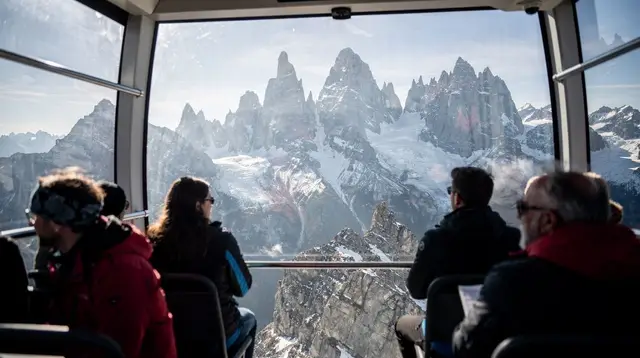
a day excursion into Chamonix gives a sense of what such a detour looks like, including access toward the Aiguille du Midi and views onto Mont Blanc itself, France’s — not Switzerland’s — highest peak, a distinction worth keeping straight (see Mont Blanc is in France, not Switzerland).
For families with older teenagers or adults wanting an adrenaline day beyond piste skiing, the wider adventure-sports scene around Morzine is covered separately in the Morzine adventure sports guide, and skiers weighing a wider set of French Alpine options from Geneva can compare terrain directly against Chamonix’s winter sports and against higher-altitude Zermatt winter sports.
Planning a Morzine winter trip from Geneva
A single day trip is workable but tight: driving time both ways eats into the ski day, so a genuine full day on the slopes generally means an early departure from Geneva and accepting a late return. For families with young beginners in lessons, a short overnight or long weekend gives far more breathing room than a single day, and fits naturally with the winter weekend from Geneva itinerary or the broader two days in Geneva and the Alps itinerary.
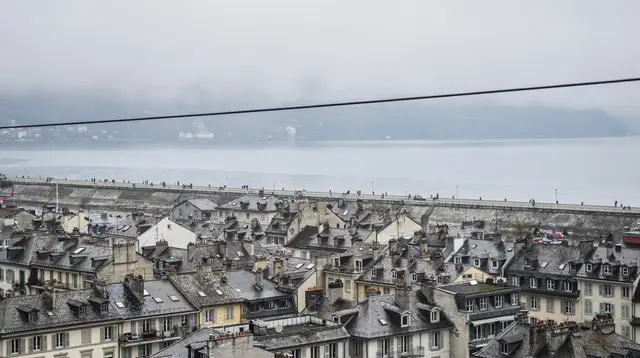
Whatever the length of stay, three things are worth confirming before setting off: a valid passport or ID card for the France crossing, euros rather than francs for on-the-ground spending in Morzine, and a recent snow report given how variable village-level conditions can be. None of these change the fact that Morzine remains one of the more accessible ski options from Geneva — but “accessible” and “guaranteed” are different claims, and treating the border and the snow both as real, checkable variables rather than formalities makes for a smoother trip. For a general sense of what winter around Geneva itself looks like before or after a Morzine trip, does it snow in Geneva is a useful companion read.
Winter in Geneva
Verified deep-linked GetYourGuide tours. Book through these links and we earn a small commission at no cost to you.
GetYourGuide does not provide a product photo for this activity — the image shows the meeting point, photographed by us.